
The Russian Corps in Africa strikes Kyrnia in Mali — 8 civilians killed by a Su-24 in 2026
 Marie Dubois
The Russian Africa Corps Strikes Kyrnia in Mali — 8 Civilians Killed by a Su-24 in 2026
Kyrnia, Mopti region, June 15. The livestock market was open, the stalls tightly packed around the village chief's house, and fighters from the Group for Support of Islam and Muslims (GSIM, or JNIM) were not far away. According to Human Rights Watch, an aircraft identified by two Malian military sources as a Sukhoi Su-24 dropped at least two munitions on this locality in central Mali. The documented toll is heavy and precise: eight civilians killed, including three children, and several injured. No jihadist fighters are known among the dead.
This detail changes the operational reading. We are not facing a failed strike in the desert, on an isolated armed column. We are in a village controlled for six years by the JNIM, on a market day, with possible targets mixed among civilians. This is exactly the type of situation where air power gives an impression of control from the cockpit, but where it becomes politically costly on the ground.
Two Craters in Southern Kyrnia
HRW reports having interviewed 19 people between June 24 and July 14, including six witnesses, community leaders, local journalists, and Malian military sources. The organization also states that it analyzed satellite images, a video published by the Africa Corps, and photographs released by an armed Islamist group. The two impacts have been geolocated in southern Kyrnia.
The first munition struck near the village chief's residence. It killed his wife, two of his children, and another child. The second fell about twenty meters further away, on a small livestock market, killing four men. The craters are said to measure about twelve meters wide each, which corresponds to large munitions dropped from the air. At this distance, the distinction between a suspicious pickup, a shop used by the JNIM, and civilians buying fodder is not a legal nuance; it is the entire difference between a useful strike and a strategic error.
“Aircraft from the Africa Corps controlled by the Russian government killed civilians in a Malian village in apparent disregard for the laws of war,” said Ilaria Allegrozzi, senior Sahel researcher at Human Rights Watch.
The Su-24 Marks a Scale Change
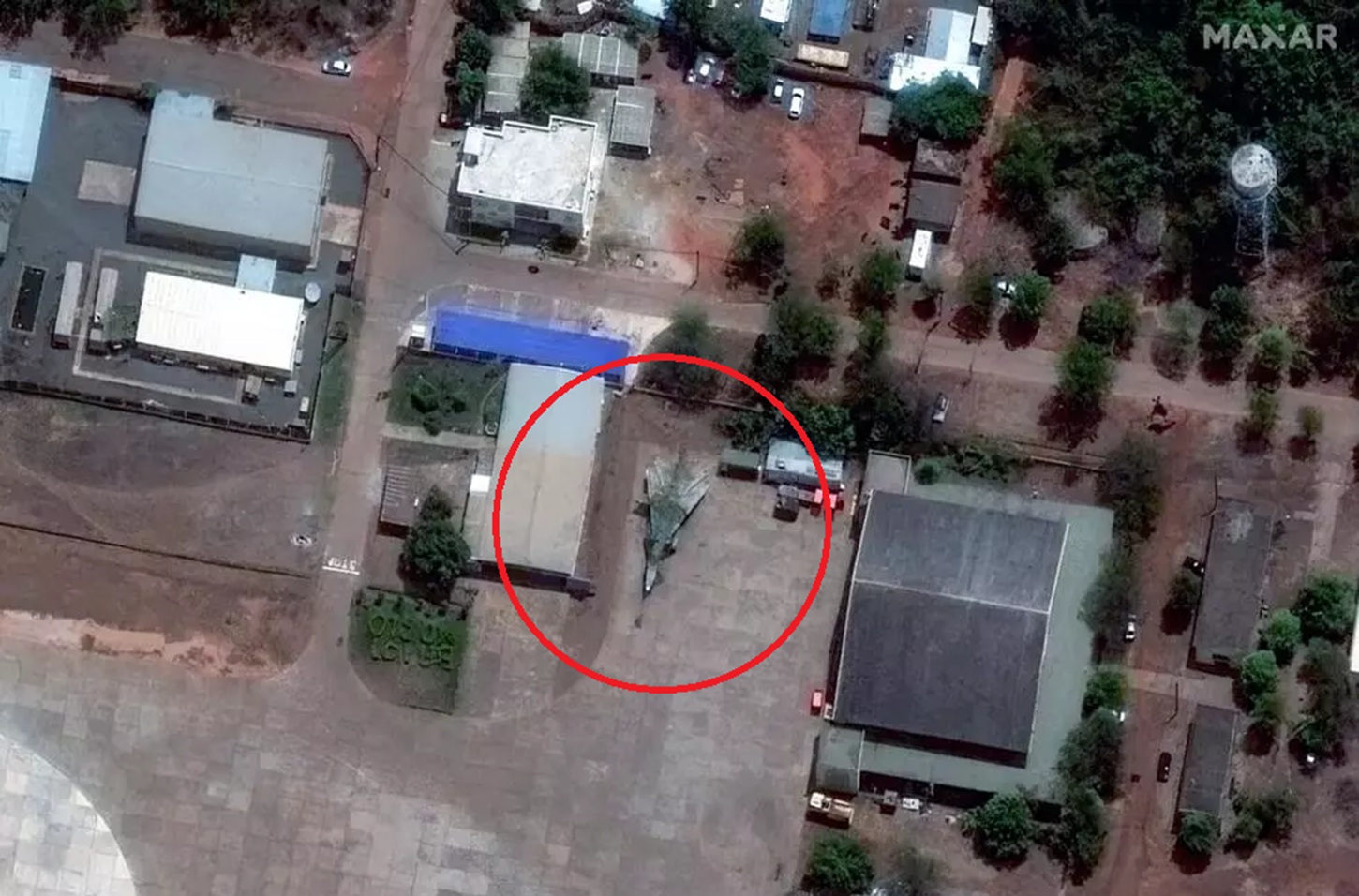
The Su-24 is not a simple close air support aircraft. It is a Soviet tactical bomber designed to penetrate at low altitude and carry a much heavier payload than a Su-25. France 24 Observers had already identified a Su-24M on the military side of Bamako airport via satellite imagery as early as April 2025, at a time when the Russian presence was gradually shifting from Wagner to the Africa Corps, a structure more directly linked to the Russian Ministry of Defense.
On the ground, this means that Bamako and its Russian partners can strike further and harder. But it also means they can produce disproportionate blast and fragmentation effects in populated villages. The Su-24 is useful against a base, a convoy, or a clearly identified depot. In a rural shopping center held by the JNIM, its use requires a solid intelligence chain, persistent observation, and very rigorous target validation.
- HRW speaks of at least two munitions dropped on Kyrnia.
- The documented victims include three children aged 1 to 10 years.
- The JNIM reportedly had about 100 fighters in the village, mainly near the mosque and a shop close to the market.
- The Africa Corps claimed on June 23 to have targeted a gathering place for terrorist groups in the Mopti region.
The Malian Dilemma Closes in on Bamako
It would be too easy to turn Kyrnia into an abstract trial of Russia. The primary responsibility remains political: Mali has chosen to replace the French and UN presence with a more opaque Russian partnership, less constrained by international scrutiny and more compatible with the junta's logic. After the coups d'état of 2020 and 2021, General Assimi Goïta promised to restore territorial integrity. Four years later, this promise involves increased militarization of central areas, without preventing jihadist groups from controlling markets, roads, and local taxes.
Kyrnia illustrates this lock-in. The village chief traded in an environment dominated by the JNIM; some residents say that weapons, fuel, or food have sometimes passed through nearby places. But HRW claims to have found no evidence showing that his house stored weapons at the time of the strike. This uncertainty matters. From experience, in central Sahel, many notables negotiate with jihadists because they have no choice. Labeling them all as military targets amounts to emptying villages of any gray area, thus eliminating any chance of reliable human intelligence.
A Strike at a Dangerous Moment
The incident comes as Mali faces broader military pressure. The Institute for Security Studies described, on July 30, a worrying evolution in jihadist tactics: coordinated attacks by the JNIM and the Azawad Liberation Front (FLA), targeting strategic infrastructure, use of commercial drones, and disruption of economic corridors to Bamako. On July 4, this coalition struck several localities and took part of Anéfis. Le Monde, citing AFP, reported that the Malian army and the Africa Corps retook the city after several days of fighting, with a convoy coming from Gao and air support.
This sequence gives Kyrnia a warning value. The more armed groups impose simultaneous operations, the more Bamako will seek quick responses from the air. However, airstrikes do not clear a road, do not reopen a market, do not reassure a village. They can kill a commander; they can also convince a grieving family that the Malian state is just another threat from the sky.
What to Watch Now
The immediate question is not just legal. It is tactical. If the Africa Corps continues to employ Su-24s against mixed localities in central Mali, three indicators will need to be monitored: an increase in civilian casualties, a shift of markets to areas even more controlled by the JNIM, and a reduction in intelligence shared by residents with Malian forces. The last point is the most serious. An army that loses the ear of the villages ends up bombing silhouettes.
The available information remains incomplete, and both Bamako and Moscow have not provided detailed responses to HRW's questions. But the Kyrnia episode already shows one thing: Russian air superiority in Mali does not compensate for the lack of fine control on the ground. In the coming weeks, the Mopti-Bandiagara-Douentza area will be the sector to watch. If the JNIM maintains its markets and patrols there despite the strikes, then the Su-24 will have mainly added noise, fear, and eight civilian deaths to a war that Bamako claimed to be regaining control over.
The Africa Corps conducted an airstrike using a Sukhoi Su-24 in Kyrnia, Mali, on June 15, 2026, resulting in the deaths of eight civilians, including three children. The strike occurred during a livestock market day in a village controlled by JNIM, raising concerns about the targeting of civilians. Human Rights Watch reported on the incident, highlighting the implications of using heavy munitions in populated areas.
- Eight civilians killed, including three children, in an airstrike by a Sukhoi Su-24.
- The airstrike occurred in Kyrnia during a livestock market day.
- The area has been controlled by JNIM for six years, complicating the operational context.
- Human Rights Watch conducted interviews and analyzed satellite imagery related to the incident.
- The use of the Su-24 marks a significant escalation in airstrike capabilities by Russian forces in Mali.