
The siege of Bamako by JNIM exposes 73 civilians killed in Mali since Kidal
 Marie Dubois
The Siege of Bamako by JNIM Exposes 73 Civilians Killed in Mali Since Kidal
In Zambougou, about sixty kilometers from Bamako, passengers were forced to get off their buses before fighters from the Support Group for Islam and Muslims set the vehicles on fire. This was not a battle for a barracks, nor an ambush against a military column. It was an interception of civilians on a capital road, ten days after JNIM announced a "total siege" of Bamako.
The report published by Human Rights Watch on June 28, relayed on Monday by RFI, provides a cold measure of what the offensive of April 25 has unleashed in Mali. In the cities of Gao and Kidal alone, fighting between JNIM, the Azawad Liberation Front, Malian forces, and Africa Corps reportedly killed 13 civilians and injured at least 25 others. Between May 6 and May 21, jihadists burned more than 40 civilian vehicles heading to Bamako. Between May 14 and May 17, Malian army counter-insurgency operations against Fulani communities resulted in 38 civilian deaths, including 23 children. Two drone strikes attributed to Malian forces, in Guimbé and Téné, killed at least 22 additional civilians.
These figures are not a complete toll. They are a documented minimum, obtained through 34 remote interviews, geolocated videos, verified photographs, and satellite imagery. On the Malian ground, where journalists have limited mobility and each camp produces its own version, this methodological caution matters.
Kidal is No Longer Just a Symbol
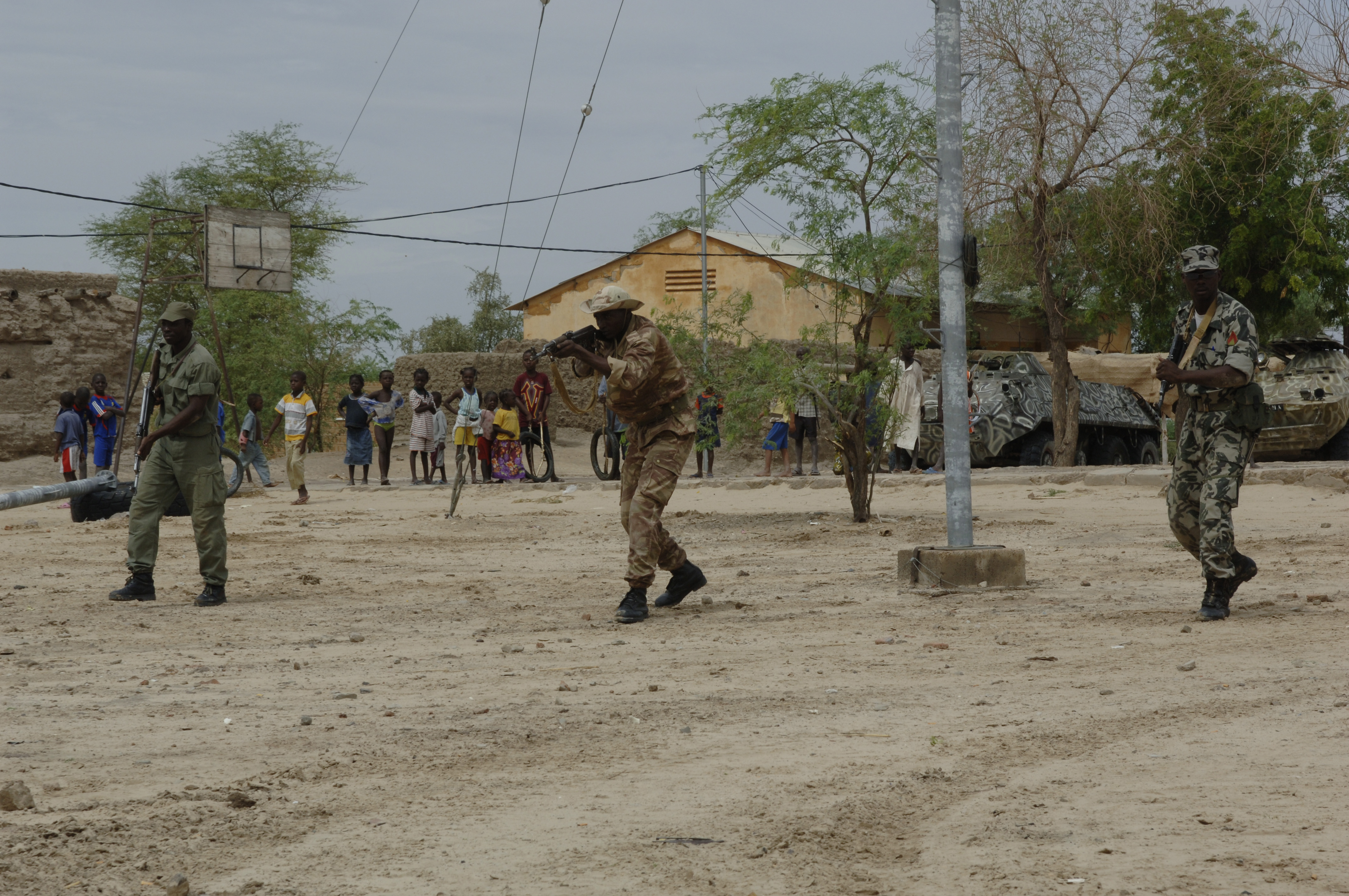
The capture of Kidal after the coordinated attacks of April 25 not only dealt a political blow to Bamako. It shifted the line of effort for armed groups. JNIM and the FLA struck Kati, Mopti, Sévaré, Gao, and Kidal in the same sequence. The Malian Minister of Defense, Sadio Camara, was killed in Kati. Russian fighters from Africa Corps withdrew from Kidal two days later, according to accounts cited by HRW and France 24, leaving around 200 Malian soldiers as prisoners.
From experience, when a force loses a stronghold like Kidal, it does not just lose a point on the map. It loses supplies, intelligence networks, patrol habits, and above all, the certainty of local populations that the state can return tomorrow morning. Armed groups know this. JNIM exploits this window through a method that is anything but improvised: it cuts off roads, punishes transporters, spreads fear southward, and forces the capital to consume its own reserves.
The fuel blockade, tracked since September 2025 by Bellingcat, had already destroyed more than 130 tankers on several supply routes. Today, the logic is expanding. On June 26, RFI reported that Timbuktu had been without electricity and water for several days, with gas stations running dry for about a month. When a liter of gasoline is trading at three times the regulated price on the black market, the war is no longer just in the barracks. It is in buckets of water, closed classrooms, and hospital generators.
Bamako's Response Creates Its Own Tactical Cost
In the face of this pressure, Bamako responds with sweeping operations and increased use of drones. The problem is not that the state strikes. The problem is that it often strikes in a fog of intelligence where target identification seems insufficient. In Téné, on May 17, an explosive munition apparently dropped from a drone hit a wedding and killed at least 10 civilians. In Guimbé, on April 25, 12 children and teenagers were killed. These are not secondary losses in an armored duel. They are mistakes that reorganize the relationship between the army and the villages.
In central Mali, collective suspicion against Fulani communities remains an old operational poison. An army that confuses human environments with enemies gives JNIM what it seeks: families that no longer dare to speak to soldiers, young people who see flight or armed engagement as the only options, and local notables who negotiate locally with those who control the roads. Counter-insurgency then becomes a machine for producing the adversary's intelligence.
It must be clear: JNIM commits crimes by attacking civilians, publicly executing a man in Tonka, burning vehicles without immediate military objective, and using the siege as a social weapon. Its response to HRW, claiming that civilians violated its rules, is not a justification. It is the admission of a coercive power imposed on captive populations.
Africa Corps Does Not Replace a Security Architecture
The sequence also reveals the limits of the Russian option. Africa Corps can support a specific fight, defend a sensitive site, or provide firepower. It cannot, alone, hold the vastness between Kidal, Gao, Timbuktu, Mopti, and the approaches to Bamako. France 24 already noted after the April offensive that the Russian withdrawal from Kidal damaged the image of a reliable partner. But the issue goes beyond Moscow's reputation.
Without a sustainable aerial network, without reliable human intelligence, and without local forces capable of remaining in the villages after the columns pass, drones become a dangerous substitute for knowledge of the terrain. The French failed to stabilize Mali despite far superior resources and extensive experience in the theater. Imagining that a more opaque, less accepted, and more coercion-dependent Russian support could solve the same problem was already a form of magical thinking.
The Next Weak Point Will Be the Road, Not the Capital
The immediate risk is not necessarily a takeover of Bamako. JNIM does not need to enter the capital to reduce its freedom of action. It is enough to maintain pressure on the axes coming from Senegal, Côte d'Ivoire, and the north, and then multiply vehicle fires at a psychological distance from the city. Sixty kilometers, in this context, is very close. A column leaving Bamako can reach there quickly on the map. It can also arrive too late if the jihadists have already filmed the fire, scattered the passengers, and disappeared into the villages.
The battle that opens after Kidal is therefore less spectacular than an urban offensive, but more corrosive. It pits two brutal methods against each other: the jihadist strangulation of civilians and the punitive counter-insurgency of the state. Between the two, the inhabitants of Gao, Kidal, Zambougou, Téné, Guimbé, and Timbuktu pay the price of a war where everyone claims to protect them by reducing their space for survival.
The next serious alert may not come from an attacked barracks. It may come from a suddenly empty road, a depot without fuel, or a Fulani village that no longer responds to calls from the administration.
JNIM's siege of Bamako has resulted in the deaths of 73 civilians since the offensive began on April 25, 2023. In Zambougou, civilians were forced off buses and vehicles were burned. The Malian Armed Forces have also conducted operations leading to civilian casualties, including drone strikes. The ongoing conflict has severely impacted civilian life, with fuel shortages and increased violence in the region.
- 73 civilians killed since Kidal
- JNIM attacked civilians and military forces
- Malian Armed Forces conducted counter-insurgency operations
- Drones used in attacks resulting in civilian casualties
- Fuel blockade affecting civilian life in Mali