
The strike by "Geran-4" on a warehouse near Kyiv killed 37 people and revealed Moscow's strategy.
 Dmitri Volkov
Strike by "Geran-4" on a warehouse near Kyiv killed 37 people and revealed Moscow's strategy
The figure of 37 in the current war has long ceased to be just a tally of losses. In the case of the strike on the village of Myla in the Kyiv region, it has become an indicator of how Russian logic in the air campaign has changed by the end of summer 2026. This is not just about hitting a Ukrainian ammunition depot, after which a chain detonation began, but also about a demonstrative strike against the very principle of Ukraine's rear resilience. According to local authorities, the Ministry of Internal Affairs of Ukraine, and publications from The Kyiv Independent, 37 people were killed, 42 were injured, at least 130 residential buildings were damaged, and 381 people had to be evacuated. Reuters also confirmed this scale of losses on August 29. This is no longer an episode of frontline tactics, but an attack on the nerve system of the state.
For me, the important conclusion here is not emotional, but structural. When the Russian drone "Geran-4" strikes a target just a few kilometers from Kyiv, and secondary explosions turn a military target into a zone of widespread civilian casualties, Moscow achieves three results at once. First, it destroys a specific stockpile of ammunition. Second, it overloads the Ukrainian rescue, police, medical, and road logistics systems. Third, it imposes on Ukrainian society the idea that even the rear is no longer a safe zone. This is a very Soviet in spirit, but technologically updated model of pressure.
What happened in Myla
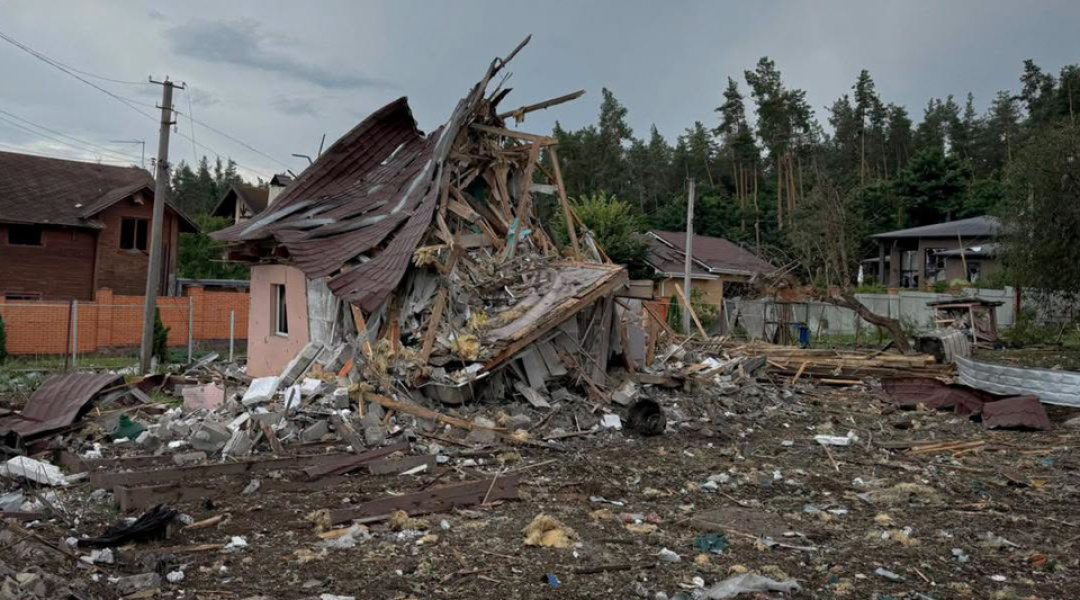
According to statements from Ukrainian authorities, the first strike hit a Ukrainian forces ammunition depot in the area of the village of Myla, west of Kyiv, near the Kyiv-Chop highway. This was followed by a prolonged detonation of shells, mines, and drones, which sharply expanded the area of impact. Residential buildings and an institution for the elderly and disabled were damaged, and among the dead was the head of the Dymer community, Taras Dydych, who was one of the first to arrive at the scene. In this case, not only the strike itself is important, but also its physics: one precise incoming impulse produced consequences that are disproportionate to a typical strike on a depot at a remote military site.
- 37 dead and 42 injured as of the evening of August 29
- At least 130 damaged residential buildings
- 381 evacuated, including 59 children
- According to Ukrainian military sources, on August 29, Russia launched hundreds of drones, with the majority targeting Kyiv and the region
This is what makes the episode in Myla so indicative. If it were merely a "random" secondary effect, Kyiv's response would have been limited to condemning Russia. But Volodymyr Zelensky and Prime Minister Serhiy Korotkyi almost immediately began to speak about internal responsibility: ammunition should not be stored near residential areas. In other words, the strike revealed not only Russian effectiveness but also Ukrainian institutional vulnerability. War is merciless to such mistakes in general, and drone warfare is doubly merciless.
Why Moscow strikes warehouses, not just the front
In recent days, Ukrainian sources have reported almost continuous alerts over Kyiv and massive waves of drones. Just during one period on August 29, the Ukrainian side reported hundreds of drones used, with most directed specifically at the capital region. This means that Russia's task is no longer limited to finding individual symbolic targets. Moscow is methodically expanding its campaign of attrition, targeting warehouses, shopping centers, logistics hubs, road junctions, and energy infrastructure. Ukraine's Minister of Agrarian Policy Taras Vysotsky stated on August 28 that Russian strikes had destroyed 90% of the country's modern warehouse capacities. This figure still needs to be clarified, but even if it is exaggerated, the trend is clear: the Russian command is not looking for a beautiful military effect, but for cumulative disintegration of the supply environment.
This is where the new role of "Geran-4" and other reactive drones comes into play. They are faster, harder to intercept by conventional interceptor drones, and better suited for saturating air defense. If earlier the Russian long-range campaign was divided into two layers, where cheap Shahed drones created mass, and missiles finished off priority targets, now Moscow is trying to erase this boundary. The reactive drone becomes an intermediate class between a cruise missile and a loitering munition. It is cheaper than a missile, but psychologically and operationally already closer to a missile strike. For the Russian war economy, this is almost the ideal weapon: acceptable price, large series, high exhausting effect.
The Ukrainian problem is deeper than one warehouse
The most unpleasant conclusion for Kyiv is that the Russian strategy works better the more mistakes the Ukrainian storage and dispersal system makes. After the July strike on the warehouse in Vyshneve, Ukrainian law enforcement agencies had already opened cases regarding violations of ammunition storage rules. Now a similar story has repeated itself in Myla. This resembles a late Soviet disease, where formal instructions existed, but real practice was subject to convenience, inertia, and departmental irresponsibility. I know this type of organizational culture well: it holds up as long as the enemy strikes inaccurately. As soon as the enemy acquires a mass cheap tool for precise long-range strikes, all this inertia begins to kill people.
Russia does not have to be genius to achieve results. It is enough for it to repeatedly find where bureaucracy has been slower than war.
Therefore, the tragedy near Kyiv is important not only as a Russian crime but also as a warning about the end of the old rear model. A large warehouse near a highway and next to a residential area in 2026 is no longer active but a potential mass grave. Resilience is now created not by the volume of accumulated stocks, but by their dispersal, camouflage, speed of movement, and storage discipline. This is a boring truth, but it is precisely on such boring things that armies break.
What this means for the fall of 2026
I expect that in the coming months, Russia will continue to shift the focus from frontline romance to suffocating the Ukrainian rear. Strikes on warehouses, distribution centers, and facilities around Kyiv will be repeated because they provide Moscow with a rare combination of military and political effect. With relatively limited costs, Russia achieves the destruction of stocks, overloads air defense, burdens rescue services, ignites internal Ukrainian disputes over responsibility, and maintains a constant background of anxiety in the capital. This is no longer a pure intimidation campaign and not a classic operational isolation of the front. This is a war of attrition against the urban and logistical fabric.
Ukraine will likely be able to adapt, but at the cost of an expensive restructuring of the entire storage and delivery architecture. And if such restructuring begins immediately, the effect of Russian strikes will decrease by winter. If not, Myla will not be an exception but a model. This is the coldest conclusion: by the fall of 2026, the Russian air strategy has become less spectacular but more mature. It does not promise Moscow a quick victory, but with the preservation of Ukrainian organizational failures, it can systematically raise the cost of resistance.
A Russian drone strike using a Geran-4 targeted an ammunition depot in Myla, Kyiv Oblast, on August 29, 2026, resulting in 37 fatalities and 42 injuries. The attack caused extensive damage to at least 130 residential buildings and led to the evacuation of 381 individuals, including 59 children. This incident highlights the effectiveness of Russian tactics in disrupting Ukrainian logistics and civilian safety.
- 37 people killed and 42 injured in the strike
- 130 residential buildings damaged
- 381 people evacuated, including 59 children
- The strike targeted an ammunition depot near Myla, west of Kyiv
- Russia launched hundreds of drones on the same day