
The Tomahawk Counterattack Capability Becomes Realistic with the Return of the Maritime Self-Defense Force's Chōkai
 Tanaka Takashi
The Return of JMSDF Chokai to Port Brings Reality to Tomahawk Counterstrike Capability
The return to Kure is not unusual. However, the destroyer "Chokai," which returned after being granted Tomahawk operational capability in the United States, has brought the debate over Japan's counterstrike capability from the drawing board back to the deck. If the successful live-fire test at the end of July demonstrated that it can "shoot," this return signifies that we have entered the next stage of "who will shoot, and with what information."
From Successful Test Firing to Home Port Return
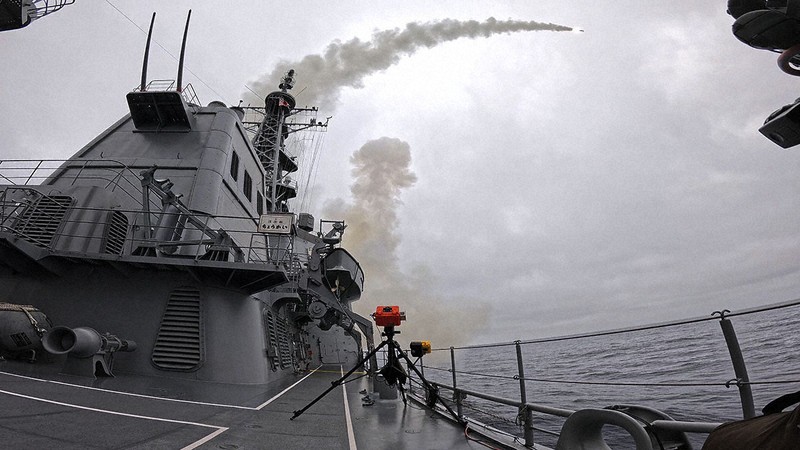
According to USNI News and The Japan News, "Chokai" is the first Tomahawk-capable ship to return to Japan after undergoing modifications and training in the United States. Japan is advancing the acquisition of approximately 400 missiles and the modification of five Aegis destroyers in the JMSDF, but it has not previously had a system that maintains long-range land strike capabilities from the sea.
What is changing here is not just the equipment list. The JMSDF has primarily been a "defensive fleet" from the Nansei Islands to the East China Sea, but with the introduction of long-range cruise missiles, it now possesses the means to threaten enemy launch sites and command nodes from a distance. Even if intentions have not suddenly changed, the addition of this capability itself alters the calculations of neighboring countries.
The Real Challenge is Information Connectivity
However, simply having Tomahawks onboard is not the end of the story. The critical factors are target information, route planning, and assessment of combat results, rather than just the launch tubes. To target mobile launchers or objectives within ports, continuous updates of target information are required, including satellites, patrol aircraft, drones, and U.S. military ISR. This return to port marks the beginning of the homework on how far Japan and the U.S. can bring information sharing to a combat-ready state, rather than the completion of missile introduction.
Moreover, the number of five modified ships is not a panacea. Aegis destroyers are high-demand assets that simultaneously handle air defense, ballistic missile defense, protection of allied ships, and SLOC surveillance, and cannot always be dedicated to strike missions. The possession of long-range weapons is reassuring, but it also complicates the prioritization of fleet operations.
Implications for the Japan-U.S. Alliance
In my view, this return to port signifies a transition from "Japan borrowing U.S. strike power" to "Japan jointly managing launch decisions and target information with the U.S." Here, the issue of governance—who bears political responsibility—is more significant than the budget amount. The true change is not the figure of 1,600 kilometers in range. It is that Japan's destroyers have become entities that are prioritized for monitoring as potential launch platforms for long-range strikes even in peacetime.
Ultimately, what is questioned with the return of "Chokai" is not the presence of missiles. It is whether information, legal frameworks, and political will can be aligned at the same speed near the launch button. At sea, the slowest element determines the overall capability.
The Japan Maritime Self-Defense Force's destroyer 'Chokai' returned to Kure after completing modifications and training in the U.S. to operate Tomahawk missiles. This marks a significant enhancement in Japan's military capabilities, transitioning from a defensive posture to one that can threaten enemy launch sites from a distance. The effective deployment of these missiles will depend on improved information sharing and operational coordination with U.S. forces.
- The destroyer 'Chokai' is the first Aegis ship to return to Japan after receiving Tomahawk capabilities.
- Japan is acquiring approximately 400 Tomahawk missiles and modifying five Aegis destroyers.
- The introduction of long-range cruise missiles changes Japan's naval strategy from a defensive to a more offensive posture.
- Effective use of Tomahawk missiles requires continuous target information and coordination with U.S. ISR assets.
- The return of 'Chokai' signifies a shift in Japan's military decision-making and operational capabilities.