

The McDonnell Douglas F-4 Phantom II is a venerable Cold War-era multi-role aircraft. Originally designed in the 1950s, the Phantom became a mainstay across the U.S. Armed Forces and air forces worldwide.
Even today, the F-4 remains in service with a select few nations. During its service life, pilots loved the aircraft, and it could serve in both air-to-air and air-to-ground roles.
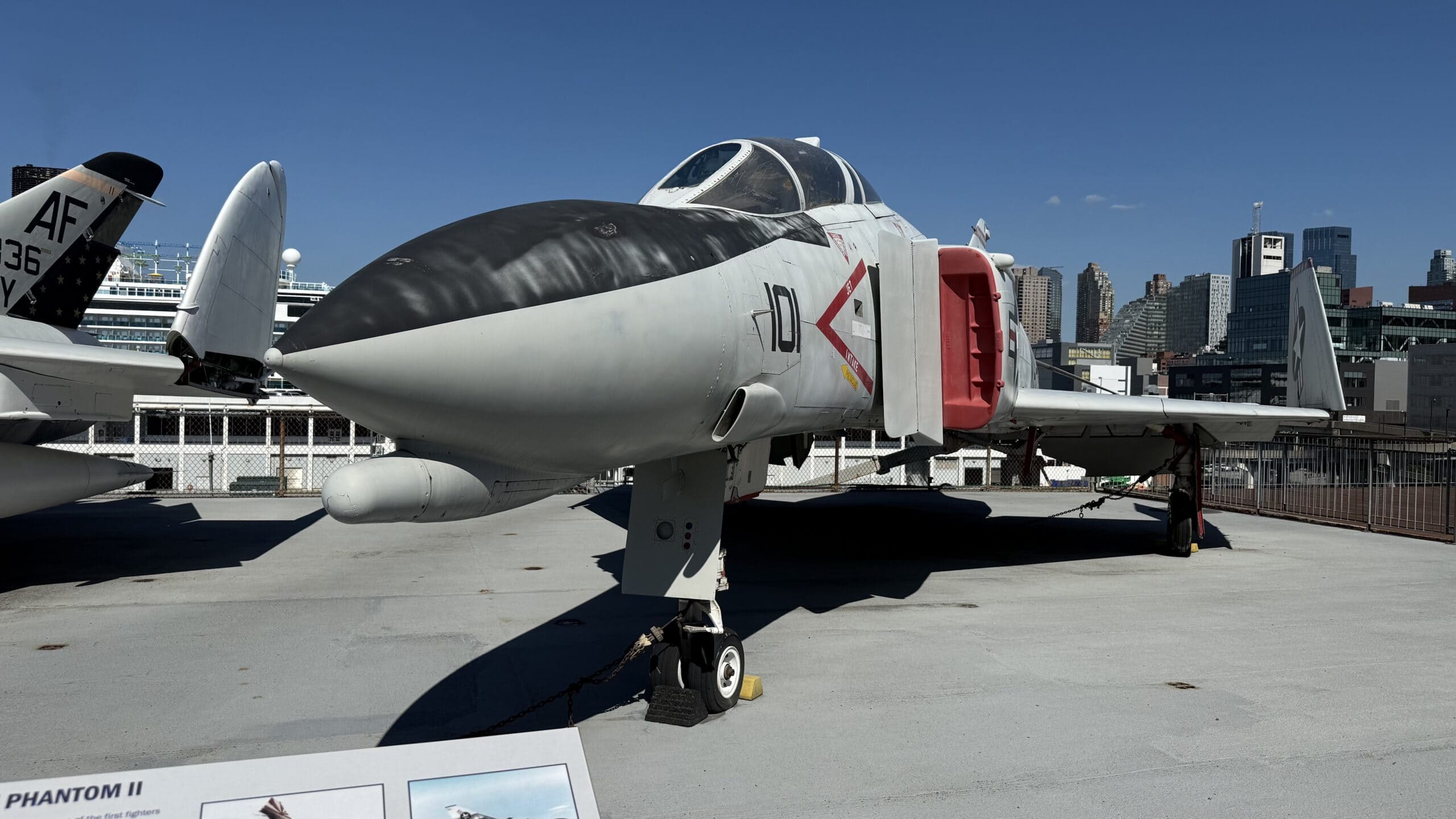
F-4 Phantom. 19FortyFive.com Photo.
It flew extensively during the Vietnam War and remained a vital component of the U.S. Air Force until its eventual retirement after the Cold War.
Heading to the UK for an Airshow
During the aircraft’s prime, the F-4 Phantom II appeared at numerous airshows and exhibitions.
In 1968, USAF Phantom pilot John Rains was asked to fly his F-4C to RAF St. Mawgan, Cornwall, for what was apparently a static display.
Rains discussed the proposal with his backseat Radar Intercept Officer (RIO), who agreed that a weekend at an RAF airshow would be fun.
Their task, as described to them, was to stand by their aircraft, smile, and try to represent the USAF in a positive light.
As far as the two were concerned, there would be no actual flying at the event; it was a simple static display and nothing else.
Explaining the trip to Cornwall, John recalled in the bookazine F-4 Phantom: Tales From the Cockpit that the aircraft was equipped with a napalm canister, repurposed as a travel pod to store extra fuel.
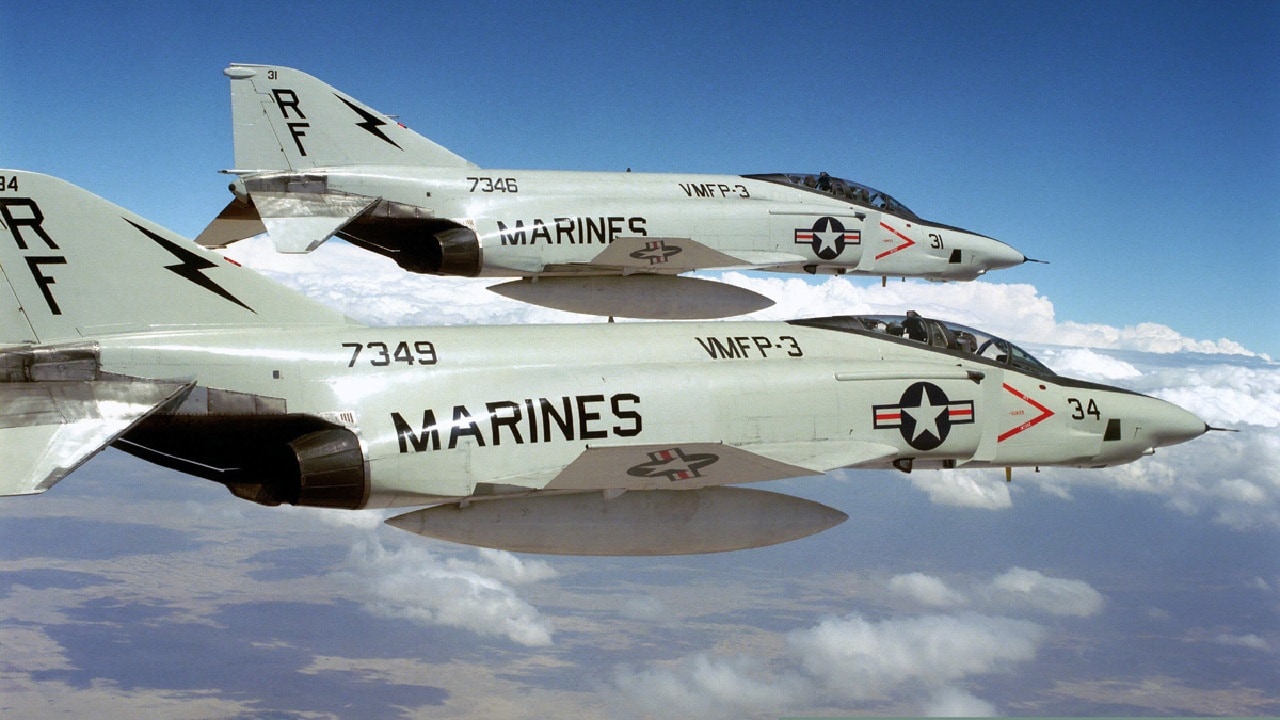
A right rear view of two RF-4B Phantom II aircraft of Marine Photo Reconnaissance Squadron Three (VMFP-3) over El Toro Marine Corps Air Station during a training mission.
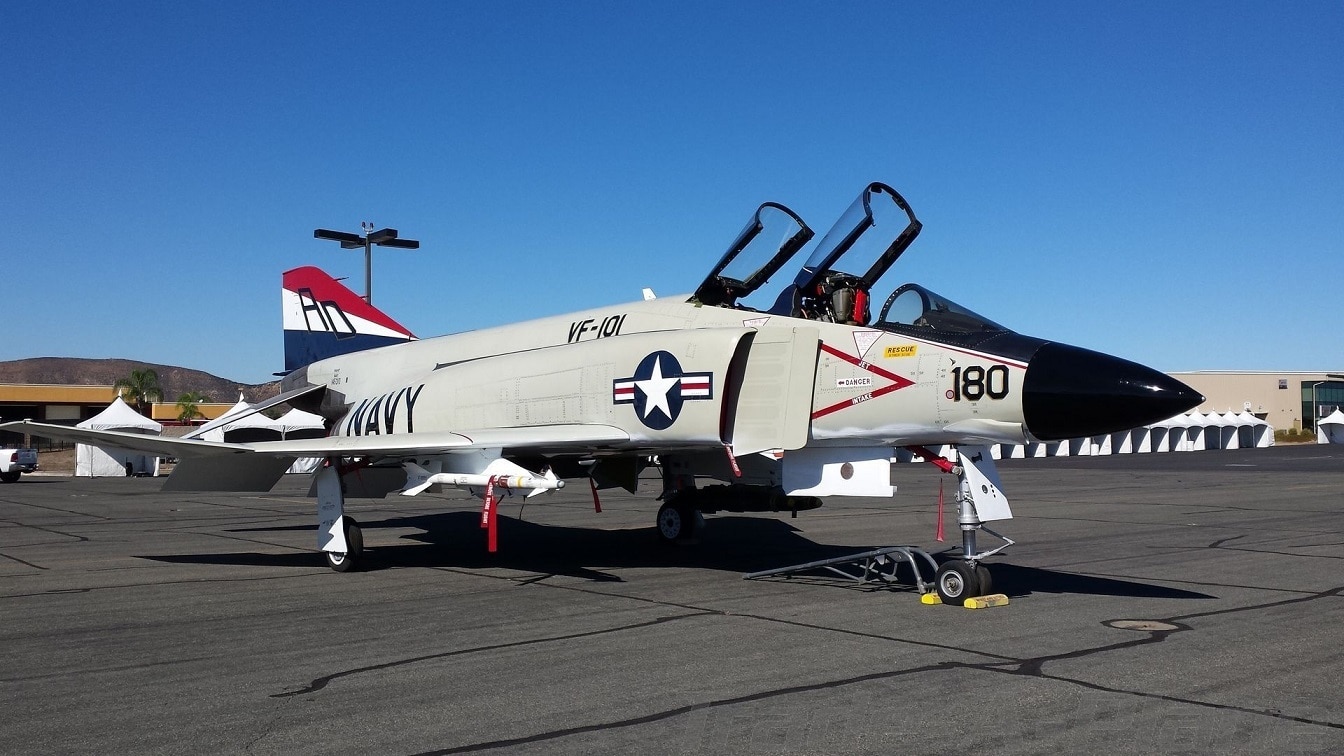
F-4 Phantom. Image Credit: Creative Commons.
“We put our personal belongings inside the travel pod, checked that we had starting cartridges, down locks, a maintenance flight manual, and so forth, shook the front and back of the travel pod to confirm its sturdiness, and then thanked the crew for this nifty new toy. The crew chief said, the only thing we ask is that you do not exceed 2G, as it has not been flight-tested yet. Since 2G was the amount used in the pitch, we said sure.”
Pulling Some High-G Maneuvers
As the Phantom approached the St. Mawgan, the crew received a different set of instructions.
“We cranked her up, taxied out and headed for the runway.”Rains recalled. “Tower gave us immediate clearance for take-off, and off we went. Everything was normal, but about 100 miles from St Mawgan the British controller told us to contact St. Mawgan tower. Really? It seemed a bit early to be talking to the tower, but okay.” The tower at St. Mawgan then told the Phantom they were clear to begin practicing their routine for the airshow, which was a bit confusing, considering they’d been told to do only a status display. After a back-and-forth with the tower, the air-controller told Rains that he was cleared to “beat up the field.”
Seeing no reason not to, the Phantom went full throttle on its approach to the airfield. “By this time, we were about 70nm from the field.
As we got closer, I did a rapid descent to about 500ft, plugged in the afterburners, crossed the field at about 500kts, and about halfway down pulled into a vertical roll on the way up; I went through 10,000ft and started a split S.
I went out of afterburner to keep it below Mach 1, yanked on the stick looking at the other end of the runway, and back down to a little under 500ft. I lit the afterburner again just as we leveled and started a tight turn to the left.”
The Travel Pod…
At this point, however, Rains remembered something: a travel pod was still strapped to the underside of the aircraft, and it wasn’t cleared beyond 2Gs. “A quick look at the g meter revealed 7.5g. Oh no! God only knows where our stuff is.” Realizing the gravity of the situation, he then contacted the control tower and requested an immediate landing.
Sounding visibly disappointed, the air traffic controller granted his request and gave the Phantom permission to land.
As soon as the aircraft came to a complete stop, the RIO in the back seat opened up his canopy to make sure the travel pod was still there. “I asked my back seater to open his canopy to see if our travel pod was still there. His canopy came up, and he said, ‘ Looks good. Phew!”
With the travel pod still attached to their aircraft, Rains and his backseater made sure that their F-4 was still in working condition following their little stunt. “We parked our jet next to other static display airplanes, went inside, cleared ops, and called maintenance to confirm the condition of our aircraft. All was good, we said; we had enough fuel in our drop tanks to not need any from the Brits, and I casually mentioned that we had accidentally flight-tested their travel pod to 7.5g, and it did fine. ‘You b*******!’ They replied, and then they laughed. We bought drinks later that week at Bentwaters and regaled them and ourselves with our bravery and stupidity. Gotta love fast movers!”
About the Author: Isaac Seitz
Isaac Seitz, a Defense Columnist, graduated from Patrick Henry College’s Strategic Intelligence and National Security program. He has also studied Russian at Middlebury Language Schools and has worked as an intelligence Analyst in the private sector.