
The UK and France Plan to Send Mine-Sweeping Ships to the Strait of Hormuz, Multiple Parties Assess the Mine-Sweeping Capabilities of European Countries
[Global Times Special Correspondent Chen Shan] French President Macron and British Prime Minister Starmer plan to jointly host a video conference in Paris on April 17 to form an international alliance excluding the United States, Israel, and Iran, aimed at assisting in the restoration of shipping in the Strait of Hormuz by deploying mine countermeasure vessels and other military ships. There is widespread concern about how this alliance would operate if it is indeed established, with the foremost question being the current mine countermeasure capabilities of European navies.
On the 14th, Macron stated that the plan is an "international defense mission" that does not include "conflict parties," namely the United States, Israel, and Iran. European diplomats familiar with the plan revealed that European vessels will not operate under U.S. command. Currently, the main mine countermeasure vessels equipped by several European countries are the "Tripartite" class minehunters, developed jointly by France, the Netherlands, and Belgium in the 1970s. They have a displacement of about 600 tons, with hulls made of fiberglass material, featuring low magnetic characteristics that reduce the risk of triggering magnetic mines. They are primarily used for searching and clearing bottom mines and anchor mines, and can also perform various roles such as patrolling, training, and serving as motherships for remotely operated mine countermeasure vessels. To accomplish these tasks, this class of ships is equipped with a range of specialized equipment. The core is the DUBM-21A hull-mounted sonar, capable of searching for mines at depths of 80 meters and within a range of 500 meters. Once a target is confirmed, the onboard PAP series remotely operated mine disposal devices carry explosives for precise elimination.
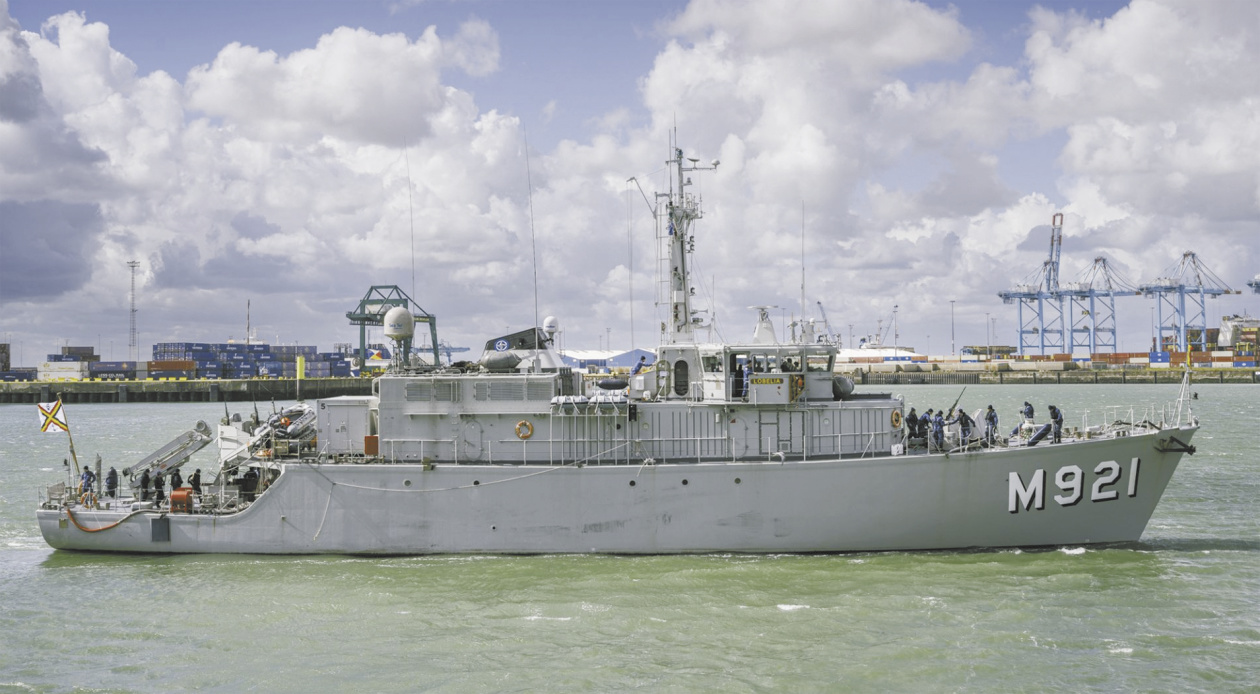
As the "Tripartite" class minehunters age, France, the Netherlands, and Belgium have jointly introduced a new generation of "City" class minehunters, with the retired "Tripartite" class vessels being transferred to countries such as Ukraine and Bulgaria. The "City" class minehunters have a displacement of up to 2800 tons and can carry a large number of unmanned systems to perform high-risk mine countermeasure tasks. Both Belgium and the Netherlands have ordered six of this new type of minehunter.
The French version of the "City" class minehunter has an extended deck to accommodate the French-customized "Future Unmanned Mine Warfare System" (SLAM-F). This system deploys a swarm of unmanned aerial vehicles, unmanned surface vessels, autonomous underwater vehicles, and mine disposal devices, relying on a new multifunctional mine warfare mothership as a maritime control center, achieving non-contact mine clearance that keeps personnel away from minefields. Compared to traditional methods, SLAM-F can increase mine clearance efficiency by 5 to 10 times while significantly enhancing underwater situational awareness.
The UK is also positive about forming the "International Alliance." Currently, the main mine countermeasure vessels of the British Navy include over ten "Hunter" class and "Sandown" class minehunters, as well as the new "Sterling Castle" mine countermeasure mothership. The latter has a displacement of 5800 tons and can serve as a mobile base at sea, carrying and commanding various unmanned vehicles to perform missions. Additionally, the British newspaper The Times reported at the end of March that the UK Ministry of Defence is planning to convert the "Lime Bay" landing ship, deployed in Gibraltar, into a floating base equipped with unmanned mine countermeasure vessels to support mine clearance operations in the Strait of Hormuz.
The British Navy has currently equipped multiple unmanned mine countermeasure systems, which can remotely detect and detonate mines at a safe distance using unmanned surface vessels, towed sonar, and remotely operated submersibles, significantly improving efficiency and reducing personnel risk. In the future, the UK also plans to collaborate with other countries to build more motherships and continuously introduce large unmanned underwater vehicles.
The Wall Street Journal reported that senior German officials confirmed that Germany, which has consistently publicly resisted involvement in any military operations, is likely to join this joint mine countermeasure operation. Among European countries, Germany has a large fleet of mine countermeasure vessels, including about 12 newer and continuously upgraded "Frankenthal" class and "Ensdorf" class minehunters. They use non-magnetic steel as hull material, have a displacement of about 650 tons, and can also carry a large number of unmanned mine countermeasure systems, including "Penguin" or "Sea Fox" mine disposal devices, capable of safely and efficiently executing mine search, identification, and clearance tasks. At the same time, the German Navy is accelerating its transition to unmanned systems, having equipped the "TROIKA" remotely operated mine countermeasure system and is actively exploring new mine countermeasure technologies through testing large autonomous underwater vehicles such as "Blue Whale" and "Gray Shark," as well as disposable mine disposal devices. However, reports indicate that the German constitution imposes strict limitations on any such deployments of the German military. To participate in mine countermeasure operations, the German government needs to obtain parliamentary authorization, which in turn requires strong international authorization.
Compared to European countries, the U.S. Navy's mine countermeasure capabilities are severely lacking. According to the U.S. Naval Institute website, the U.S. Navy currently has only the last four "Avenger" class mine countermeasure vessels deployed in Japan, two of which are heading to the Middle East. Additionally, the U.S. Navy has equipped several Littoral Combat Ships with mine countermeasure mission modules, which can also conduct mine clearance operations. After the U.S. launched military actions against Iran, the U.S. Navy has withdrawn all three Littoral Combat Ships deployed in the Middle East.
France and the UK are forming an international alliance to assist in mine clearance operations in the Strait of Hormuz, excluding the US, Israel, and Iran. This coalition will involve multiple European navies, each deploying their mine countermeasure vessels and systems. Germany is likely to participate, while the US Navy's capabilities in this area remain limited.
- France and the UK plan to form an international alliance excluding the US, Israel, and Iran for mine clearance in the Strait of Hormuz.
- European navies will not operate under US command and will utilize their own mine countermeasure vessels.
- Germany may join the operation despite constitutional restrictions on military deployments.
- The UK is enhancing its mine countermeasure capabilities with new vessels and unmanned systems.
- The US Navy's mine countermeasure capabilities are currently limited compared to European forces.