
The United States escorts 3,000 ships through Hormuz in 2026 and reveals the Gulf's reliance on American maritime deterrence.
 Ahmed Al-Rashid
The United States Escorts 3,000 Ships Through Hormuz in 2026 and Reveals Gulf's Dependence on U.S. Naval Deterrence
On October 26, U.S. Central Command announced that more than 3,000 commercial ships have crossed the Strait of Hormuz in the past six months with U.S. support, and that over 1.5 billion barrels of oil have exited Gulf countries despite Iranian threats. The numbers may superficially appear as a victory for freedom of navigation, but practically they reveal something more embarrassing for Gulf capitals: their exports have returned to pre-war levels thanks to foreign power, not due to a Gulf naval capability able to secure the vital passage on its own.
Transit Numbers Do Not Mean the Crisis Is Over
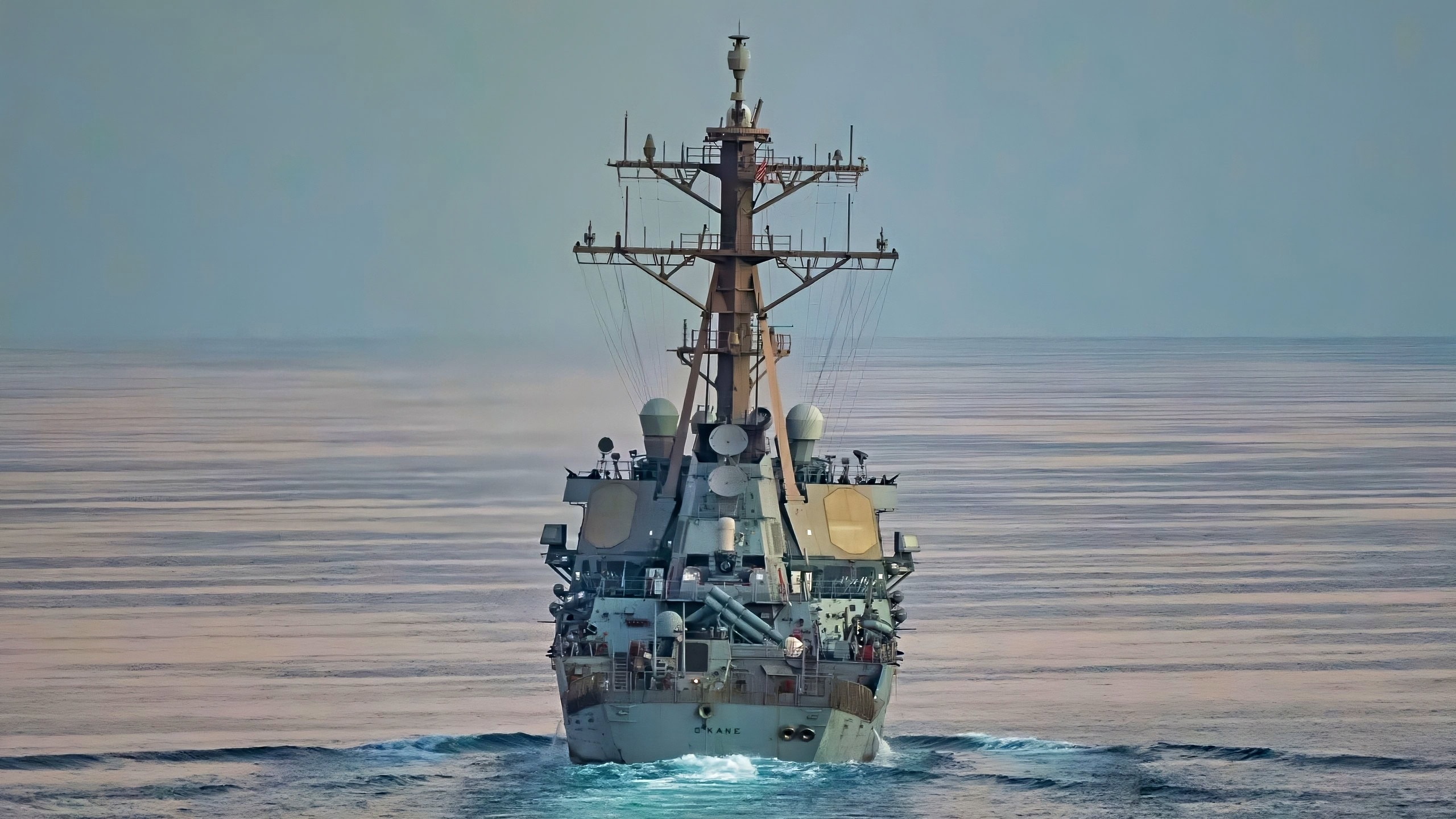
Central Command stated that over 95 percent of the ships that used the main corridors crossed safely, and mine-clearing efforts kept the shipping routes open. Al Jazeera reported that oil flow reached about 16.5 million barrels per day in September, close to the pre-war average, excluding Iranian oil. However, the price of Brent crude remained around $114.50 per barrel, compared to $72.48 on February 27, just one day before the start of the U.S.-Israeli war on Iran.
This difference is significant. The passage has not been completely closed, but the risks have not disappeared. Rising insurance costs, changing shipping routes, transferring cargo from one ship to another at sea, and increased use of pipelines are all costs borne by the region even when tankers reach their destinations. Statistically safe passage does not equate to cheap or stable passage. In military calculations, it is sufficient for Iran to threaten a limited number of ships or sow doubt about mines to impose a cost on the market greater than the cost of the missile itself.
The United States Holds the Kill Chain
What U.S. forces are doing is not merely armed guarding around oil tankers. It is an integrated system that combines maritime reconnaissance, aircraft, surface vessels, mine sweepers, communications, coordination with Gulf Cooperation Council countries and shipping companies, and the ability to respond quickly if harassment turns into an attack. This is the kill chain that makes the Iranian threat containable. Gulf fleets possess missile boats, frigates, patrol aircraft, and advanced surveillance systems, but they do not form a unified command and control network capable of managing this volume of traffic in a war environment.
Anyone who has served in the region knows that buying a frigate is much easier than building the institution that makes six frigates operate as one force. Gulf countries have spent billions of dollars on air defense systems and fighter jets, but they still rely on the United States for long-range reconnaissance, mine clearance, establishing rules of engagement, and protecting commercial vessels. Here, the triad of capability that I always use comes into play: equipment, training, and institution. The Gulf has the equipment, is improving in training, but has yet to resolve the issue of a joint institution.
Iran No Longer Needs to Close the Strait
The Iranian rhetoric about controlling Hormuz does not require a complete closure of the strait to be effective. It is sufficient to maintain a distributed capability that includes fast boats, coastal missiles, drones, mines, and electronic warfare means. These tools do not need to defeat the U.S. fleet in a conventional battle; they only need to create recurring doubt about the next ship and the next passage. Therefore, Washington's announcement that 95 percent of ships crossed safely can be read in two ways. It confirms U.S. deterrent capability, but it also proves that the remaining risk percentage is sufficient to keep oil and insurance prices above pre-war levels.
The picture is complicated because Saudi Arabia, the UAE, Qatar, and Kuwait do not view the threat in the same way. Some have alternative pipelines and ports, while others rely more on Hormuz, but all need the U.S. umbrella in moments of escalation. This dependence gives Washington political leverage that is no less than its military leverage. The state that guarantees the flow of oil can influence the timing of de-escalation, the terms of negotiations with Tehran, and the shape of any future maritime coalition.
The Deferred Gulf Lesson
Gulf countries should not settle for merely repeating the phrase of security partnership. What is needed is to transform the partnership into measurable capability, starting with a joint maritime operations center, a unified maritime situational picture, continuous training on mine clearance and port protection, and then escalating to a clear distribution of tasks in wartime. Coastal defense must also be linked to the protection of oil infrastructure and pipelines, because a tanker that survives a missile may remain hostage to an exposed export terminal.
However, I do not believe that complete maritime independence is near. The United States possesses satellites, bombers, submarines, and operational experience that cannot be bought at a defense expo in two years. Gulf countries can reduce dependence, but not eliminate it. The paradox is that Washington's success in keeping Hormuz open may delay Gulf reform once again; the more oil returns to the sea, the more capitals revert to buying reassurance instead of building capability. In the Gulf, as in ancient armies, whoever holds the key does not need to own the whole door. The problem is that the key to Hormuz remains in American hands, while the countries in the region want to act as if they possess full sovereignty over their maritime gateway.
Sources
U.S. Central Command reported that over 3000 commercial vessels transited the Strait of Hormuz with U.S. support in the past six months, facilitating the export of 1.5 billion barrels of oil from Gulf countries. Despite 95% of vessels passing safely, ongoing risks from Iranian threats keep oil prices elevated. Gulf states continue to depend on U.S. military capabilities for maritime security and operational coordination.
- Over 3000 commercial vessels transited the Strait of Hormuz with U.S. support in the past six months.
- 1.5 billion barrels of oil were exported from Gulf countries despite Iranian threats.
- 95% of vessels using main routes passed safely due to U.S. efforts.
- Oil prices remain elevated due to ongoing risks despite safe passage statistics.
- Gulf states rely on U.S. for maritime security and operational coordination.