
German firm develops low-cost interceptor to stop mass drone attacks
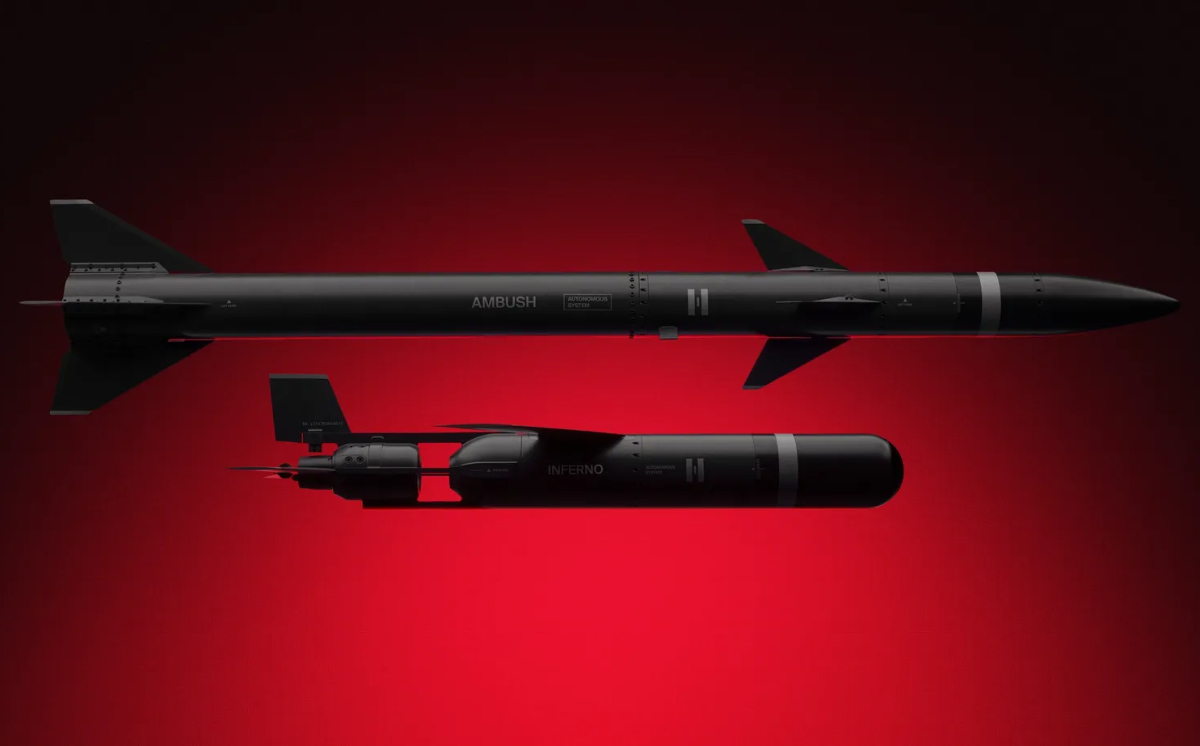
German defense AI company Helsing on Oct. 26 unveiled Contra, an autonomous, AI-controlled air defense system designed to protect countries against large-scale drone and missile attacks, along with two new interceptor missiles, the jet-powered AD-1 Inferno and the rocket-powered AD-2 Ambush, the company announced.
Helsing said Contra fuses data from sensors and weapons into a single air picture so it can detect and engage hundreds or even thousands of incoming drones and missiles at the same time, while operators keep control over decisions and target priorities through the company’s Altra command-and-control software. The company did not name any customers, say when the system could enter service, or disclose whether the interceptors have been flight-tested.
The AD-1 Inferno is a jet-powered interceptor that can loiter in the air, operate in swarms and re-engage targets if it misses on the first pass, which Helsing said makes it suited to fast jet-powered drones. The AD-2 Ambush uses a solid rocket motor for quick intercepts, reaching Mach 2.5 with a range of more than 20 km (12 miles), and is intended for higher-flying threats.
Both missiles are launched from containers, receive course updates in flight from Contra’s ground radar stations, and carry their own radar seeker to find the target in the final phase of flight, which allows them to work at night and in bad weather. Helsing said the system can also take in third-party weapons such as other interceptors, counter-drone lasers, guns and net-based systems within days, and that it is already demonstrating several such integrations to military customers.
The company said it will mass-produce the interceptors at its Resilience Factories at prices significantly lower than existing interceptor missiles, though it did not give a unit cost.
“Contra ends the air defence dilemma: slow fair-weather drones, or million-euro missiles fired at cheap, mass-produced targets. Our AI links existing sensors and effectors in real time and adds our interceptors, AD-1 and AD-2. With jet and rocket propulsion, a low-cost all-weather radar seeker, and two independent European supply chains, they deliver autonomous fire superiority up to ten kilometres high – affordable and at industrial scale,” said Niklas Köhler, Helsing’s co-founder and president.
Helsing tied the launch to Russia’s growing production of jet-powered attack drones and cruise missiles, citing recent intelligence reports that output of the Geran-4 and Geran-5 jet drones alone has reached 4,000 units a month and that Russia is building additional launch sites that put parts of the European Union within range.
Founded in 2021 and headquartered in Munich, Helsing began as a software company and has since moved into hardware, including the HX-2 strike drone and the CA-1 Europa uncrewed combat aircraft. In July, it raised $1.8 billion at an $18 billion valuation and selected West Virginia for its first U.S. Resilience Factory, and on Oct. 20 it announced a commercial partnership with Swiss-Dutch drone and missile maker Destinus.
Content preview only. Full article available at source. View Full Article
Helsing unveiled Contra, an autonomous air defense system, on October 26, 2023, in Germany. The system is designed to counter large-scale drone and missile attacks and includes two new interceptor missiles, the AD-1 Inferno and AD-2 Ambush. The AD-2 Ambush can reach speeds of Mach 2.5 and has a range exceeding 20 km. Helsing aims to mass-produce these interceptors at significantly lower costs than current models.
- Helsing unveiled Contra, an AI-controlled air defense system on October 26, 2023.
- The system is designed to protect against large-scale drone and missile attacks.
- Two new interceptor missiles, AD-1 Inferno and AD-2 Ambush, were introduced.
- The AD-2 Ambush can reach speeds of Mach 2.5 and has a range of over 20 km.
- Helsing plans to mass-produce these interceptors at lower costs than existing models.