
The U.S. Army's 2026 First Island Chain Plan Still Cannot Move Enough Tomahawks
 Marcus Chen
The U.S. Army's 2026 First Island Chain Plan Still Cannot Move Enough Tomahawks
The U.S. Army's new Pacific guidance identifies the right battlefield and the wrong comfort level. Its “How the Army Fights” document, released on October 7, says the service must be ready to act on day one of a conflict inside the First Island Chain. That means hardened command posts, pre-positioned fuel and ammunition, long-range fires, air defenses, cyber and electronic warfare, and a resupply fleet that can move while Chinese missiles are searching for it.
The Plan Is a Logistics Rewrite
The important change is not that the Army wants more missiles. It is that the Army is admitting that missiles without a distribution network are inventory, not combat power. The guidance calls for “Total Army Power Projection Equipment,” a revised approach to pre-positioned stocks designed to sustain rotational and forward units from the opening hours of a high-intensity fight.
USNI News reported on October 16 that Army planners are looking at the First Island Chain as an archipelago and maritime operating area, not as a collection of conventional land bases. The proposed network reaches across Japan, Australia, the Philippines, Singapore and Guam, with hardened fuel and munition nodes in the Second Island Chain feeding units closer to the fight.
That is a sensible design. It is also a large target set. Every node adds capacity, but every port, runway, fuel farm, warehouse and command link becomes something the People's Liberation Army Rocket Force can locate, disrupt or destroy. Dispersal improves survivability only if the force has enough trucks, landing craft, engineers, air defense and repair capacity to keep the nodes connected.
Missiles Are the Easy Part
Army forces assigned to U.S. Indo-Pacific Command already have access to a useful menu of fires. The Mid-Range Capability uses a ground-based Mark 41 vertical launch system to fire Tomahawk cruise missiles and SM-6 interceptors. Army multi-domain task forces are also expected to combine long-range fires with sensors, electronic warfare, cyber effects and unmanned systems.
On paper, that gives land forces a way to threaten ships, aircraft and missile infrastructure without depending entirely on aircraft carriers. In practice, the magazine is the weapon. A launcher that fires four Tomahawks is valuable once. A battery that can reload under attack, receive targeting data after communications are degraded, and move before the next salvo is valuable for the length of a campaign.
The guidance itself acknowledges the problem: the Western Pacific requires more long-range-strike munitions than current production and distribution systems can comfortably provide. This is the gap between a force-design document and a war plan. The first salvo is a procurement question. The tenth salvo is an industrial question.
The First-Day Promise Meets Geography
The Army says its forward posture must avoid traditional, lengthy deployment timelines. That is essential. The distance from the continental United States to the western Pacific is measured in thousands of miles, while the People's Liberation Army begins close to the theater with shorter internal lines and dense missile coverage.
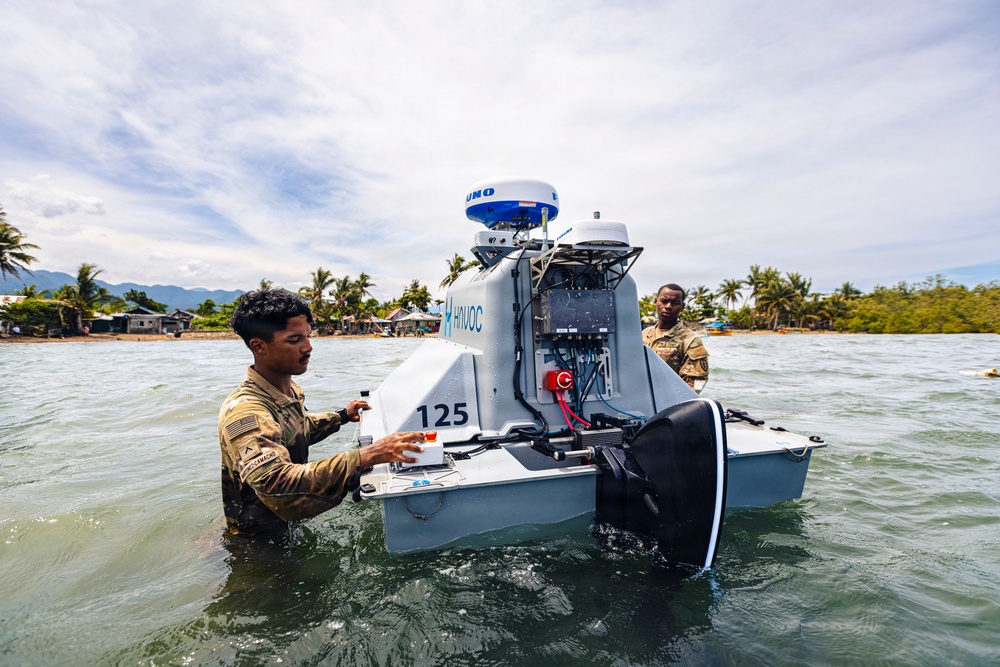
Pre-positioning helps, but stocks do not sustain themselves. Fuel evaporates, batteries require maintenance, vehicles need parts and crews need food and medical support. A warehouse in the Philippines is not a combat unit until a contested port can unload it, local infrastructure can move it, and U.S. forces can protect the route. The Army's proposal for watercraft, unmanned surface vessels and unmanned aerial vehicles is therefore more consequential than the brochure language about multi-domain effects.
The Philippines illustrates the difficulty. Subic Bay and other access points can shorten the deployment problem, but they also sit inside the operating area that the guidance says China can contest. A route that works during an exercise may fail when commercial shipping stops, civilian air traffic is restricted and every predictable movement attracts surveillance.
What the Guidance Gets Right
- It treats the First Island Chain as maritime terrain. Army units cannot plan as if roads and bases will remain available after the opening strikes.
- It connects fires to sustainment. Tomahawk and SM-6 launchers need fuel, reloads, communications and protection, not just launch authority.
- It distributes the burden. Japan, Australia, the Philippines, Singapore and Guam can provide more options than a single primary base, if political access survives the crisis.
- It makes unmanned logistics operationally relevant. Small vessels and aircraft may move supplies in ways that are less predictable and less politically costly than large transports.
What Washington Still Has to Prove
The Army needs to publish the numbers that make the concept testable: how many days of fuel and ammunition each node holds, how many reloads each long-range battery receives, how quickly a damaged port can reopen, and what percentage of the network can function without satellite communications. Without those measures, “day one” is a slogan.
The United States also needs a clearer division of labor with Japan and the Philippines. Host-nation access is not the same as host-nation consent for combat operations. A plan that assumes every runway, road and harbor remains available after Chinese attacks is not resilient; it is optimistic.
The Army has finally identified the operational problem: land power in the western Pacific is a supply-chain problem with missiles attached.
That is progress. But the math remains severe. A single SM-6 or Tomahawk launcher can complicate Chinese planning; it cannot by itself keep an island chain supplied. Unless Washington funds the stockpiles, transport fleet, repair capacity and protected communications behind the launchers, the 2026 guidance will produce a force that can fire on day one and run out of war on day ten.
Sources
The U.S. Army is preparing for potential conflict in the First Island Chain by enhancing its logistics and missile distribution capabilities. The 2026 plan emphasizes the need for a robust supply network to support operations across Japan, Australia, the Philippines, Singapore, and Guam. The Army recognizes that effective missile deployment requires more than just inventory, highlighting the importance of pre-positioned stocks and unmanned logistics for operational success.
- The U.S. Army's 2026 plan emphasizes the need for a robust logistics network for missile distribution.
- The Army acknowledges that missiles without a distribution network are ineffective.
- The First Island Chain is viewed as a maritime operating area rather than conventional land bases.
- Pre-positioned stocks are essential for sustaining operations in a high-intensity conflict.
- The Army's proposal includes unmanned logistics to enhance supply chain resilience.