
The U.S. "Kennedy" Nuclear-Powered Aircraft Carrier Completes Its First Sea Trial
Reference News Network, February 6 According to a report from the U.S. "Stars and Stripes" website on February 4, the USS John F. Kennedy (CVN-79) returned to the shipyard in Virginia on the 4th, completing its first week-long sea trials. The aircraft carrier is expected to be delivered to the U.S. Navy early next year.
The USS John F. Kennedy is the second of ten Gerald R. Ford-class nuclear-powered aircraft carriers being built by Newport News Shipbuilding, a subsidiary of Huntington Ingalls Industries. The U.S. Navy estimates the procurement cost of the USS John F. Kennedy to be $13.196 billion.
This aircraft carrier, designated CVN-79, is scheduled to be delivered in March 2027 and officially commissioned into the U.S. Navy.
Derek Murphy, Vice President of the new aircraft carrier project at Newport News Shipbuilding, said, “We are proud to see CVN-79 take another step toward joining the active fleet.”
Newport News Shipbuilding stated that the carrier left Newport News on January 30, “to test important ship systems and components at sea.” The company said that the technological advancements in the design of this carrier will enhance operational efficiency and reduce crew requirements. According to the Navy's estimates, the number of sailors required for this ship will be about 900 fewer than that of the Nimitz-class carriers.
The Ford-class carriers will also be equipped with upgraded dual reactors, thereby enhancing power generation capabilities. The aircraft elevators and catapult systems on the Ford-class carriers utilize electromagnetic systems.
The Congressional Research Service stated that adjustments to the new systems are one of the reasons for the two-year delay in the delivery of the USS John F. Kennedy. Other delays were due to the certification work for the arresting gear.
President Trump has signed an executive order requiring the Navy to use traditional steam-powered catapults to launch aircraft on future aircraft carriers.
However, the U.S. does not plan to build any new aircraft carriers before Trump leaves office in January 2029.
The Navy has initiated a $145 million power system upgrade project at Naval Base Kitsap. The Navy stated that this base will become the home port for the USS John F. Kennedy. Future home ports for several Ford-class carriers will also require similar upgrades.
The home port of the USS Gerald R. Ford is located at Naval Station Norfolk in Virginia. After the USS John F. Kennedy is commissioned and moves to Naval Base Kitsap west of Seattle in 2029, the U.S. Navy will deploy one of the latest class of carriers on each coast.
The Navy stated that the Nimitz-class and Ford-class carriers are the largest warships in the world, with a displacement of about 100,000 tons.
The Navy plans to build ten new carriers to replace the ten Nimitz-class nuclear-powered aircraft carriers that were commissioned between 1975 and 2009.
The previous USS John F. Kennedy (CV-67) was the last conventionally powered aircraft carrier built by the U.S. and was decommissioned in 2007. (Translated by Zhu Jie)
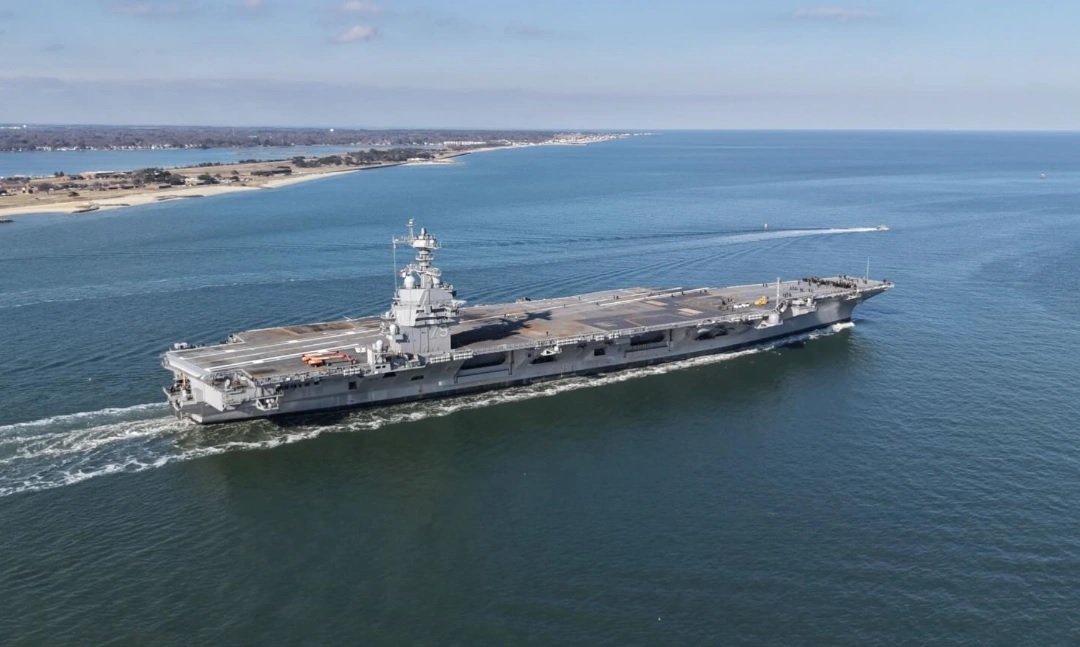 USS John F. Kennedy departs for sea trials (AP)
USS John F. Kennedy (CVN-79) completed its first sea trial in Newport News, Virginia, on February 4, 2023. The aircraft carrier is expected to be delivered to the U.S. Navy in early 2024, with an estimated procurement cost of $13.196 billion. This new class of carriers will operate with a reduced crew size compared to previous models, enhancing operational efficiency.
- USS John F. Kennedy (CVN-79) completed its first sea trial on February 4, 2023.
- The carrier is expected to be delivered to the U.S. Navy in early 2024.
- The procurement cost of the carrier is estimated at $13.196 billion.
- The carrier will require approximately 900 fewer sailors than the Nimitz-class carriers.
- The USS John F. Kennedy is the second of ten Gerald R. Ford-class nuclear-powered aircraft carriers.