
The U.S. Military Tests New Weapons by Airstrikes on Iran
[Global Times Comprehensive Report] Like previous localized conflicts, this time the U.S. airstrike against Iran has also become a testing ground for new weapons from the Pentagon. According to reports from U.S. media, the U.S. military has for the first time deployed the black "Tomahawk" cruise missile, the "LUCAS" suicide drone, and the new generation "Precision Strike Missile" (PrSM) in this operation.
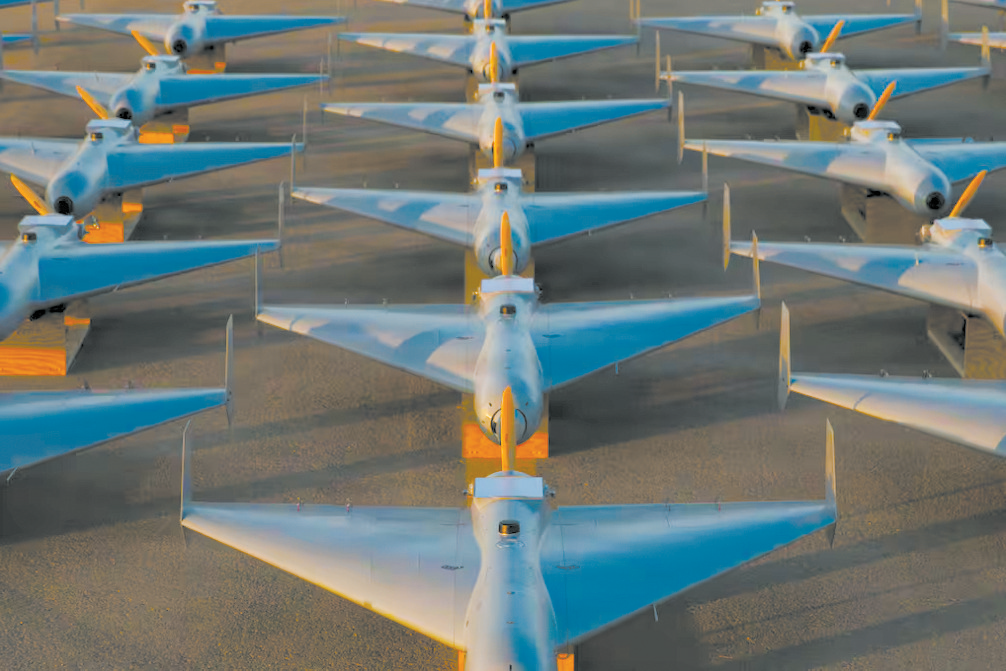
The U.S. Military Times reported on March 1 that officials from the U.S. Central Command confirmed that the new "LUCAS" suicide drone was used for the first time in combat during the airstrikes against Iran. The official stated that this low-cost drone targeted the command and control facilities, air defense missiles, drone launch sites, and military airfields of the Iranian Islamic Revolutionary Guard Corps.
"LUCAS" is a reverse-engineered version of the Iranian "Shahed-136" drone, which gained prominence during the Russia-Ukraine conflict, originally intended as a target drone for anti-drone training. It has a range of approximately 500 miles and can carry a warhead equivalent to twice the explosive yield of a "Hellfire" missile. Compared to the advanced but expensive munitions in the U.S. arsenal, it has a unit cost of about $35,000. The "LUCAS" drone has been assigned to the newly established "Scorpion Strike" task force, a special drone unit recently created by Central Command.
The U.S. website "Power" noted that in the photos and videos released by the U.S. Navy regarding the airstrike against Iran, there was an image of an RGM-109 "Tomahawk" cruise missile being launched from a "Burke" class destroyer. However, unlike before, this missile was painted black instead of the matte gray typically used for missiles of the same type.
Reports suggest that the dark color of the missile matches that of the U.S. Navy's active AGM-158C long-range stealth anti-ship missile. This may belong to a type of low-detectability coating that has radar-absorbing and infrared signal suppression characteristics, designed to enhance the missile's survivability, especially when striking maritime targets, making it harder to detect when flying low over the water surface.
Additionally, the U.S. Army has also used the new "Precision Strike Missile" (PrSM) in military operations against Iran. This short-range tactical ballistic missile is the successor to the "Army Tactical Missile System" (ATACMS), which was widely used during the Russia-Ukraine conflict, and has only been in service for two years, marking its first deployment in combat. A video clip released by the U.S. Central Command clearly shows a "Precision Strike Missile" being launched from a "HIMARS" rocket launcher. The missile has a range of 500 kilometers, significantly exceeding the ATACMS's 300 kilometers, with plans to increase it to 650 kilometers. The U.S. Army is also developing a longer-range version with a range of at least 1,000 kilometers.
Although it is currently unclear where the PrSM was launched from during the airstrike, the missile's range will greatly expand the U.S. military's ability to strike Iranian targets in the region. Reports indicate that compared to other types of missiles used by the U.S. military (including subsonic cruise missiles), the high-speed flight of ballistic missiles presents additional challenges to enemy air defense systems. "The speed at which ballistic missiles strike targets allows them to penetrate deeper into fortified targets, which are quite common within Iran."
Furthermore, these tactical ballistic missiles typically fly at relatively high speeds, making them particularly suitable for striking time-sensitive targets, such as Iran's missile launchers and mobile air defense missile systems. (Chen Yang)
The U.S. military conducted airstrikes against Iran, employing new weaponry such as the LUCAS suicide drone and black-painted Tomahawk missiles. This operation marked the first combat use of the LUCAS drone, targeting Iranian Revolutionary Guard facilities. Additionally, the new PrSM precision strike missile was utilized, enhancing the U.S. strike capabilities in the region.
- U.S. military used LUCAS suicide drones for the first time in combat against Iranian targets.
- Black-painted Tomahawk missiles were launched from U.S. Navy destroyers.
- PrSM missiles were deployed, significantly increasing strike range against Iran.