
U.S. Military Strikes Opponent's Warships, Iran Builds Blockade Defense Line, Strait of Hormuz Influences U.S.-Iran War Situation
[Global Times Special Correspondent Chen Yang] On March 1, U.S. President Trump stated that "the U.S. has destroyed and sunk 9 Iranian naval vessels." When Trump announced a large-scale airstrike against Iran, codenamed "Epic Fury," on February 28, he claimed that one of the goals was to "destroy the Iranian navy." This move is widely seen as a reflection of U.S. concerns over Iran's blockade of the Strait of Hormuz. On the evening of February 28, the Iranian Islamic Revolutionary Guard Corps announced a ban on any vessels passing through the Strait of Hormuz. A large number of ships are stranded at both ends of the strait, directly leading to a rise in global crude oil prices. The ongoing "struggle" between the U.S. and Iran over the Strait of Hormuz has become a focal point of global attention.
"Has the Iranian navy been basically destroyed?"
The Iranian maritime forces that Trump specifically mentioned for destruction are mainly composed of the navy of the Islamic Republic of Iran Army and the navy of the Islamic Revolutionary Guard Corps. The Islamic Republic Army's navy is responsible for offshore defense, including the Gulf of Oman, while the Revolutionary Guard mainly handles defense in the Persian Gulf region. On March 1, Trump posted on social media that the U.S. has destroyed and sunk 9 Iranian naval vessels, some of which are "large and significant."
According to the U.S. website "Global Security," the main base of the Iranian navy in the direction of the Persian Gulf is Abbas Port, which is the location of the Iranian navy command and is Iran's most important and largest naval base. Additionally, the Chabahar Port Konarak naval base facing the Gulf of Oman is also an important docking base for the Iranian navy's main vessels. Currently, the Iranian navy has 3 "Alvand" class frigates manufactured in the UK in the 1970s, as well as several "Moudge" class frigates that Iran has modeled after these ships. They are the largest surface combat vessels in the Iranian navy, but their air defense capabilities are weak and they are basically unable to cope with modern airstrikes.
The international maritime news media "Maritime Executive" reported on March 1 that prior to the U.S. airstrikes, the Iranian navy did not seem to adjust its deployment, only dispersing significantly from its home port a few hours before the attacks occurred. Reports indicate that satellite images show that as of February 27, the Iranian main frigates "Sabalan" (F73), "Sahand" (F74), "Jamaran" (F76), and "Zagros" (H313) were all docked at Abbas Port. At the same time, the port also had a Russian-made "Kilo" class conventional submarine "Tareq" (S901) in a semi-operational state and another "Kilo" class submarine "Nuh" (S902) still undergoing modifications in dry dock, while a third submarine of the same class, "Younis" (S903), has been missing since it went out to sea.
In addition, several large vessels of the Iranian Islamic Revolutionary Guard Corps are also docked here, including a drone aircraft carrier converted from a tanker.
The current situation regarding U.S. strikes on Abbas Port is unclear, but U.S. Central Command announced on March 1 that it had sunk a frigate at the Konarak naval base. The U.S. website "Power" reported on its "Battle Zone" channel that satellite images show that 3 frigates were docked at the base's pier, one of which was severely damaged, with its hull obscured by thick smoke. Additionally, the Iranian Islamic Revolutionary Guard Corps possesses a large number of missile boats and armed speedboats, which are dispersed across more small docks and ports, making them harder to locate.
"Iran may have the capability to paralyze traffic in the strait for a month"
The "Maritime Executive" website stated that it is unclear whether Trump is referring to the navy of the Islamic Republic of Iran Army or the navy of the Islamic Revolutionary Guard Corps, with the latter posing a greater deterrent to shipping in the Strait of Hormuz.
The British news website "Sky" reported on March 2 that the Strait of Hormuz is an important maritime trade route in southern Iran, with its narrowest point being about 39 kilometers wide (in reality, there are only two one-way channels, each about 3 kilometers wide, safe for large tankers), and it accounts for one-fifth of the world's oil trade. After Iran announced the closure of the strait, about 150 tankers have been anchored in the open waters on both sides of the Strait of Hormuz waiting to pass. Reports indicate that Nick Childs, a maritime security expert at the British think tank International Institute for Strategic Studies, stated that Iran has developed a "fairly extensive" capability, including mines, speedboats, submarines, drones, and anti-ship missiles, to blockade the Strait of Hormuz. He stated, "If these weapons are used in a full-scale operation, it could cause very serious damage."
The British "Guardian" reported that if Iran can effectively integrate these capabilities, it could paralyze traffic in the Strait of Hormuz for a month or even longer. "U.S. efforts to reopen the strait are likely to quickly escalate into sustained large-scale air and naval operations."
Reports indicate that the easiest way for Iran to blockade the strait is to lay mines in the two 3-kilometer-wide channels; once passing vessels are detected, these mines will explode. Iran possesses thousands of mines, including relatively conventional anchor mines and modern rocket-propelled mines, posing a significant threat to passing vessels. During the Iran-Iraq War, Iran used old mines to damage a large tanker escorted by the U.S. Navy. In the 1991 Gulf War, the U.S. Navy's "Tripoli" and "Princeton" were also damaged by Iraqi mines, which fully demonstrates the threat of mines to modern navies.
The "Guardian" believes that under the close surveillance of the U.S. Navy, Iran would need submarines and small boats to covertly lay mines to blockade the Strait of Hormuz. Although "Iran can utilize coastal anti-ship firepower, small boats, and aerial drones to support mine-laying operations, it may face attacks from the U.S."
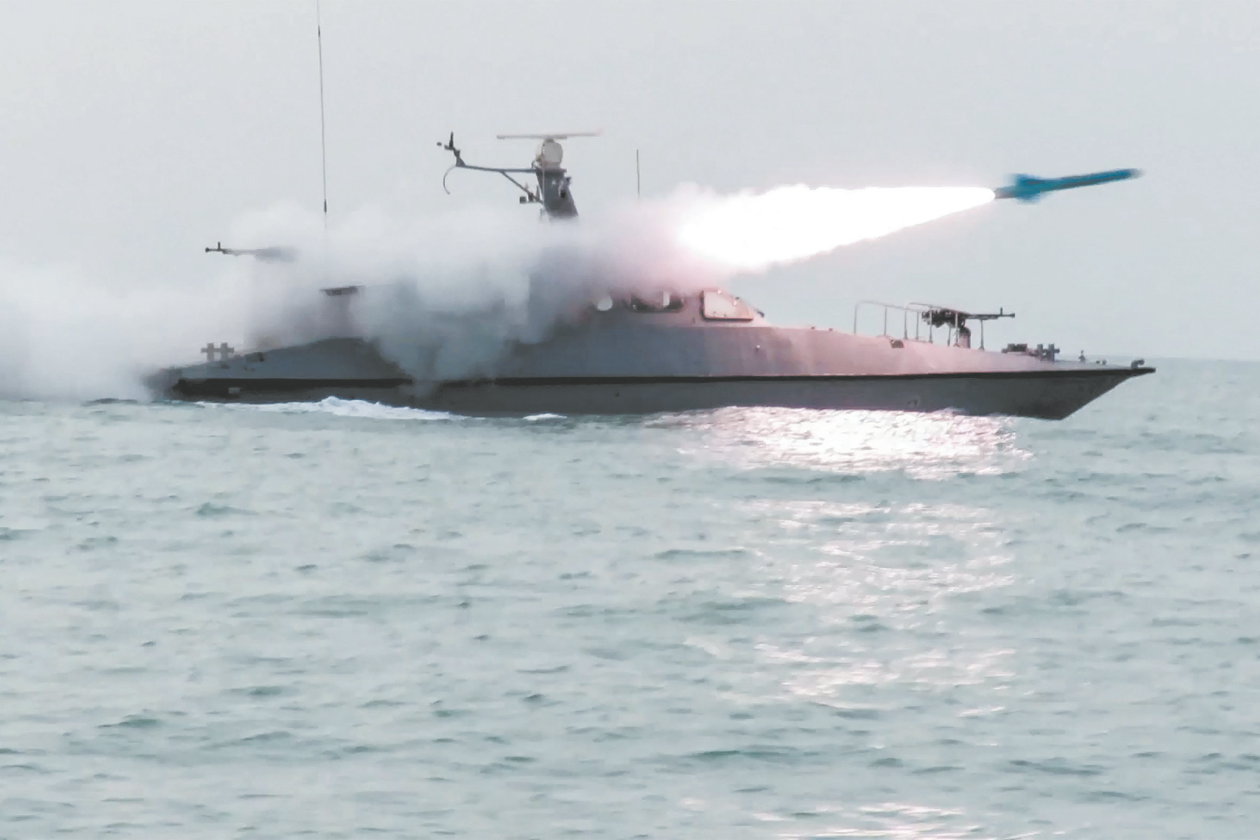
Additionally, another option for Iran to blockade the Strait of Hormuz is to deploy a large number of armed speedboats and missile boats to conduct "wolf pack attacks," which is also a focus of training for the Iranian Islamic Revolutionary Guard Corps in recent years. Currently, the U.S. Navy's "Lincoln" carrier strike group needs to guard against the threat of Iranian coastal anti-ship firepower; however, the carrier is located far from the Strait of Hormuz, limiting its ability to continuously monitor and strike in the strait. The Iranian coastline is dotted with more than a dozen large ports and over 60 small ports, as well as many dispersed fishing villages and towns, providing excellent hiding places for small vessels. This creates opportunities for Iran to use speedboats to ambush passing vessels.
Mines as Iran's weapon of blockade
Currently, the U.S. has a considerable military presence in the Gulf region, but it is still unable to completely suppress Iranian maritime activities, especially since mine-laying operations can be accomplished with small boats, which means that Iran's use of mines to blockade the Strait of Hormuz is highly feasible militarily.
The "Guardian" states that mine sweeping at sea is a complex and dangerous task that ideally should be conducted in a relatively safe, non-conflict environment. Although the risks of modern mine sweeping have been significantly reduced with the application of unmanned mine-sweeping equipment, the main steps have not fundamentally changed: first, using high-performance sonar to search for suspicious targets, then using mine-sweeping tools to approach for location, confirmation, and final detonation. This means that mine-sweeping vessels, which lack sufficient self-defense firepower and are slow-moving, need to approach and enter the Strait of Hormuz to operate, thereby exposing themselves to Iranian coastal anti-ship firepower such as drones and anti-ship missiles.
Theoretically, the U.S. military deployed in the Middle East has certain mine-sweeping and hunting capabilities, but there has been a significant decline compared to the Gulf War period. The U.S. website "Power" previously mentioned that while the U.S. has repeatedly threatened military action against Iran, the U.S. Navy has been decommissioning four "Avenger" class mine countermeasure ships stationed in Bahrain since September 2025 and has transported them back to the U.S. mainland on heavy transport ships this January.
The U.S. Naval Institute website states that the mine countermeasure tasks of the U.S. military stationed in the Middle East are mainly handled by 3 littoral combat ships in the region, of which only the "Canberra" is equipped with a complete mine-sweeping operation module. However, conducting mine-sweeping operations in the Strait of Hormuz requires approaching the Iranian coast, and the littoral combat ships, limited by their 3,000-ton hulls, do not have enough space and weight capacity to install effective air defense and missile defense weapons after installing the mine-sweeping module, resulting in almost zero air defense capability during mine-sweeping missions and a lack of self-defense capability.
On March 1, 2023, U.S. airstrikes destroyed and sank 9 Iranian naval vessels, as President Trump announced. In response, Iran's Islamic Revolutionary Guard Corps declared a blockade of the Strait of Hormuz, leading to around 150 oil tankers being stranded. The situation has raised global oil prices and heightened tensions in the region.
- U.S. President Trump announced the destruction of 9 Iranian naval vessels.
- Iran's Islamic Revolutionary Guard Corps declared a blockade of the Strait of Hormuz.
- Approximately 150 oil tankers are stranded waiting to pass through the Strait of Hormuz.