
The U.S. Navy Launches Its First "Drone Aircraft Carrier," U.S. Media: Too Late
[Global Times Special Correspondent Xie Zhao] According to the U.S. Navy Times report on the 11th, the USS Roosevelt has now become the first U.S. Navy aircraft carrier equipped with an unmanned aerial operations center, enabling the operation of Boeing's MQ-25A unmanned aerial refueling system on the carrier, which is the U.S. Navy's first operational carrier-based drone. However, U.S. media must also admit that the timeline for deploying carrier-based drones on U.S. aircraft carriers is significantly behind the original plan, and the MQ-25A unmanned aerial refueling system will take a few more years to achieve full combat capability. In contrast, several other countries have launched aircraft carriers equipped with carrier-based drones.
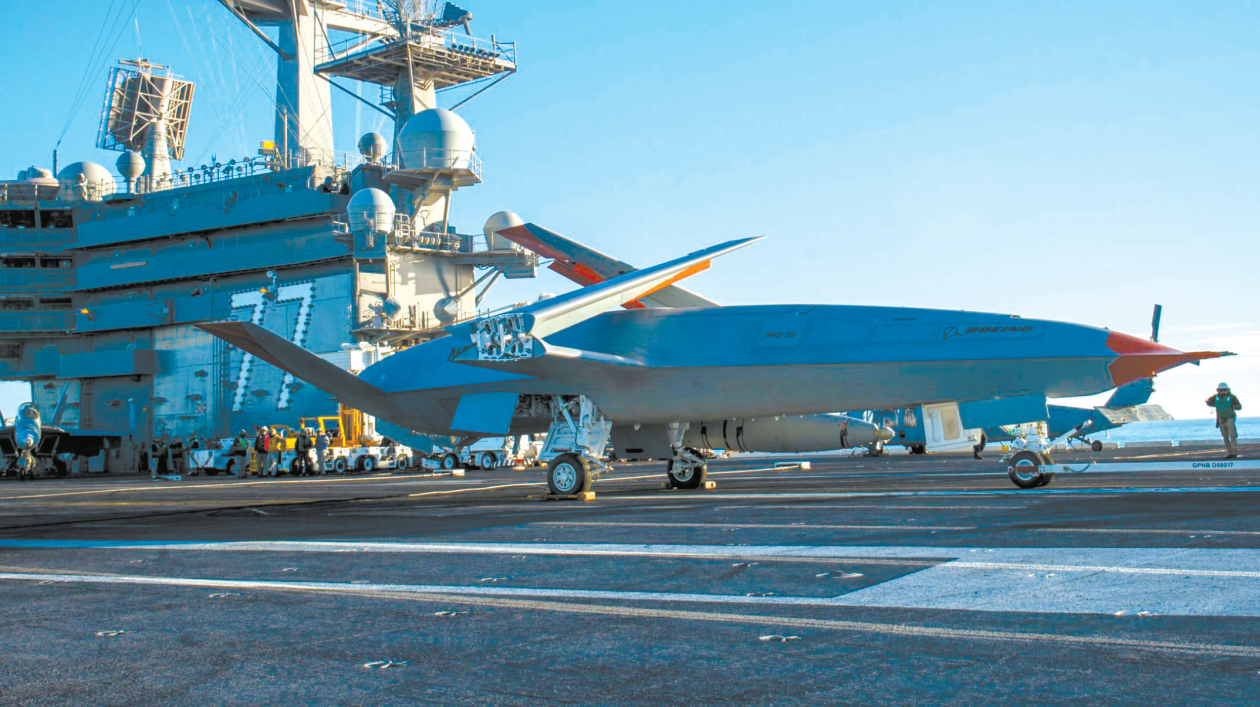
The report states that the Pentagon's recently released "Modernization Optional Procurement Report" shows that the unmanned aerial operations center on the USS Roosevelt makes it "the first U.S. aircraft carrier capable of full operational/deployment capability with the MQ-25A drone," and the similar unmanned aerial operations center on the USS Reagan is expected to achieve full operational/deployment status by the end of August this year. The U.S. Navy states that this center integrates the carrier-based unmanned aerial mission control system and the MD-5E ground control station, which are core systems required for the command and control of the MQ-25A carrier-based drone and are crucial for the operation of this unmanned refueling aircraft. In May of this year, Acting Navy Secretary Gao Xiong announced at a Senate Armed Services Committee hearing that the MQ-25A drone has entered the low-rate initial production and deployment phase. The design of the aircraft aims to free the U.S. F/A-18E/F Super Hornet fighter jets from partner air refueling tasks, allowing them to focus on strike missions, thereby significantly enhancing the operational range and efficiency of U.S. carrier strike groups.
The Navy Times states that although the U.S. Navy proposed the idea of deploying drones on aircraft carriers long ago, the actual progress has been noticeably lagging. In 2006, the U.S. Navy began planning to deploy fixed-wing drones on aircraft carriers. In 2010, the U.S. Navy officially launched the Carrier-Based Unmanned Aerial Surveillance and Strike System (UCLASS) project, envisioning the development of a new generation of carrier-based stealth drones capable of penetrating inland and extending the operational range of carrier strike groups. However, due to technical and budget constraints, the project was later adjusted in 2016 to the Carrier-Based Aerial Refueling System (CBARS). In 2018, the U.S. Navy signed a contract with Boeing for the procurement of four MQ-25A drones under this project framework, including the design, development, manufacturing, testing, and delivery of the drones, with initial operational capability expected by 2024. The U.S. Navy estimates that the entire project will require the procurement of 72 drones, with a total cost of approximately $13 billion.
However, the reality is that the MQ-25A drone only transitioned from the engineering and manufacturing development phase to the production and deployment phase in May of this year, with the expected timeline for achieving initial operational capability now delayed to the fiscal year 2030. Meanwhile, the retrofit progress of U.S. aircraft carriers equipped with the MQ-25A drone has also been less than satisfactory. As early as August 2024, the U.S. Navy installed and tested the first unmanned aerial command operations center on the USS Bush, but the related facilities only recently achieved operational capability on the USS Roosevelt.
The U.S. website "Breaking Defense" states that just as the U.S. Navy's drone ship program has been significantly delayed, other countries around the world are rapidly catching up. Public reports indicate that Turkey's Anadolu, which entered service in 2023, is the world's first aircraft carrier primarily equipped with drones, and the first takeoff and landing of Turkey's domestically produced drones on this carrier is expected to be completed in 2024; the UK's HMS Prince of Wales completed takeoff and landing tests with the Mohawk drone several years ago; China's Fujian aircraft carrier and 076 amphibious assault ship are designed to have the capability to carry fixed-wing drones, and multiple types of stealth drones have been publicly showcased in the 2025 National Day parade.
The U.S. Navy's USS Roosevelt has become the first aircraft carrier equipped with an unmanned aerial operations center, enabling operations of the MQ-25A drone. However, the initial operational capability of the MQ-25A has been delayed until FY 2030, while other nations are rapidly advancing their drone carrier capabilities. The U.S. plans to procure 72 MQ-25A drones at a total cost of approximately $13 billion.
- USS Roosevelt is the first U.S. aircraft carrier equipped with an unmanned aerial operations center.
- The MQ-25A drone is the first operational carrier-based drone for the U.S. Navy.
- The initial operational capability of the MQ-25A has been delayed to FY 2030.
- The U.S. Navy plans to procure 72 MQ-25A drones at an estimated cost of $13 billion.
- Other countries are advancing their drone carrier capabilities faster than the U.S.