

In 2022, the US Navy sold the retired aircraft carriers USS Kitty Hawk and USS John F. Kennedy for just one cent apiece.
At first glance, the sale seems unbelievable—these ships cost billions and billions of dollars. But the penny price wasn’t just symbolic—it reflected how remarkably expensive the cost and liability of dismantling a supercarrier actually is.
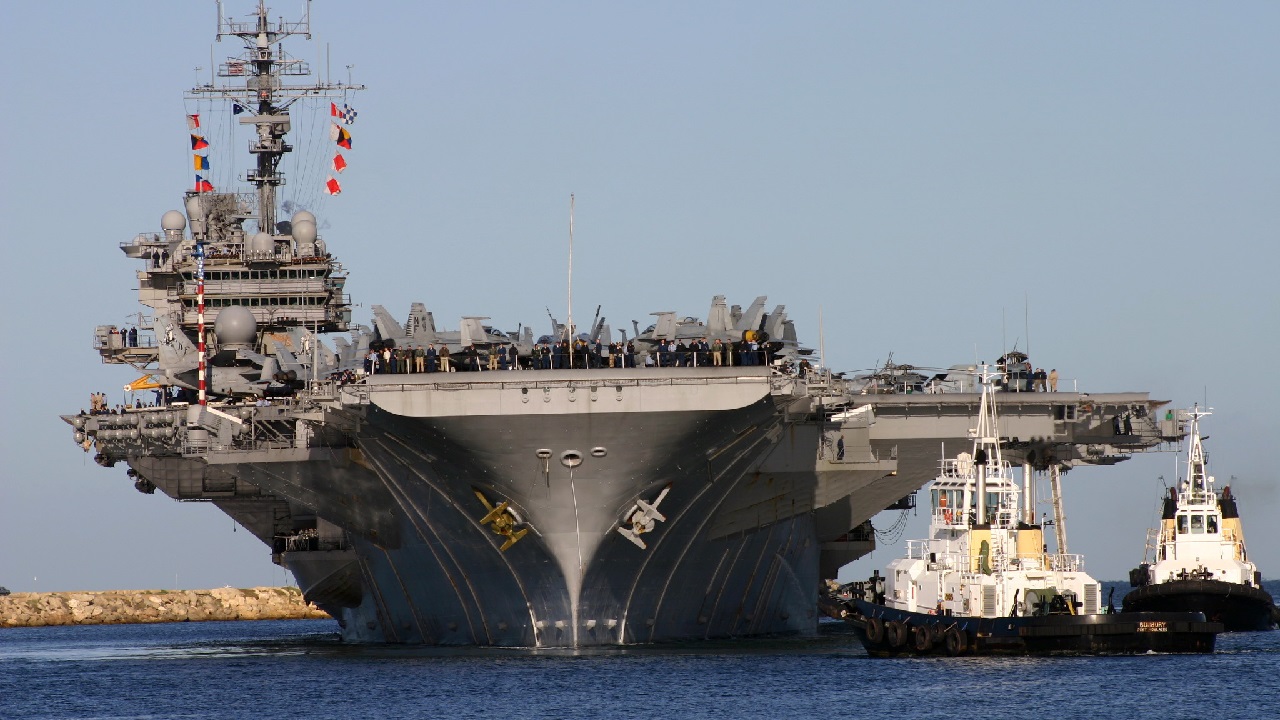
Fremantle Harbour, Australia (Apr. 22, 2004) – Tug boats escort USS Kitty Hawk (CV 63) and embarked Carrier Air Wing Five (CVW-5) into Fremantle Harbour, Australia where the crew will enjoy a five day port call. This was Kitty Hawk’s fifth visit to Fremantle and the ninth for CVW-5. Kitty Hawk is one two remaining conventionally powered aircraft carriers in the U.S. Navy, and is currently homeported in Yokosuka, Japan.
After being sold, the ships were towed to Brownsville, Texas, the unofficial carrier graveyard, where they were dismantled methodically for scrap.
Not Really a Bargain
The one-cent sale sounds like a bargain. It’s not.
The buyers didn’t acquire valuable operational ships—they assumed massive responsibility for dismantling them.
Scrapping an aircraft carrier is an enormous industrial undertaking, with costs that include hazardous material removal, asbestos remediation, PCB disposal, fuel and fluid cleanup, and environmental compliance.
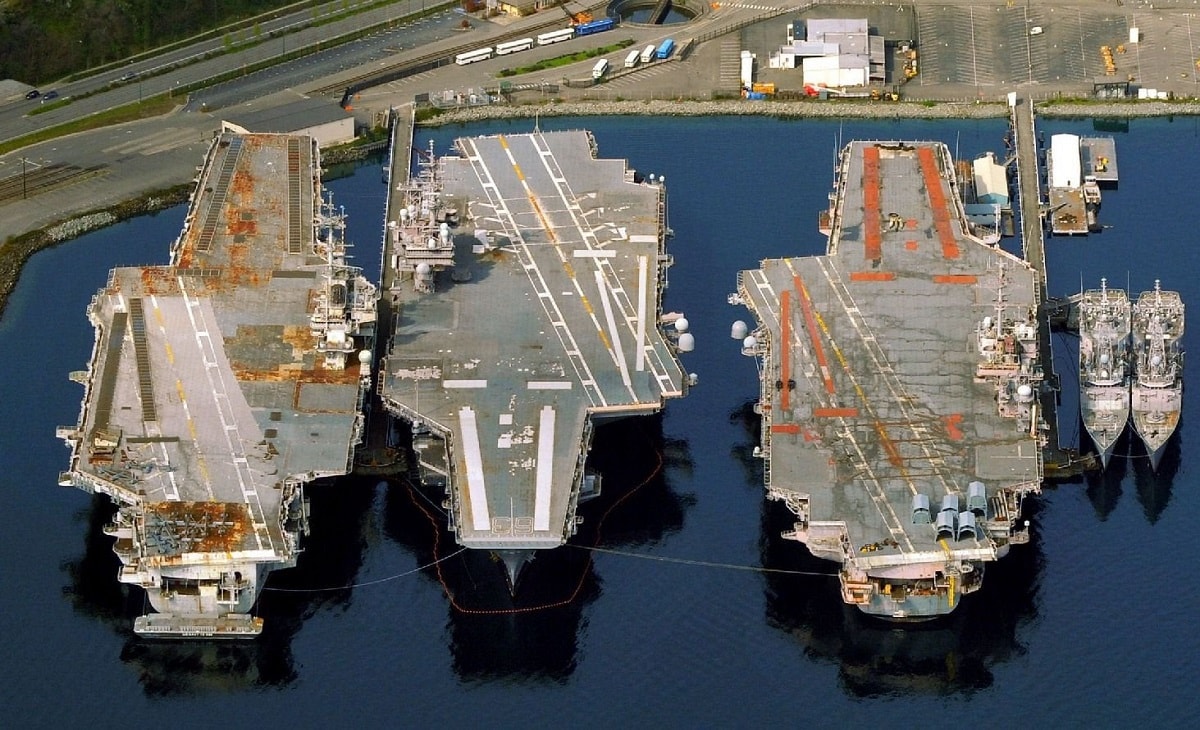
Image of several old carriers headed to the scrap yard. Creative Commons Image.
The scrap steel has value, but so do the costs of safely taking the ship apart. And the Navy’s objective is responsible disposal, not maximizing the sale price.
The One Cent Carriers
The USS Kitty Hawk was commissioned in 1961 as the last conventionally powered US Navy supercarrier.
It served in Vietnam, the Cold War, and over various operations in the Middle East before being decommissioned in 2009.
After efforts to convert the ship into a museum piece failed, she was sold for scrap.
The USS John F. Kennedy, nicknamed Big John, was used to support Cold War deployments and post-9/11 operations. Preservation advocates attempted to save this ship, too, but failed before the vessel was sold for one cent alongside the Kitty Hawk.
Why Brownsville?
Brownsville has become America’s unofficial carrier scrapyard. Why? The Port of Brownsville is America’s leading commercial ship recycling center.
Deep-water access accommodates enormous vessels, and specialized workforces experienced in dismantling naval ships are readily available.
The facility is capable of handling projects this large, in part because of strict environmental oversight, which facilitates compliance with the sprawling environmental regulations governing supercarrier dismantlement.
Brownsville is well equipped to recover and recycle steel, copper, aluminum, and other materials from the retired carriers.
Why Not Museums?
You’d think these carriers would be preserved and respected, put on public display for general audiences to enjoy. But aircraft carriers aren’t as easy to display as battleships or destroyers; they’re massive and complex, even by the standards of a 21st-century warship.
The maintenance burden associated with carriers is enormous; the vessels are nearly 1,100 feet long, with thousands of compartments and aging infrastructure.
Preservation requires waterfront, millions of dollars in annual upkeep, and a strong tourism market to support ongoing revenue.
That’s why only a handful of carriers have successfully threaded the needle to become museums, including the USS Midway, USS Intrepid, USS Lexington, and USS Yorktown. Most retired carriers simply cannot attract the funding needed to survive.
What About Nuclear Carriers?
Nuclear carriers are an entirely different story.
The Kitty Hawk and Kennedy, both conventionally powered, were therefore relatively easy to handle in that they could be legally sold for commercial scrapping.
Nuclear-powered carriers, on the other hand, cannot be sold for commercial scrapping. Their reactors must be defueled and dismantled under Navy supervision.
The USS Enterprise (CVN-65) has recently demonstrated how much more expensive and technically difficult nuclear disposal can be, especially relative to the Kitty Hawk or Kennedy, which are essentially sold and scrapped.
End of a Generation
The one-cent sales illustrate how military value and economic value are often different things. Ships that spent a generation projecting American power across the world eventually descended into industrial liabilities without military application.
Once a carrier’s service run ends, the vessel has only a limited purpose. And the Navy, of course, has already moved on, investing heavily in the Gerald R. Ford-class to keep pace with evolving global demands.
In one respect, the one-cent carrier transactions symbolize more than just thrift—they mark the end of the conventionally powered supercarrier era and the transition into the 21st century of naval warfare.
About the Author: Harrison Kass
Harrison Kass is a writer and attorney focused on national security, technology, and political culture. His work has appeared in Tablet, City Journal, The Hill, The Spectator, and The Cipher Brief. He holds a JD from the University of Oregon and a master’s in Global & Joint Program Studies from NYU. More at harrisonkass.com.