

The 60,000-Ton Supercarrier Too Wide for the Panama Canal: Inside the Midway-Class
The Midway-class were among the first carriers laid down during World War II, but construction was not finished before the end of the war. The class incorporated design elements from earlier U.S. ships, as well as those of allies, and these improvements aided their battle efficiency and armored protection.
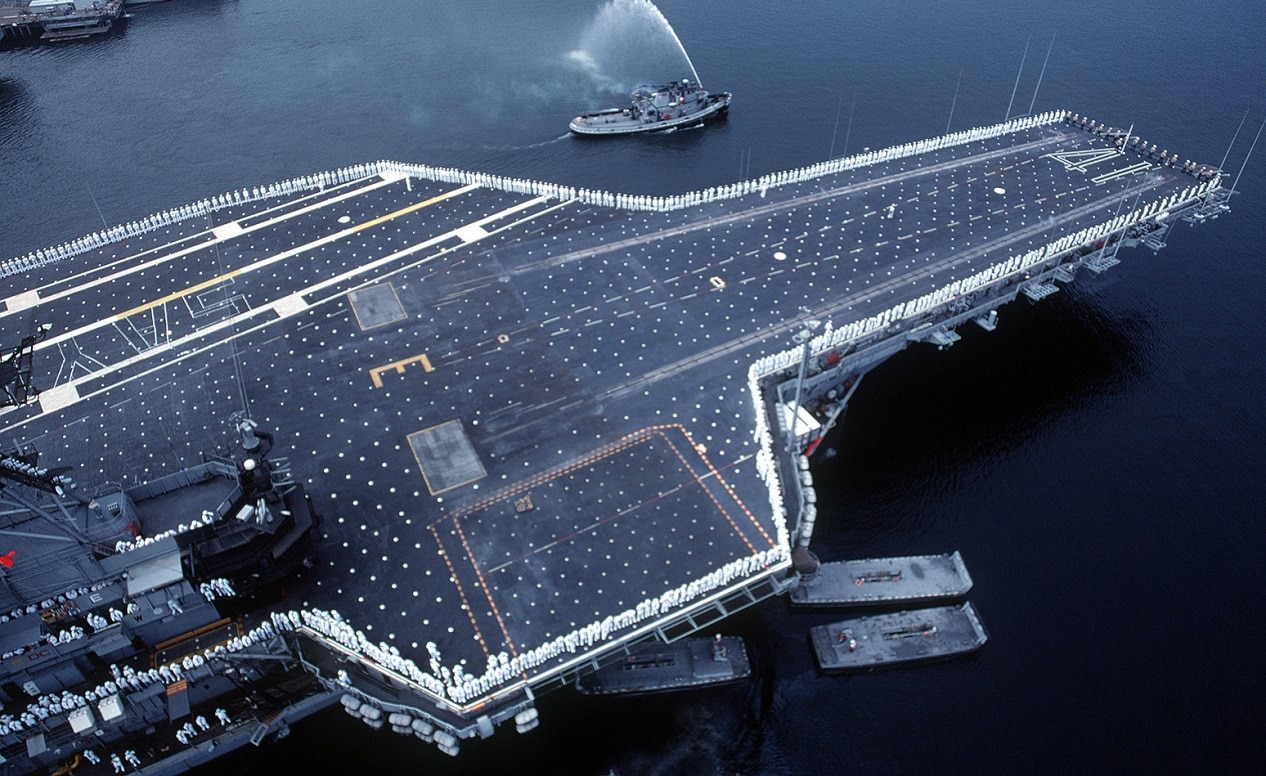
The aircraft carrier USS MIDWAY (CV-41) moves away from the pier as it departs from Yokosuka for the last time. The MIDWAY, which has been based in Japan since 1973, will be replaced by the aircraft carrier USS INDEPENDENCE (CV-62) as the Navy’s forward-based aircraft carrier.
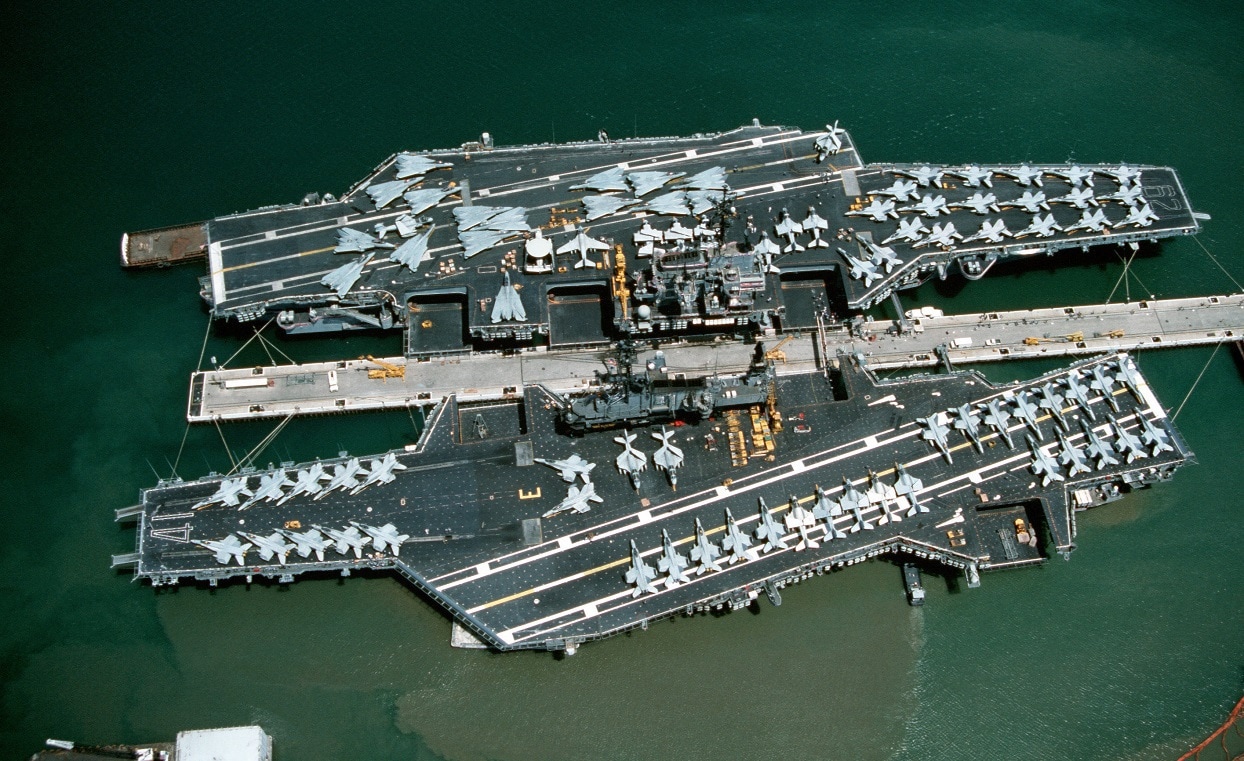
An aerial view of various aircraft lining the flight decks of the aircraft carrier USS INDEPENDENCE (CV-62), right, and USS MIDWAY (CV-41) moored beside each other in the background. The MIDWAY is en route from Naval Station, Yokosuka, Japan, to Naval Air Station, North Island, California, where it will be decommissioned in the spring of 1992. The INDEPENDENCE will travel to Yokosuka to take over as the Navy’s forward-based aircraft carrier.
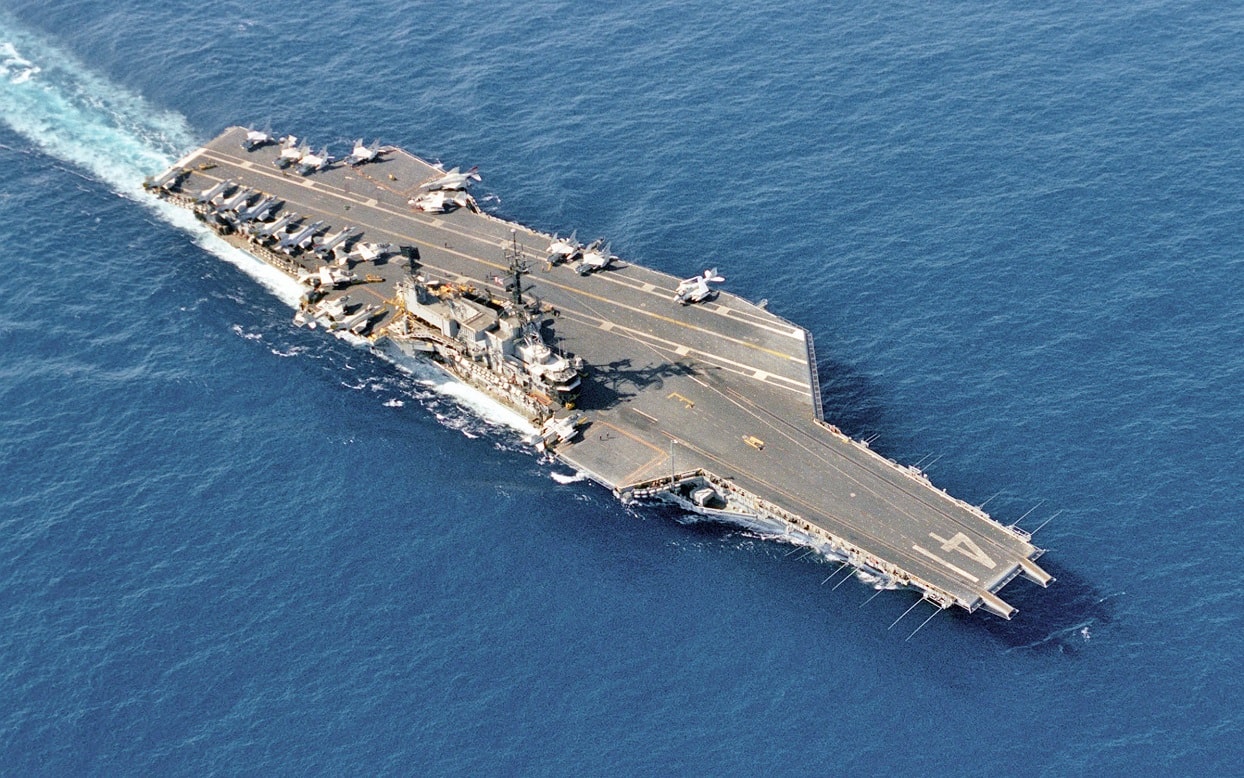
An elevated starboard bow view of the aircraft carrier USS MIDWAY (CV 41) underway off the coast of Okinawa, Japan.
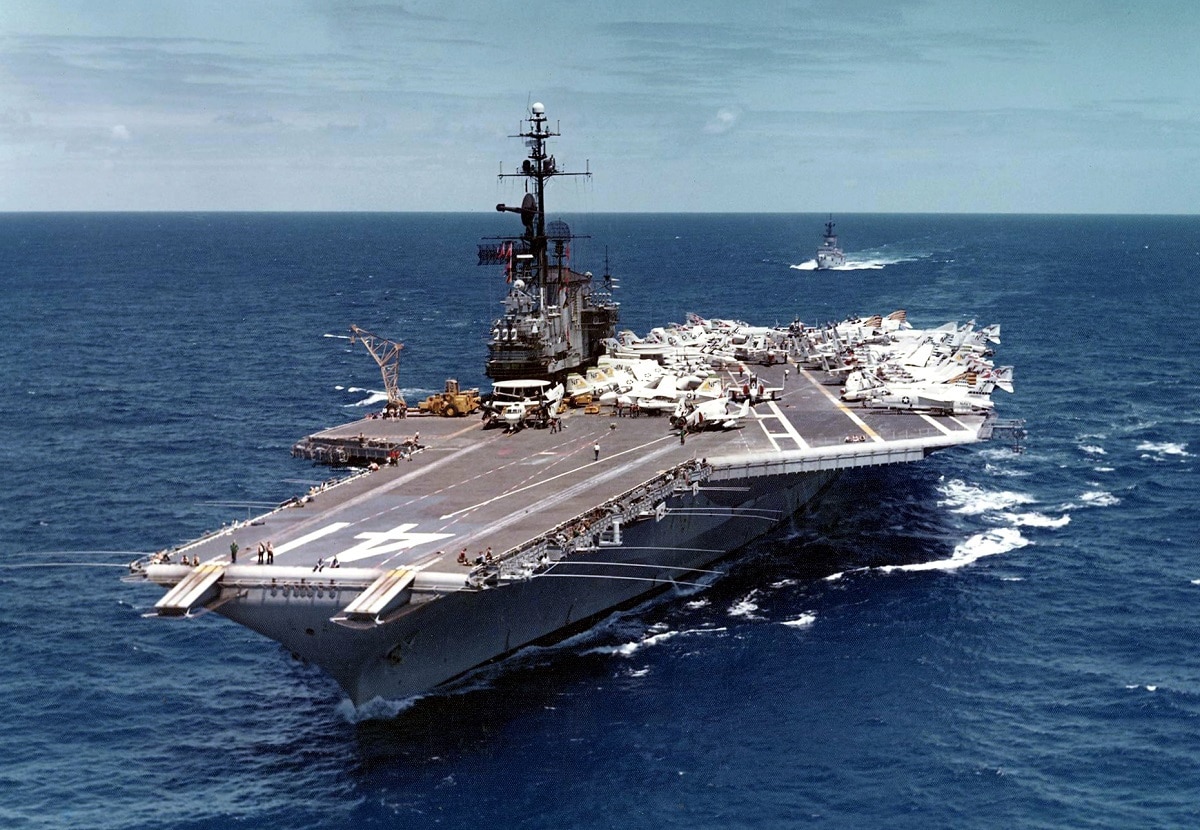
Midway-Class Aircraft Carriers. Image: Creative Commons.
The Midways were a kind of bridge class of warship—superior to the older aircraft carriers designed before the war, but much smaller than Cold War-era aircraft carriers.
The Navy wanted to build a carrier similar in size to the Essex-class, but with better armored protection—particularly of the flight deck—and expanded defenses against enemy aircraft. The class’s survivability was thus better than predecessors’, and their larger size allowed the carriers to ship a large air wing of up to 120 airplanes.
Extensive Institutional Knowledge
The Midway carriers incorporated a number of British design elements. “The damage experiences of several British carriers,” one war damage report explained, “which unlike US Carriers were fitted with armored flight decks, demonstrated the effectiveness of such armor in shielding hangar spaces from GP bombs and vital spaces below the hangar deck from semi-armor-piercing (SAP) bombs.”
The carrier’s weight was one of the first design elements demanding a compromise. In order to keep weight manageable, the carriers had to eliminate much of their defensive weaponry, including the 8-inch guns they originally were to carry.
Extensive armored plating aided survivability—in some instances, the armor included three or four inches of steel. Cognizant that carriers would likely take hits regardless of how well protected they were, a heavy emphasis was placed on compartmentalization and the separation of weapons, crew, fuel, and materials.
The First of Many Supecarriers for the Navy
The class enjoyed many firsts.
As one publication explained, “from the beginning of its service, the Midway played key roles in the Cold War. In 1946, it became the first American carrier to operate in the midwinter sub-Arctic, developing new flight deck procedures. The following year, Midway became the only ship to launch a captured German V-2 rocket. The trial’s success became the dawn of naval missile warfare. Just two years after that, Midway sent a large patrol plane aloft to demonstrate that a carrier could deliver atomic bombs.”
At the time of their construction, the ships were among the largest carriers afloat. Displacement reached 60,000 tons under full load. They would be dwarfed by the Navy’s later supercarriers, but thanks to the Midway’s 113-foot beam, or width, they were unable to transit the Panama Canal’s 110-foot locks.
The Midway-class was a rather small class compared to the 10-ship Nimitz-class and today’s Gerald R. Ford-class of new nuclear supercarriers, of which 10 also are planned. Only three Midway-class carriers were built for the Navy: the USS Midway (CV-41), USS Coral Sea (CV-43), and USS Franklin D. Roosevelt (CV-42).
They were built in record time, being completed in 1947. And though they never fought in World War II, they did serve in the Navy until the end of the Cold War.
Modernizations
Extensive modernizations kept the class relevant, particularly as carrier aviation transitioned from piston-powered aircraft into the jet age. That transition was aided in part by their comparatively large size and extensive deck reinforcements to withstand the taxing operations of jet aircraft. Other modernizations included a redesigned bow and altered flight decks.
“All three Midway-class ships subsequently carried out operations against Vietcong and North Vietnamese targets,” the U.S. Naval Institute wrote in 2007. “From 1965 to 1975, the Midway made nine deployments to the war zone, the Coral Sea eight, and the Roosevelt—still an Atlantic Fleet carrier—one.
The Midway and Coral Sea also had important roles in the evacuation of military personnel and civilians from Saigon when South Vietnam fell in April 1975.
“On 11 September 1973, in a historic move, the Midway became the first U.S. aircraft carrier based overseas when Yokosuka, Japan, became her home port. From there, with air wing CVW-5 embarked, she operated in the Western Pacific and Indian Ocean areas for 18 years.
On 2 November 1990, she arrived in the North Arabian Sea to provide air support for Operation Desert Shield. And, with five other U.S. carriers, the Midway flew missions in support of Desert Storm in 1991. Keeping pace with the larger carriers, her aircraft flew 3,339 combat sorties—an average of 121 per day—during the conflict.”
But that would mark the beginning of the end of the Midway-class.
The Midway-class was not retired in its entirety until 1992, when the Midway was taken out of service. Their story is remarkable, as was the length of their service in the U.S. Navy.
About the Author: Caleb Larson
Caleb Larson is an American multiformat journalist based in Berlin, Germany. His work covers the intersection of conflict and society, focusing on American foreign policy and European security. He has reported from Germany, Russia, and the United States. Most recently, he covered the war in Ukraine, reporting extensively on the war’s shifting battle lines from Donbas and writing on the war’s civilian and humanitarian toll. Previously, he worked as a Defense Reporter for POLITICO Europe. You can follow his latest work on X.