
The US PrSM Network Cannot Fire for Long in 2026
 Marcus Chen
The US PrSM Network Cannot Fire for Long in 2026
The Pentagon's new Pacific defense concept has a simple battlefield promise: put long-range missiles inside the First Island Chain, make Chinese ships and aircraft pay for every movement, and complicate any attack on Taiwan. The harder question is how many times those launchers can fire. A US Naval Institute report published on October 2 says the Pentagon is doubling down on a forward area-denial network and the high-end munitions needed to sustain it. That is the right diagnosis. The weakness is not the concept. It is the magazine.
The Network the Pentagon Wants
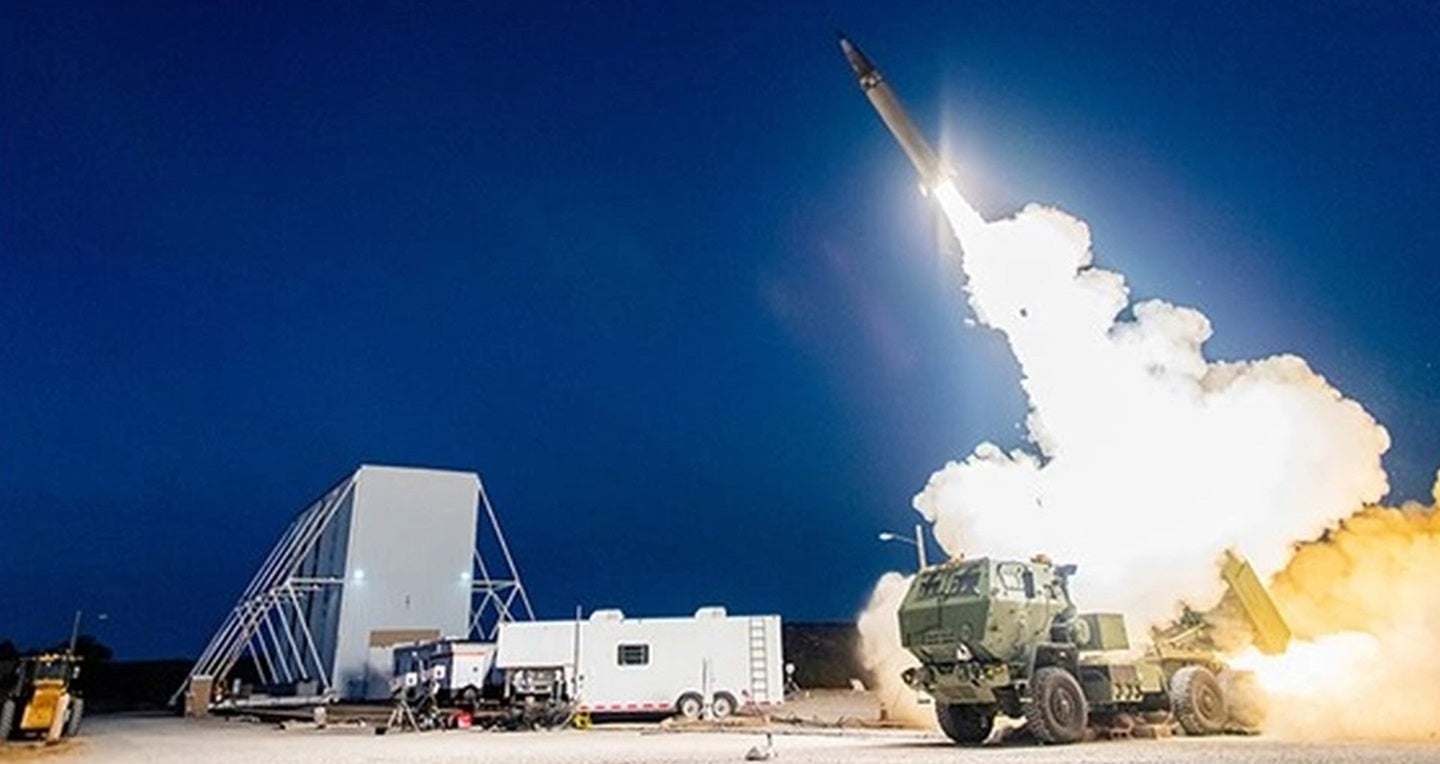
The centerpiece is the Precision Strike Missile, or PrSM, a road-mobile Army weapon designed for the High Mobility Artillery Rocket System and the Multiple Launch Rocket System family. Its published range is greater than 400 kilometers, and later increments are intended to add seekers and an anti-ship role. In the Pacific, that gives a relatively small launcher a way to threaten ports, airfields, missile batteries, and surface vessels without requiring a carrier or a fixed air base.
PrSM is not operating alone. The Army's Mid-Range Capability, built around the Typhon launcher, can employ the SM-6 and Tomahawk at much longer ranges. The Marine Corps' Navy-Marine Expeditionary Ship Interdiction System adds a lighter, more mobile option for coastal defense. Together, these systems are supposed to create overlapping fires from Japan, the Philippines, Guam, and other positions that can be dispersed before Chinese surveillance finds them.
On a map, this looks like a denial belt. In an operations room, it is a resupply problem spread across islands, roads, and politically sensitive host nations.
Range Is Not the Same as Combat Power
A PrSM battery's advertised range says almost nothing about its endurance. The useful calculation is launcher count multiplied by ready rounds, then reduced by the number of targets, decoys, and re-attacks required in the opening phase. A battery that fires four missiles at one radar site has not necessarily achieved a kill; it may have only forced a relocation. A ship engagement could demand a salvo, and a contested target may need a second salvo after battle-damage assessment.
The US Army is buying the missile in a program that is still moving from testing toward volume production. That transition matters because a Pacific war would consume expensive precision rounds faster than peacetime procurement assumptions. The Congressional Research Service has repeatedly identified long-range fires, industrial capacity, and Indo-Pacific logistics as linked problems. Buying launchers without building a deep stock of missiles creates a force that can demonstrate access denial for a week and then becomes an intelligence target.
There is a second constraint: the kill chain. PrSM must receive a target good enough to justify a shot, and that data must survive Chinese jamming, deception, cyber attack, and attacks on the sensors that provide it. A missile can have a 400-kilometer reach and still be useless if the firing unit cannot distinguish a real destroyer from a decoy or update its aim point after the target moves. The weapon is only one part of the system.
China Has the Same Geography and More Depth
China's advantage is not that every PLA missile will work perfectly. It is that the People's Liberation Army Rocket Force can draw on a much larger domestic industrial base and fire from the mainland, where its launchers are protected by geography, air defenses, and a dense transport network. The US network must operate near the threat it is trying to deter. Chinese reconnaissance aircraft, satellites, electronic warfare units, and maritime law-enforcement vessels can search for signatures before a crisis becomes a shooting war.
That creates an unfriendly exchange rate. A US launcher may cost less than a warship, but its survival depends on camouflage, movement, emissions control, local security, and replacement missiles. Every relocation consumes time and fuel. Every launch reveals a position. Every missed or intercepted salvo reduces the political credibility of the network.
CSIS assessments of the Taiwan scenario have emphasized the value of dispersed fires and the difficulty of sustaining operations under missile attack. The conclusion should be narrower and more practical: distributed launchers are valuable only when the United States can distribute reloads, repair teams, targeting data, and air defense with them.
The Political Math Is Just as Hard
The geography forces Washington to negotiate access. Japan is central to any First Island Chain plan, but bases there are vulnerable and host-nation politics matter. The Philippines offers useful positions, yet Manila will decide how much of its territory can be used in a crisis. Guam is secure relative to forward islands, but its distance makes it a staging and logistics hub rather than a substitute for local fires.
This is why the Pentagon's new emphasis on area denial is important but incomplete. The United States does not need a missile force that merely exists at the moment of deterrence. It needs one that can keep firing after the first wave of Chinese strikes, replenish from ships and airfields under attack, and preserve enough rounds for the second week of a campaign.
What Washington Should Measure
- Days of fire: the number of realistic salvoes each forward unit can deliver before resupply.
- Reload time: not the depot delivery date, but the time from an empty launcher to a concealed, ready-to-fire position.
- Kill-chain resilience: whether targeting continues when satellites, networks, and airborne sensors are degraded.
- Host-nation endurance: how long access remains politically and physically available after Chinese strikes.
The October 2 USNI reporting is therefore more significant than another announcement about a new missile belt. It shows that Pentagon planners understand the central problem is shifting from range to sustained fire. That is progress. But the United States still tends to count launchers because launchers are visible, contractable, and easy to brief to Congress. War is decided by reloads, targeting, fuel, maintenance, and the ability to keep crews alive.
The PrSM network could make a Chinese operation more dangerous and less predictable. It cannot, by itself, hold the First Island Chain. Unless Washington funds the magazine, the logistics, and the industrial surge at the same speed as the launchers, its Pacific area-denial plan will have a short firing window. That is not deterrence by denial. It is a timed demonstration.
Sources
- USNI News, Pentagon Doubles Down on Pacific Area Denial, Need for High-end Munitions, October 2, 2026.
- Congressional Research Service, The US Army's Long-Range Precision Fires Program.
- CSIS analysis of distributed fires and the Taiwan contingency.
- US Army background on Precision Strike Missile fielding.
The U.S. is developing a forward area-denial network in the Pacific, focusing on the Precision Strike Missile (PrSM) to deter Chinese military actions. However, logistical challenges may limit the effectiveness of these systems, as the U.S. must ensure sustained fire capability after initial engagements. The report emphasizes the importance of resupply and operational endurance in a potential conflict scenario.
- The U.S. is focusing on a forward area-denial network in the Pacific.
- The Precision Strike Missile (PrSM) has a range of over 400 kilometers.
- Logistical challenges could limit the effectiveness of U.S. missile systems.
- China has a larger industrial base for missile production.
- The U.S. needs to ensure sustained fire capability beyond initial strikes.