
The Weapon Industry Group's Fuxi Humanoid Robot Debuts at the World Robot Conference, State-owned Enterprise Robot Innovation Consortium Bets on Sentinel Reconnaissance
 Li Minghui
NORINCO's Fuxi Humanoid Robot Debuts at the World Robot Conference, State-Owned Enterprise Robot Innovation Consortium Bets on Sentinel Reconnaissance
At the 2026 World Robot Conference, which opened on August 19, NORINCO publicly unveiled the "Fuxi" special-purpose humanoid robot for the first time in the central enterprise exhibition area it leads. According to official statements, this full-sized humanoid robot weighs approximately 90 kilograms and is capable of all-weather reconnaissance, intelligent patrolling, and performing alternative operations in hazardous areas. Operators can remotely replicate its movements in real-time—this remote operation system, referred to as "external avatar," is described as China's first independent and controllable remote operation solution for a full-sized humanoid robot.
Technical Features of Fuxi
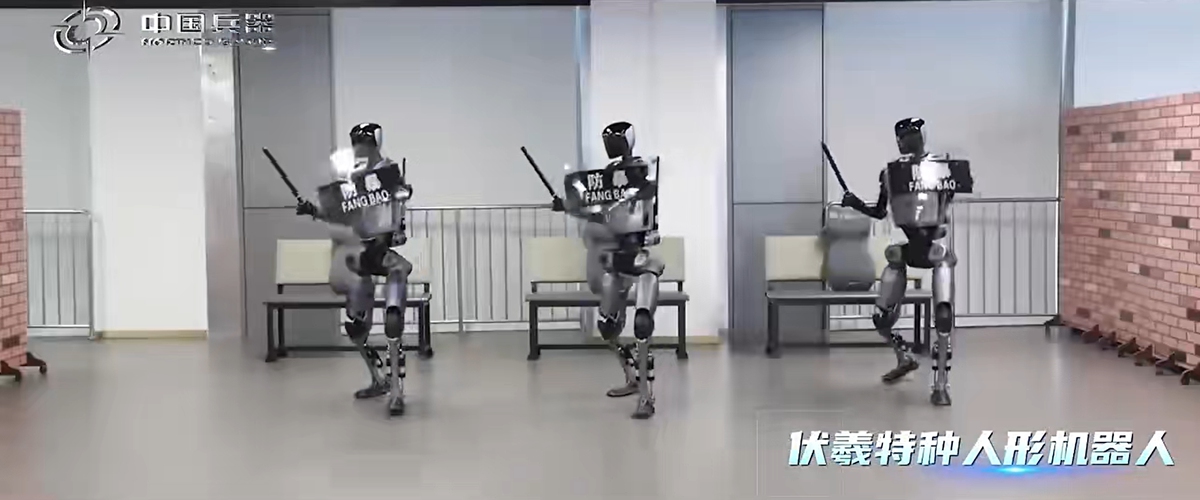
From publicly available information, Fuxi's key technologies focus on three areas: human motion perception and cross-platform motion transfer, full-body coordinated control, and real-time motion remapping for remote operation. Its mission is clearly defined—personnel identification and anomaly alert during sentinel duty, all-weather reconnaissance, intelligent patrolling, and alternative operations in high-risk environments. Multiple Fuxi units can operate in formation, with nighttime urban patrol being an officially highlighted demonstration task.
In simple terms, this is not a general-purpose humanoid robot, but rather a sentry and reconnaissance platform with legs. Notably, NORINCO deliberately emphasizes the "remote manual control + on-site robotic operation" human-machine collaboration model, rather than full autonomy. This choice itself indicates that, at the decision-making level, the military-industrial system currently does not trust the autonomy of humanoid robots and prefers to keep human judgment in the loop.
What Really Deserves Attention Is Not the Robot, but the Consortium
Compared to Fuxi itself, the "Central Enterprise Robot Innovation Consortium" announced on the opening day is more worthy of consideration. This consortium, led by NORINCO, features 18 subordinate units exhibiting 68 products, covering humanoid robots, exoskeletons, augmented reality glasses, and even including what is claimed to be the first mobile edge cloud product in the defense industry to pass trusted cloud certification—the latter clearly points to a collaborative computing base for large-scale unmanned swarms.
When looking at these items together, NORINCO's intention is not to sell one or two humanoid robots, but to integrate individual soldier equipment, unmanned swarms, and edge computing into a cohesive system. Augmented reality glasses are used for human-machine collaboration, exoskeletons for load-bearing, and edge cloud for swarm scheduling, with the humanoid robot being the most prominent component of this system. In supply chain terms, this positions them as the "final assembly plant" in the race for robots.
The Military Value of Humanoid Robots Is Not So Easy to Calculate
I have always held a reserved attitude towards the military value of humanoid robots. The energy efficiency of bipedal walking is far lower than that of wheeled or quadrupedal platforms, and the 90-kilogram weight of the entire machine is a burden for transport and battlefield maintenance. The reliability of joint motors and batteries in field conditions is also questionable. Compared to humanoid robots that have been mass-produced by civilian manufacturers like UBTECH and Unitree, NORINCO's Fuxi has no advantages in terms of production capacity and cost.
A detail that is easily overlooked is the repeated mention of "sentry," "patrol," and "alternative operations in hazardous areas" in the official introduction—these are all low-speed, structured scenarios. When it comes to high-speed maneuvers or complex terrains, a humanoid robot may not be more useful than a quadrupedal robot or a small tracked platform.
My judgment is that Fuxi's debut is more about showcasing technology than being driven by combat needs. Its significance lies in declaring that the Chinese military-industrial system has officially entered the humanoid robot arena, and it is doing so in an organized manner through a state-owned enterprise consortium, positioning robots as part of the next-generation individual soldier equipment system. This is more important than any specific parameters of a robot.
The real unanswered question is: can this "remote manual control" model maintain that communication link in a strong electromagnetic countermeasure environment? If the link is severed, will the 90-kilogram Fuxi continue to execute its mission, or will it become an expensive piece of scrap metal? This question has no answer visible at the exhibition booth.
NORINCO unveiled the 'Fuxi' humanoid robot designed for reconnaissance and patrol at the World Robot Conference on August 19, 2026. The robot weighs approximately 90 kg and features a remote operation system for real-time control. This initiative is part of a larger collaboration among state-owned enterprises to develop advanced robotics for military applications.
- NORINCO unveiled the 'Fuxi' humanoid robot at the World Robot Conference.
- The robot weighs approximately 90 kg and is designed for reconnaissance and patrol.
- The robot features a remote operation system called 'external avatar'.
- The focus is on human-robot collaboration rather than full autonomy.
- The unveiling is part of a broader initiative involving multiple companies in the robotics sector.