

Summary and Key Points: The Northrop YF-23 is to the F-22 Raptor what Boeing’s X-32 is to the F-35: the jet that lost. The Advanced Tactical Fighter program began in 1981 to replace the F-15, narrowed to Lockheed’s YF-22 and Northrop’s YF-23 in 1986, and the Black Widow II first flew on August 27, 1990, named for the P-61 night fighter and a red hourglass painted on its air scoop.
The YF-23 Legend Won’t Go Away: We Have the Photos
The Northrop YF-23—unofficially nicknamed the “Black Widow II”—is to the Lockheed Martin F-22 Raptor what the Boeing X-32 was to the F-35 Lightning II: the 5th-generation a losing entrant in the race to become one of America’s representatives in the 5th-generation stealth fighter race.
Whilst the X-32 lost out to the F-35 in the Joint Strike Fighter (JSF) contract competition, the “Black Widow II” lost out to the then-YF-22 in the Advanced Tactical Fighter (ATF; not to be confused with that other ATF) bid to become the first true stealth fighter; yes, the older F-117 Nighthawk was called the “Stealth Fighter,” but that was a misnomer, as it only dropped bombs in reality.
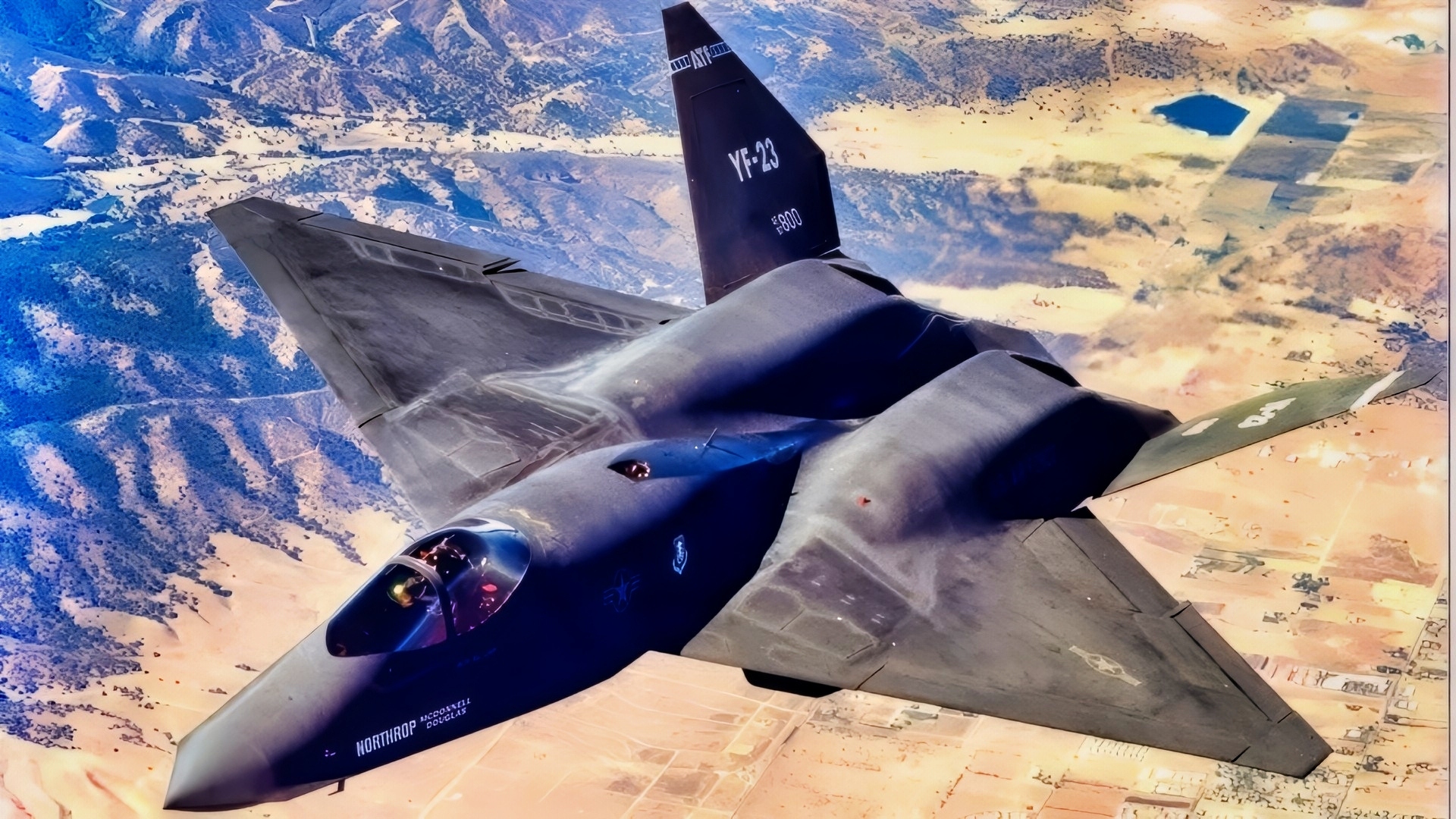
YF-23 Fighter Creative Commons Photo
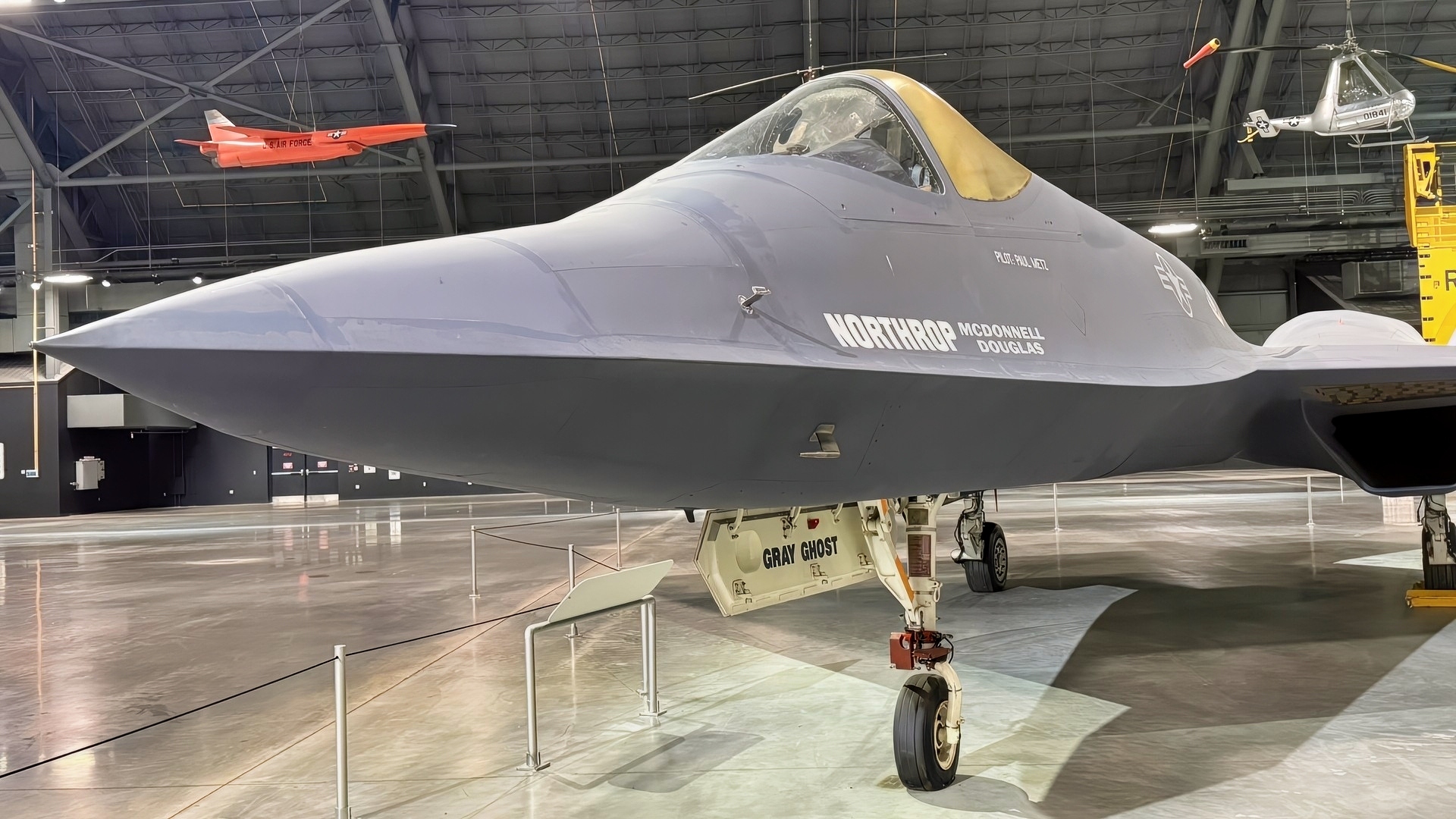
YF-23 Gray Ghost Stealth Fighter 19FortyFive Image
Both the YF-23 and the X-32 make for great “What if?” and “What might have been stories.
In the case of the YF-23 in particular, many pundits and experts still think it was actually the superior warbird and therefore should’ve been the winner of the government contract.
So, why do these opinions still linger after three decades?
Bottom Line Up Front (BLUF): Black Widow II Advantages Over the Raptor
According to several subject matter experts (SMEs), the YF-23 was actually the better performer than what was known at the time as the YF-22 in multiple respects:
-Superior supersonic cruise performance
-Superior stealth
-Superior raw performance from its then-state-of-the-art General Electric (G.E.) variable-cycle YF120 engine
The YF-23 also had only slightly less maneuverability than the YF-22 at extremely low airspeeds.
So, what went wrong with the YF-23?
If you could oversimplify it to three words, they’d be “Madison Avenue Marketing.” Or, as Stavros Atlamazoglou put it, “But Lockheed Martin did a much better job marketing the aircraft, highlighting its high-g capabilities and maneuverability.”
And for the sake of being fair & balanced, the Lockheed warbird did indeed have the advantages over its Northrop competitor in terms of better agility and thrust vectoring.
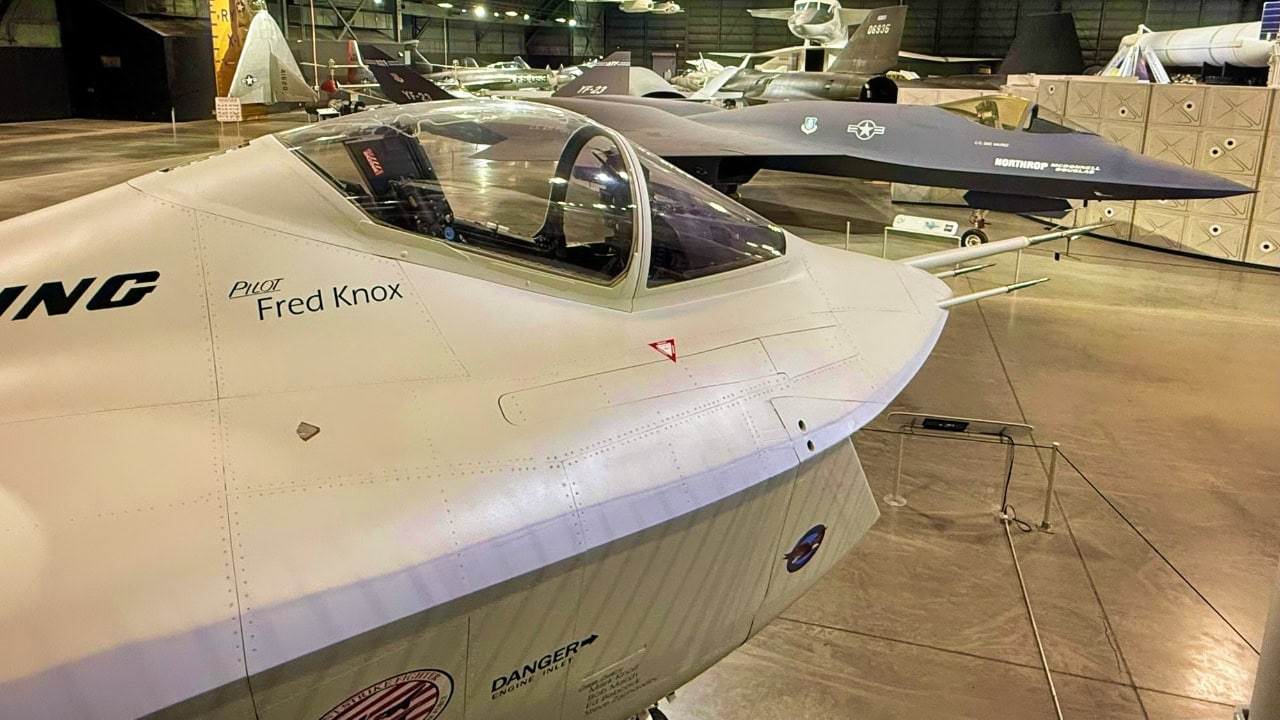
X-32 and YF-23 Together at U.S. Air Force Museum. 19FortyFive.com Image.
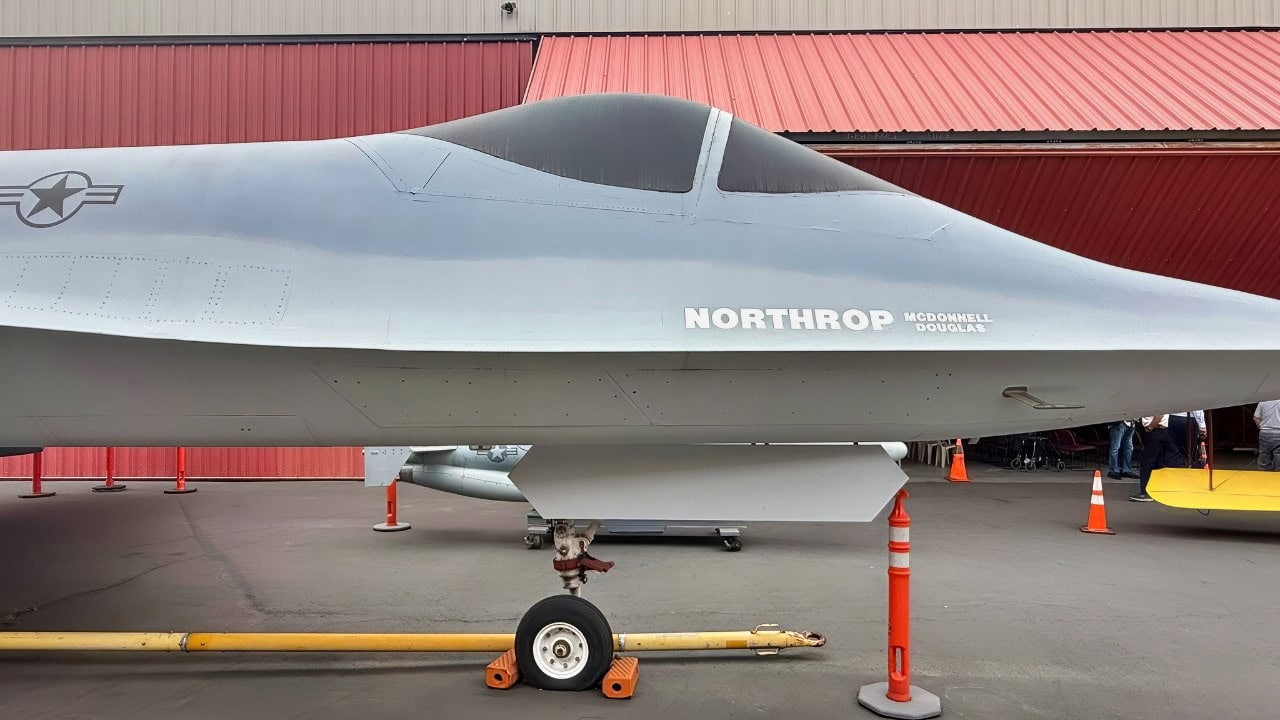
YF-23A Black Widow II 19FortyFive Image Taken by Harry J. Kazianis.
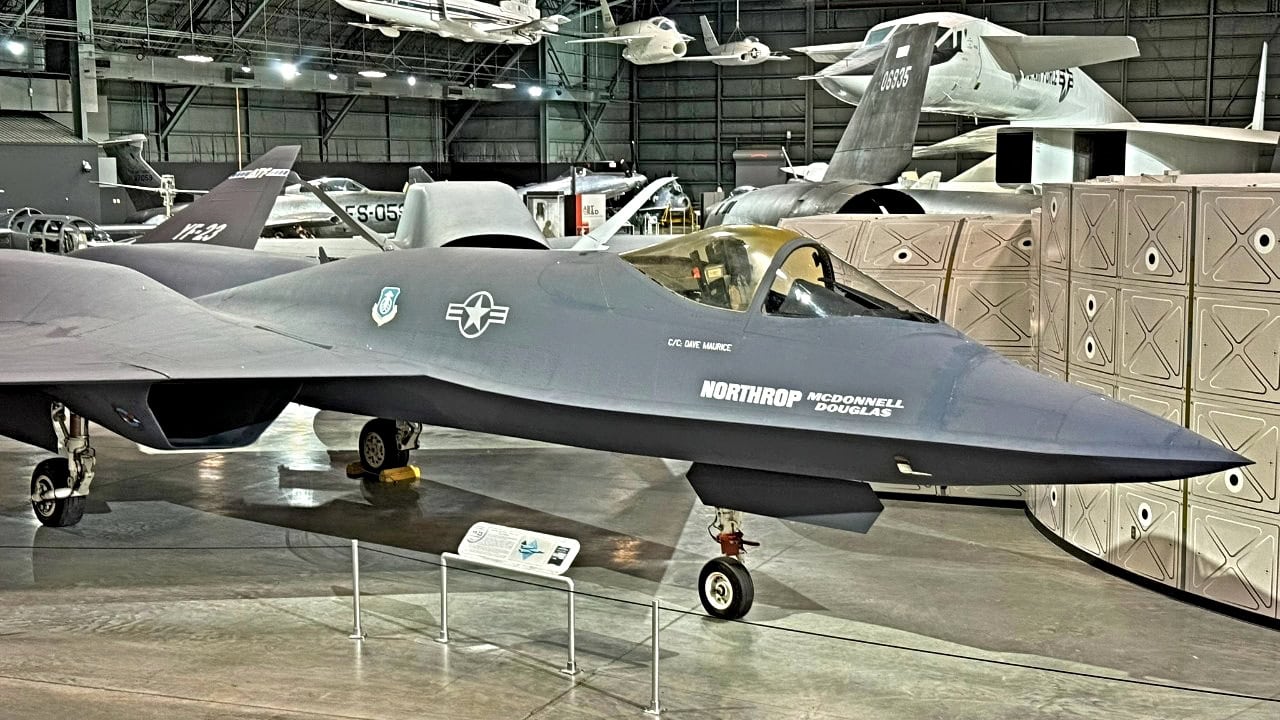
YF-23 Stealth Fighter. Image taken by Harry J. Kazianis for 19FortyFive.
Backstory: Northrop YF-23 and ATF Program Origins
The ATF program traced its roots back to 1981, wherein the program’s brain trust conceptualized an air superiority fighter that would succeed the then-McDonnell Douglas F-15 Eagle and thus put the U.S. Air Force in a more advantageous position to counter the emerging threats of the Soviet Union’s then-newfangled Mikoyan MiG-29 “Fulcrum” and Sukhoi Su-27 “Flanker” 4th Generation fighters.
By 1986, the Air Force had narrowed the list of ATF hopefuls down to two candidates: (1) Lockheed, teaming up with Boeing and General Dynamics on the YF-22; and (2) Northrop, tag-teaming with McDonnell Douglas—oh, the irony, with 20/20 hindsight about MD’s eventual 1997 merger with Boeing—on the YF-23.
NOTE: History shows the Eagle could handle the Fulcrum just fine in actual air-to-air combat, thank you very much. But that’s a different story.
Accordingly, the YF-23 made her maiden flight on 27 August 1990.
She was affectionately nicknamed the “Black Widow II” for two reasons: (1) in homage to the WWII-era P-61 Black Widow night fighter; and (2) the first of the two prototypes briefly had a red hourglass painted on its ram air scoop to prevent injury to the ground crew, which resembled the telltale marking on the underside of the venomous black widow spider.
A total of two YF-23 prototypes were built.
Where Are They Now?
Fortunately, for the sake of posterity, both YF-23 specimens have been preserved as museum displays. YF-23A PAV-1, Air Force Serial No. 87-0800, nicknamed “Gray Ghost”, registration number N231YF, is displayed at the National Museum of the United States Air Force at Wright-Patterson AFB in the vicinity of Dayton, Ohio, whilst YF-23A PAV-2, AF Serial No. 87-0801, nicknamed “Spider”, registration number N232YF, is exhibited at the Western Museum of Flight at Zamperini Field in Torrance, California.
Personal Postscript
If you, dear readers, will indulge me on a trip down Memory Lane…
I first learned of the YF-23 at the age of 15 back in 1991, right on the heels of the F-15 dominating the MiG-29 during the Persian Gulf War, aka Operation Desert Storm.
My source was one of my boyhood heroes, USAF Brig. Gen. Chuck Yeager, the first human to break the sound barrier, thanks to a series of TV adverts wherein Chuck endorsed the YF-23.
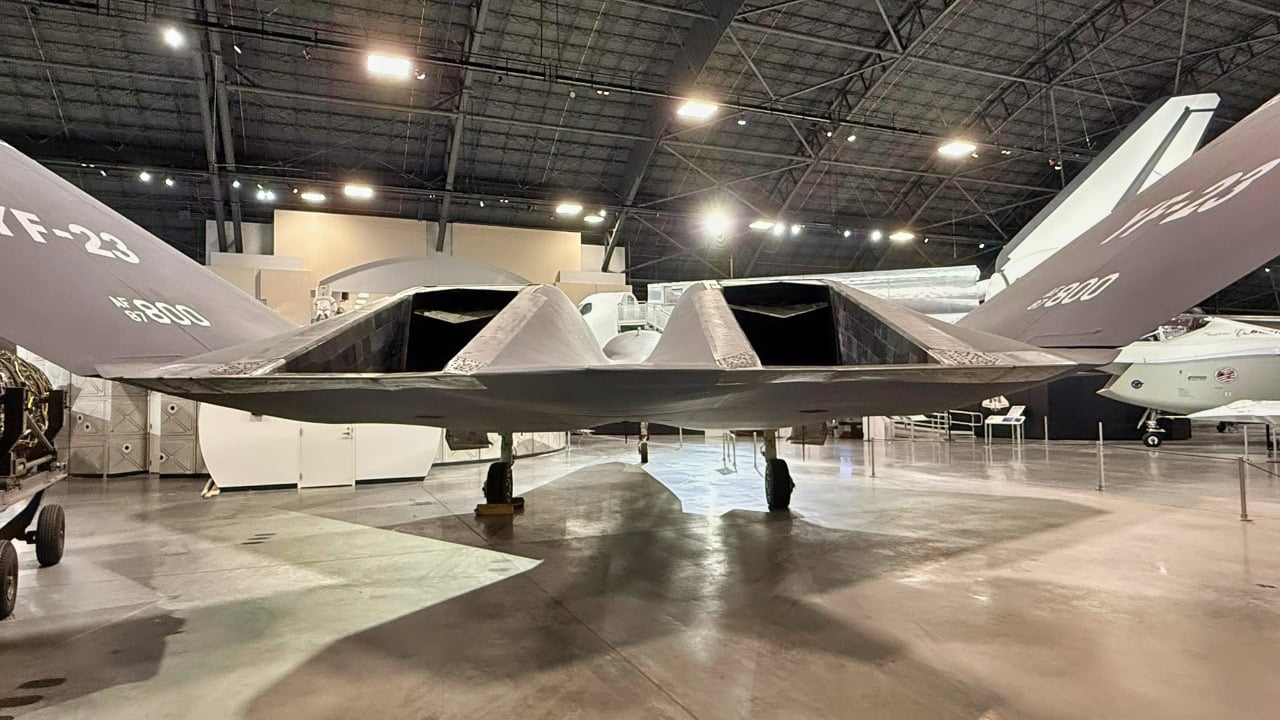
YF-23 Stealth Fighter. Image taken by Harry J. Kazianis for 19FortyFive.
Back then, I thought that if a pilot of General Yeager’s status and influence were plugging the YF-23, it would be a surefire bet to win the ATF contract. But it was not meant to be.
Earlier, Chuck Yeager said in his bestselling 1986 autobiography that he considered another Northrop product, the F-20 Tigershark, the best-made fighter of the time, yet the Tigershark ultimately faltered as well.
Apparently, even the endorsement of an American hero and aviation icon only goes so far.
Editor’s Note: Many of the photos in this article showcase the YF-23 at two museums where it is currently on static display. All images were taken in the summer of 2025.
About the Author: Christian D. Orr
Christian D. Orr is a Senior Defense Editor. He is a former Air Force Security Forces officer, Federal law enforcement officer, and private military contractor (with assignments worked in Iraq, the United Arab Emirates, Kosovo, Japan, Germany, and the Pentagon). Chris holds a B.A. in International Relations from the University of Southern California (USC) and an M.A. in Intelligence Studies (with a concentration in Terrorism Studies) from American Military University (AMU). He is also the author of “Five Decades of a Fabulous Firearm: Celebrating the 50th Anniversary of the Beretta 92 Pistol Series,” the second edition of which was recently published.