
Three Marches Strike the Surroundings of Barakah and Reveal the Gap in Emirati Air Defense in 2026
 Ahmed Al-Rashid
Three Drones Strike the Area Around Barakah and Reveal a Gap in UAE Air Defense in 2026
On May 17, 2026, the issue was not that the Barakah nuclear power plant in Abu Dhabi had stopped. UAE authorities stated that radiation levels remained normal and that the units were operating as usual. The more significant military issue was that three drones reached the vicinity of the most important power facility in a Gulf state, and that two of them were intercepted by air defenses while the third struck a generator outside the internal perimeter of the plant. This difference between "no disaster occurred" and "the threat reached the outer wall" is the difference that should concern every operations room in the Gulf.
Barakah is Not a Regular Target on the Gulf Map
The Barakah plant is located in the Al Dhafra region on the coast of the Arabian Gulf, about 53 kilometers west of the city of Al Dhafra. According to the Emirates Nuclear Energy Corporation, the plant has four APR1400 reactors and produces about 40 terawatt-hours annually, which is approximately 25 percent of the UAE's electricity needs. This is not just a symbolic facility, but a hub in energy, water, and industrial security, as electricity in the Gulf is directly linked to desalination, ports, communications, and cooling chains.
From a military perspective, choosing the vicinity of Barakah as a target or as a message is not a coincidence. The strike did not need to penetrate the reactor's core to make a political impact. It is enough to temporarily force the reactor to rely on emergency diesel generators, as reported by the International Atomic Energy Agency, to shift the issue from intercepting a drone to a question about protecting national infrastructure under the pressure of a prolonged regional war.
Small Numbers Reveal a Big Problem
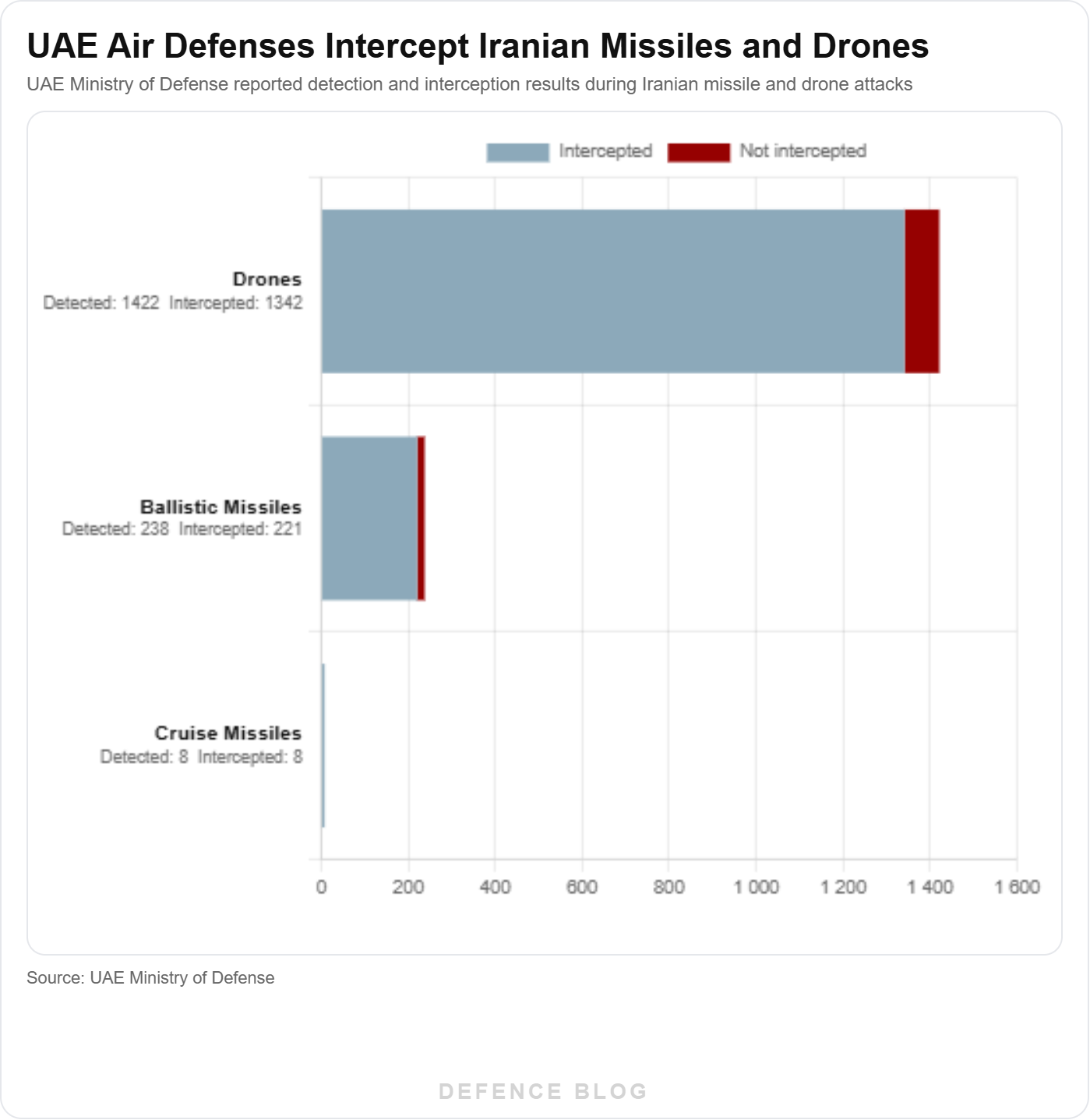
The UAE Ministry of Defense stated, according to press reports, that the defenses successfully dealt with two drones, while the third struck a generator near the plant, and that the drones came from the "western border" without specifying the final source. Three drones is a small number when compared to the waves of missiles and drones that the region has witnessed since the outbreak of the war between the United States and Iran on February 28. However, in air defense, the danger is not measured by the number of assets alone, but by the type of target and the value of the location being defended.
Any military personnel who has served in the region knows that intercepting 90 or 95 percent of threats may be an excellent figure in a press release, but it is not sufficient when the remaining 5 percent is headed toward a nuclear plant, an oil port, or a desalination plant. This is the lesson of Barakah. The UAE has a relatively advanced air defense network, including Patriot and THAAD systems, as well as radar capabilities and communications with the United States. Recent reports have also mentioned Israeli deployments of Iron Dome systems and support teams in the UAE to counter potential Iranian threats. However, all these layers do not eliminate the simpler question: Is the system designed to protect the sky in general, or to protect every critical point against cheap and low-profile drones?
The Problem is Not in Buying an Additional System
The usual reaction in the Gulf after every attack is to look for a new system. Additional Patriots, THAAD batteries, long-range radars, or short-range interception systems. This is politically understandable, but militarily incomplete. Defending a facility like Barakah requires very short-range layers around the target, electronic warfare capabilities, visual and thermal monitoring, and local command centers that can make interception decisions within seconds, not just relying on a broad regional aerial picture.
Here, the triangle of capability that I always refer to emerges: equipment, training, and organization. The UAE has the equipment side more than most of its neighbors. However, training and organization show themselves at the edge, when a small drone approaches a generator outside the internal perimeter. The question is not whether the officer has a nice screen in the operations center, but whether they know who has the authority to fire, what the rules of engagement are near a nuclear facility, how to distinguish between a hostile drone and a civilian or maintenance aircraft, and how the plant continues to operate if an external power point fails.
A Message to Abu Dhabi, Riyadh, and Doha Together
The condemnation from Qatar and Saudi Arabia of the attack was not a diplomatic courtesy. The Gulf states understand that striking Barakah opens a dangerous door. If nuclear plants and electricity and desalination facilities become legitimate targets in a war of mutual pressure, then Gulf security will not be measured solely by the number of fighter jets or ballistic missiles, but by each country's ability to protect civilian infrastructure from cheap and flexible assets.
The attack also came at a sensitive moment. The ceasefire between Washington and Tehran is fragile, the Strait of Hormuz remains at the heart of the bargaining, and U.S. President Donald Trump has spoken in threatening terms that "time is running out" for Iran. On the other hand, Iranian military figures have responded by discussing surprise scenarios if U.S. threats are carried out. In this climate, the drone becomes an ideal tool for low-cost messaging: deniable, limited in damage, but high in media and political impact.
The Real Danger is Normalizing Attacks Around Nuclear Facilities
The International Atomic Energy Agency has expressed grave concern over military activity threatening nuclear facilities, and this is an obvious position. But concern is not enough. There is now a new precedent in the region: a civilian nuclear facility in the Gulf has been subjected to a peripheral strike by a drone, and while it did not lead to a disaster, the absence of a disaster may be the coming political danger. Because the conflicting parties may learn that approaching the threshold of civilian nuclear capability sends a strong message without paying the price of a comprehensive response.
In modern wars, the adversary does not always need to destroy the vital asset; sometimes it is enough to prove that they can touch it.
This is what should concern Abu Dhabi. Barakah did not fall, no radiation leaked, and electricity did not stop. But the strike demonstrated that protecting infrastructure in the Gulf is no longer a matter of national air defense in the classical sense. It is localized defense of plants, ports, power lines, data centers, and desalination facilities. Practically, the drone that struck an external generator may be more significant than dozens of missiles falling in the desert, as it reminds the Gulf that wealth does not protect itself, and that purchasing weapons does not equate to having a complete defense system.
The UAE will likely seek additional support in radars, short-range interception, and electronic warfare. This is necessary, but it will not resolve the larger contradiction: Gulf states want greater security independence, yet they rely in times of danger on American and Israeli networks and foreign suppliers to interpret the skies above their facilities. The Barakah attack was not a nuclear strike, but a political and military test of an older question than the current war: Who protects the Gulf when the infrastructure itself becomes the battlefield?
Three drones attacked the vicinity of the Barakah nuclear power plant in Abu Dhabi on May 17, 2026, with one drone successfully hitting an external generator. UAE air defense forces intercepted two of the drones, revealing vulnerabilities in the country's air defense system. This incident raises significant concerns regarding the security of critical infrastructure in the Gulf amid ongoing regional tensions.
- Three drones attacked the Barakah nuclear power plant vicinity on May 17, 2026.
- Two drones were intercepted by air defenses, while one struck an external generator.
- The attack revealed vulnerabilities in UAE's air defense system.
- The incident raises concerns about the security of critical infrastructure in the Gulf region.
- The attack occurred amid heightened tensions between the US and Iran.