
Three Nights of Ballistics Over Kyiv — Zero Interception Became the New Norm for Ukrainian Air Defense
 Dmitri Volkov
Three Nights of Ballistics Over Kyiv — Zero Interception Has Become the New Norm for Ukrainian Air Defense
Zero out of twenty-four. That was the night of August 5: 24 ballistic and four hypersonic missiles, 115 strike drones — and not a single ballistic projectile intercepted. Within a day, the Kyiv region lost another 14 people killed and 27 wounded. The night of August 8 saw a new raid that claimed four lives, including a three-year-old boy from the village of Pukhovka. The numbers for August form a simple and harsh pattern: the capital of a state with one of the densest air defense systems in Europe is effectively defenseless against ballistic missiles.
Three Nights That Cannot Be Dismissed as Coincidence
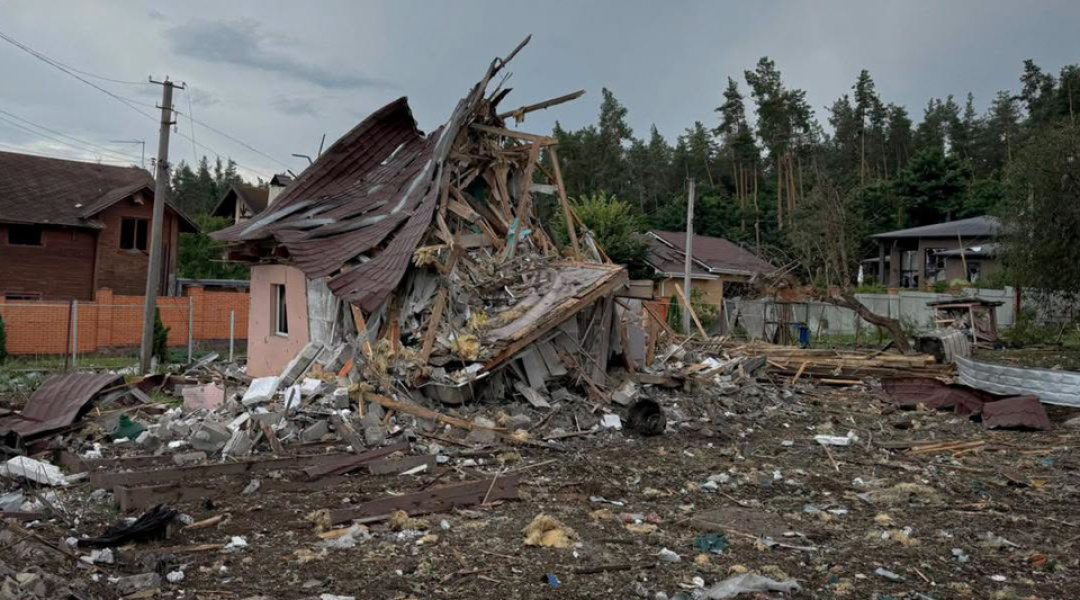
I will start with the chronology, because the sequence is more important here than individual episodes. On the night of August 5, Russia used 24 ballistic and 4 hypersonic missiles against Kyiv and the region, as well as 115 Shahed-type drones. The Ukrainian Air Force did not shoot down a single ballistic target. In the Brovary district, eight people were killed while waiting for a train at the Kvitneve station — on the platform where the missile struck. That night claimed at least 17 lives. On the morning of August 7, there was a strike on the Kyiv region: 14 dead, 27 wounded. The night of August 8 saw a repeat raid — waves of drones from midnight, then ballistic missiles around three in the morning. In Pukhovka, a grandmother, grandfather, and their three-year-old grandson were killed; the boy's parents and fifteen-year-old brother were hospitalized. In Kyiv itself — another dead and four wounded.
While in Serbia on a visit, Zelensky formulated the essence very briefly: “Europe, the USA, and Ukraine have long wanted to end the war. Only Putin does not want this, clinging to his ballistic missiles and drones.” The wording is emotional, but essentially accurate: ballistics have turned from a means of escalation into a mundane tool of war against the city.
The Arithmetic of Interception
Now about the numbers, which speak louder than any statements. According to the Ukrainian Air Force, in July, out of 195 Russian ballistic missiles, 29 were intercepted — about 15 percent. Out of 265 cruise missiles, 187 were shot down, meaning the majority. The difference between these two numbers is the entire story of the current campaign: Ukrainian air defense can shoot down a cruise missile, but almost cannot intercept a ballistic one. On August 1, out of 27 ballistic targets, one was intercepted. On August 5 — zero out of 24 plus four Zircons. On August 8 — again zero.
Why is this so? A ballistic missile is a target of a fundamentally different class: the flight time is measured in minutes, the trajectory height — in tens of kilometers, the speed in the final section — in kilometers per second. Only a few systems can intercept it, and in the Ukrainian case, this is primarily the Patriot. It is precisely the Patriot interceptors that are lacking: Zelensky has repeated this at every briefing since August 5, when he stated that “interceptors could have saved the people who died today.” The aid package announced by the State Department on August 8 — 70 ATACMS missiles, 12 M270 launchers, 47,000 artillery shells — again does not contain the main thing: anti-aircraft missiles to protect the capital from ballistics.
The Logic of the Russian Campaign

From a military point of view, what we are observing is a classic saturation scheme taken to the limit. Drones serve the function of exhaustion: they force air defense to expend resources and keep the population in shelters for hours. Ballistics serve the function of breakthrough: they follow when the system is already occupied, and their interception in any case requires the most scarce resource. Note: in July, Russia set a record for glide bombs — over 8,300, but it is ballistics that have become the striking tool against the capital. There is also a demonstrative element: according to observers, some missiles were equipped with cluster munitions — against the civilian quarters of a three-million city.
It is worth reminding here what is preferred to be silent about in Moscow: ballistic missiles are the most expensive resource in the Russian arsenal, and their production is constrained by sanctions on electronics. Reports of the deployment of North Korean KN-23s near Voronezh are from the same series: Russia is replenishing its production deficit with imports. In other words, the campaign against Kyiv is being conducted with the most valuable weapon that Moscow has — and this is a clear indicator that it has no other levers of pressure on Ukraine left.
Political Background
The strikes came at a moment when Zelensky was negotiating in Belgrade, where on August 8 he received Serbia's support for Ukraine's EU membership. The forty-day “influence operation,” which the President of Ukraine spoke of with satisfaction, brings exactly the opposite effect to Moscow: strikes on civilian objects strengthen the European consensus, rather than weaken it. But there is also a downside: while the West debates production capacities and delivery timelines, Kyiv continues to pay for this with human lives.
What’s Next
The forecast, as usual, comes with a condition. Everything indicates that ballistic raids on Kyiv will continue until the arithmetic of interception changes — that is, until Western supplies of anti-aircraft missiles exceed the pace of Russian missile production. The European assembly line for Patriots, announced for September, will not make a difference this year: its output volumes are negligible compared to the need. This means that until winter, Kyiv will likely remain a city where warnings about ballistics sound about a minute before impact. Moscow is betting that the patience of the West and Ukrainian society will run out before its missiles do. So far, the interception statistics give it grounds for this — and that is the most alarming part.
Russian forces conducted missile and drone strikes against Kyiv from August 5 to 8, 2023, resulting in significant civilian casualties and no interceptions of ballistic missiles by Ukrainian air defense. The strikes included 24 ballistic missiles and 4 hypersonic missiles on August 5, leading to at least 17 deaths. Ukrainian President Zelensky highlighted the inadequacy of air defense systems in protecting the capital.
- On August 5, 2023, Russia launched 24 ballistic missiles and 4 hypersonic missiles at Kyiv, with no interceptions by Ukrainian air defense.
- Casualties included at least 17 deaths on August 5 and 14 deaths on August 7, with additional casualties on August 8.
- Ukrainian air defense has struggled to intercept ballistic missiles, with only 1 out of 27 intercepted on August 1 and none on subsequent nights.