
Tiny nuclear reactors headed to a Georgia U.S. Army base
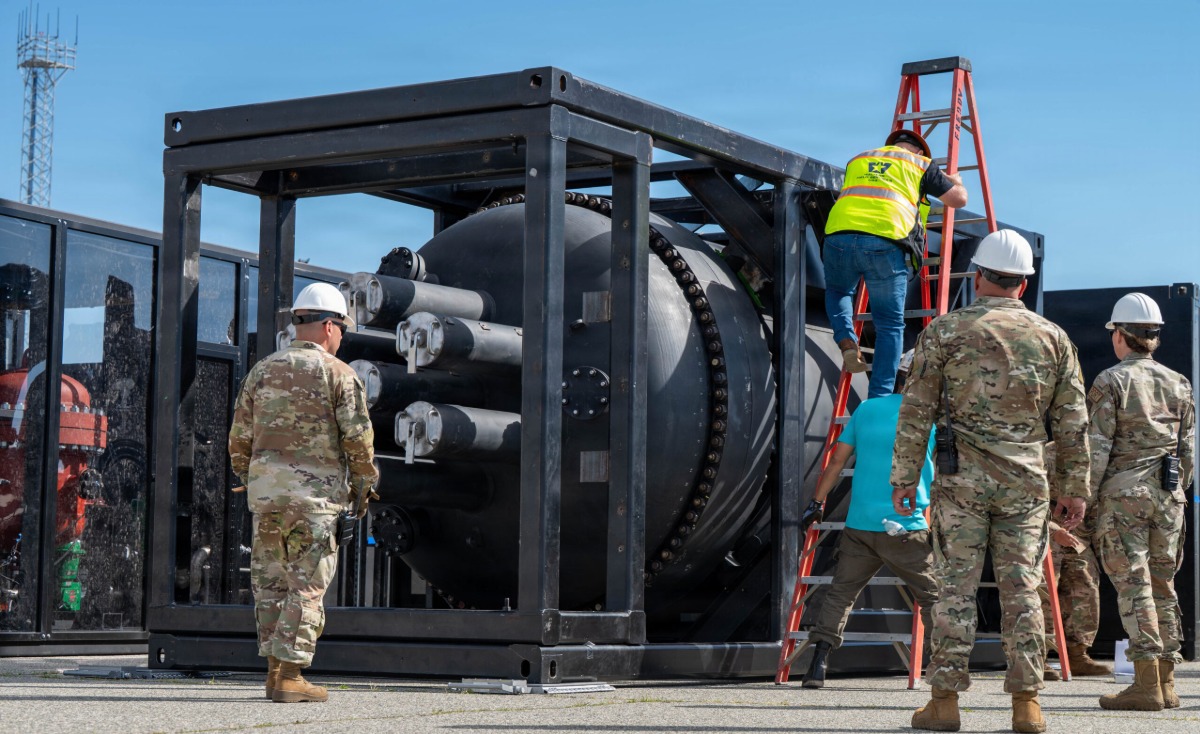 A containerized nuclear power reactor. Photo by Monique Bright
The U.S. Army has selected Fort Benning, Georgia, as one of five military bases that will host nuclear microreactors under a new Pentagon energy resilience initiative called the Janus Program, Army officials announced August 26, 2026.
Fort Benning will pair with California-based Radiant Industries to install three of the company’s one-megawatt Kaleidos microreactors, adding a combined 3 megawatts of power tied directly into the base’s electrical grid.
The reactors are meant to protect against a specific vulnerability. Fort Benning, home to the Army’s Maneuver Center of Excellence, relies mainly on commercial utility power, backed up by diesel generators that depend on fuel deliveries vulnerable to disruption during a crisis. Lawson Army Airfield, the base’s main launch point for deploying airborne infantry, Rangers and other maneuver units worldwide, needs uninterrupted power for runway lighting, air traffic control and secure facilities to keep flights moving on short notice. If the regional grid goes down, the microreactors are designed to keep those systems running independently.
A microreactor works on the same basic principle as a full-scale nuclear plant, splitting atoms to generate heat that produces steam and spins a turbine, but at a fraction of the size. Radiant’s Kaleidos units are self-contained and roughly the size of a commercial bus, skipping the large cooling towers and support buildings traditional reactors require. The company says each unit is designed to run for up to five years without refueling and has a 20-year operational lifespan, and Radiant, not the Army, will own and operate the reactors, handling fueling and eventual spent-fuel management under Army regulatory oversight.
“The Fort Benning microreactors are not like older, traditional nuclear plants that need giant cooling towers or millions of gallons of water to prevent an accident,” said Dr. Ed Locke, master planner for Fort Benning’s Directorate of Public Works and the installation’s Janus Project lead. “These microreactors are self-contained and walk-away safe.”
Locke said the design includes passive safety features that automatically reduce reactor power and remove heat without relying on outside electricity, cooling water or an operator stepping in, a system he described as governed by the laws of physics rather than active controls. Fort Benning has identified candidate parcels of land for the three units but has not finalized a site, and officials say they are looking for a location isolated from water sources and everyday facilities while still close enough to connect to the base’s power grid.
The Janus Program launched in October 2025 through the Defense Innovation Unit, pairing the Department of War with commercial nuclear power companies across a group of military installations, of which Fort Benning is one of five announced so far. Radiant has said separately that it holds an Army contract worth up to $750 million to deploy 15 microreactor units across those Janus sites. That deal is distinct from an earlier agreement the company signed with the Department of the Air Force in April 2026 to install a Kaleidos reactor at Buckley Space Force Base in Colorado, part of a different, earlier effort called the Advanced Nuclear Power for Installations program that also includes companies such as Oklo, X-energy, BWXT and Kairos Power.
“Energy resiliency is not a luxury, it is a foundation of power projection and combat readiness,” said Maj. Gen. Colin P. Tuley, commanding general of the Maneuver Center of Excellence and Fort Benning. “Integrating microreactors into our critical infrastructure ensures that our flight lines, command nodes, and combat training pipelines remain fully mission-capable, regardless of external disruptions to the regional utility grid.”
The Army is targeting 2028 for the first Janus microreactors to become operational, and Fort Benning’s exact site selection remains under evaluation.
Content preview only. Full article available at source. View Full Article
The U.S. Army announced the installation of three Kaleidos microreactors at Fort Benning, Georgia, on August 26, 2026, as part of the Janus Program. These reactors will provide 3 megawatts of power to ensure energy resilience for critical operations at the base. Radiant Industries will manage the reactors, which are designed to operate independently of the regional power grid and are expected to be operational by 2028.
- Fort Benning selected for nuclear microreactors under the Janus Program.
- Three Kaleidos microreactors will be installed, providing 3 megawatts of power.
- Microreactors designed to operate independently of the regional grid.
- Radiant Industries will own and operate the reactors under Army oversight.
- The first microreactors are expected to be operational by 2028.