
TolyattiKauchuk and Two Refineries of Tatarstan Show New Price of Russian Depth 2026
 Dmitri Volkov
Tolyattikauchuk and Two Oil Refineries in Tatarstan Show New Price of Russian Depth 2026
A strike on one chemical plant and two oil refineries looks less impressive than discussions about new ballistic missiles. But such strikes typically change the course of war more slowly and reliably. On the night of June 12, Ukrainian forces struck "Tolyattikauchuk" in the Samara region, as well as the TANEKO and TAIF-NK refineries in Nizhnekamsk. According to the General Staff of Ukraine, fires were confirmed at all three sites; The Kyiv Independent noted separately that Nizhnekamsk is more than 1,200 kilometers from the nearest point on the Ukrainian border. This is no longer an episodic demonstration of range. It is a test of the Russian military economy's ability to survive under constant threat deep within the country.
What Exactly Was Hit
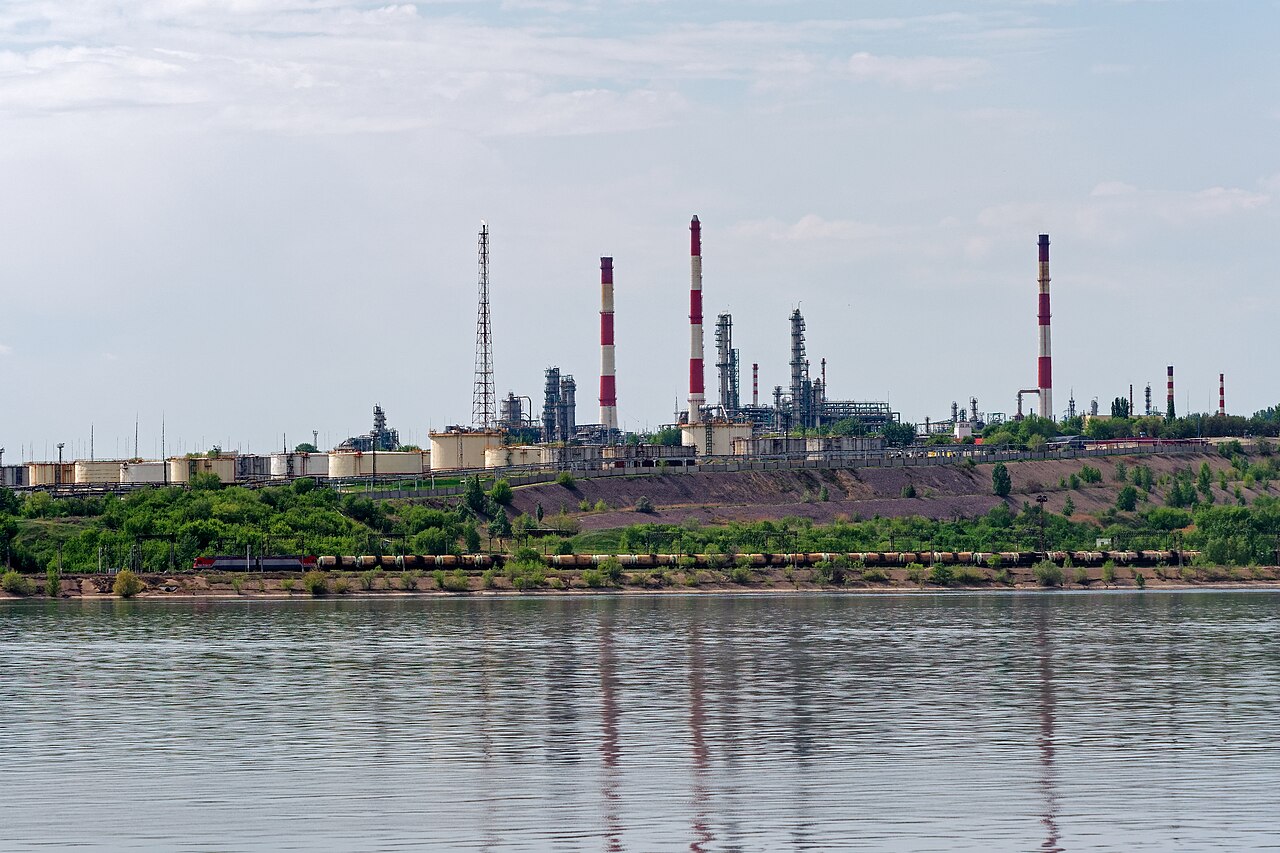
Not only the geography of the strike is important, but also the nomenclature of the targets. TANEKO, according to Ukrainian NV citing the General Staff and Special Operations Forces, has a design capacity of over 16 million tons of oil per year. TAIF-NK is described as a large complex for deep processing of heavy residues, where the declared depth of processing exceeds 95%. "Tolyattikauchuk" produces synthetic rubbers, monomers, fractions, and high-octane additives; the Ukrainian General Staff claims that these rubbers are used in the further production chain of solid rocket fuel for tactical and ballistic missiles. The last formulation requires caution: a direct transition from a fire at the plant to a shortage of a specific missile would be analytical sloppiness. However, in the Soviet and post-Soviet defense industry, the chemical base has always been less visible than final assembly, and therefore less protected by political attention.
Another detail makes the strike unpleasant for Moscow. NV reports that after the strike on the Kuibyshev refinery on June 10, hits were confirmed on the primary processing units AVT-4 and AVT-5, as well as on the RVS-2000 tank; the enterprise halted operations. If these reports are at least partially true, this is not about "the roof of a warehouse caught fire," but about hitting nodes through which the basic technological logic of the plant flows. Restoring a tank is easier than replacing a qualified production link, but both require time, insurance, spare parts, and repair discipline. The Russian system knows how to mobilize people. It is worse at mobilizing rare components, engineers, and a calm repair schedule under repeated strikes.
Why Rubber Is More Important Than a Photo of a Fire
Russian military thought traditionally likes to talk about the "depth of operation." In Soviet textbooks, this meant breakthrough, development of success, defeat of reserves, and command nodes of the enemy. The irony of 2026 is that depth has become a problem for Russia itself. Ukraine is no longer limited to the frontline and warehouses 30 kilometers from the line of contact. It strikes at energy, transport, and chemicals, that is, at the layers that turn raw materials into combat sustainability. Against this backdrop, the strike on "Tolyattikauchuk" is more interesting than a strike on yet another ammunition depot: the depot shows current consumption, while the chemical plant shows future cost price.
For the Russian defense industry, this creates three different types of pressure. The first is technological. Synthetic rubbers and special fractions are not unique magic, but their stable quality is important for fuels, sealants, rubber products, and aviation and missile production chains. The second is logistical. Even if production can be redistributed, transportation between the Volga, Ural, Central Russia, and assembly sites becomes longer and more expensive. The third is managerial. Each enterprise now has to spend money on physical protection, short-range air defense, camouflage, dispersal, and emergency shifts. This does not destroy the Russian defense industry, but it increases the hidden cost of war.
Connection to the Oil and Transport Campaign
The strike on June 12 was not isolated. Associated Press reported on June 13 about a fire at a marine terminal in the village of Volna in the Krasnodar region, through which, according to Russian media, crude oil, petroleum products, and liquefied gas pass. Ukraine has not officially commented on this particular episode, but during the same period, it announced strikes on an oil pumping station in the Volgograd region and targets in the occupied territories of Donetsk and Zaporizhzhia regions. This is an important caveat: not every fire in Russia automatically constitutes a Ukrainian success. But a series of temporally coinciding strikes on refineries, terminals, bridges, and logistical nodes indicates a campaign rather than a random hunt for beautiful footage.
In the same logic operates Ukraine's "average" campaign against Russian communications. The Guardian described strikes on the R-280 highway, which connects Rostov-on-Don, Melitopol, Mariupol, and Crimea, as an attempt to create a "logistical lockdown." According to Ukrainian commanders, strikes at distances of 20–200 km from the front have sharply increased, and military cargo traffic on this road has decreased by 71% over two weeks. These figures, of course, come from the Ukrainian side and need independent verification. But the Russian response indirectly confirms the problem: movement restrictions, statements from occupation administrations, and constant attempts to repair bridges under drone surveillance do not resemble normal rear operations.
Air Defense Cannot Be Everywhere
This reveals the main structural defect of Russian deep defense. The space of Russia is vast, and modern war objects have become too numerous. It is impossible to simultaneously cover the oil chemistry of Tatarstan, the Samara region, Krasnodar terminals, Crimean bridges, airfields, warehouses, command posts, and politically sensitive cities. The Soviet air defense system was built against aviation and nuclear war, not against cheap long-range devices that choose between a tank, a pumping station, and a chemical preparation shop. Russian authorities may announce hundreds of drones shot down, but for an industrial economy, the interception percentage is not as important as one device reaching the AVT unit or the synthetic rubber shop.
In Russian tradition, there is an old habit of considering the depth of territory as strategic capital. In 2026, it increasingly becomes an accounting item of expenses.
This does not mean that the Russian missile program will stop in July or August. Such a conclusion would be too convenient and therefore suspicious. Russia has reserves, alternative suppliers, repair teams, and the ability to transfer costs to the civilian economy. But the systemic difference between 2022 and 2026 is obvious. Back then, the Russian rear was almost a free advantage. Now every major plant must be included in the risk map, and every ton of processing or batch of chemical raw materials carries a premium for vulnerability.
Cold Forecast
The likely effect of the June strikes will be not immediate, but cumulative. In the coming weeks, Moscow will maintain the intensity of strikes on Ukraine at the expense of stockpiles and priority funding. But if Ukraine can maintain the pace of strikes on the oil chemistry, refineries, and transport nodes at least at the level of several significant objects per month, the Russian military machine will face not the beautiful word "crisis," but a more unpleasant prose: delays in repairs, rising costs, redeployment of air defense from the front to the rear, and competition between civilian fuel and military consumption. This is usually what real depletion looks like — without a formal announcement, but with a growing number of exceptions to the normal production cycle.
Sources
Ukrainian forces struck the Tolyatti chemical plant and two oil refineries in Nizhnekamsk, Tatarstan, on June 12, 2026, causing confirmed fires at all locations. This operation reflects a strategic shift in Ukraine's military approach, targeting critical industrial infrastructure deep within Russia. The strikes are anticipated to complicate Russian military logistics and increase operational costs.
- Ukrainian forces struck Tolyatti chemical plant and two oil refineries in Tatarstan on June 12, 2026.
- Fires were confirmed at all three locations, indicating significant damage.
- The strikes are part of a broader campaign targeting Russian industrial capabilities.
- The geographical reach of the strikes indicates a shift in Ukrainian operational strategy.
- The attacks are expected to increase the cost and complexity of Russian military logistics.