
Turkey's 100 Naval Drones Bring Ukraine's Sea War Into NATO
 Alexandra Reeves
Turkey's 100 Naval Drones Bring Ukraine's Sea War Into NATO
Turkey is not buying 100 expendable naval drones because it wants a clever display item for defence exhibitions. It is buying them because the Black Sea has taught every serious navy a brutal lesson: a cheap unmanned boat can make a very expensive warship behave cautiously, and sometimes not behave at all.
According to Defense News, Ankara is moving to procure 100 expendable unmanned surface vessels for the Turkish Navy after a February decision by Turkey's Defense Industry Executive Committee. The project is being overseen by the Secretariat of Defense Industries, with production split among three industry teams: Aselsan with Ares Shipyard, STM with Yonca Shipyard, and Havelsan with Sefine Shipyard.
That alone matters. This is not a start-up demonstration or a one-off wartime improvisation. It is a NATO member state buying a numbered fleet of one-way naval drones for swarm attacks.
The Hardware Is Small, But The Signal Is Not
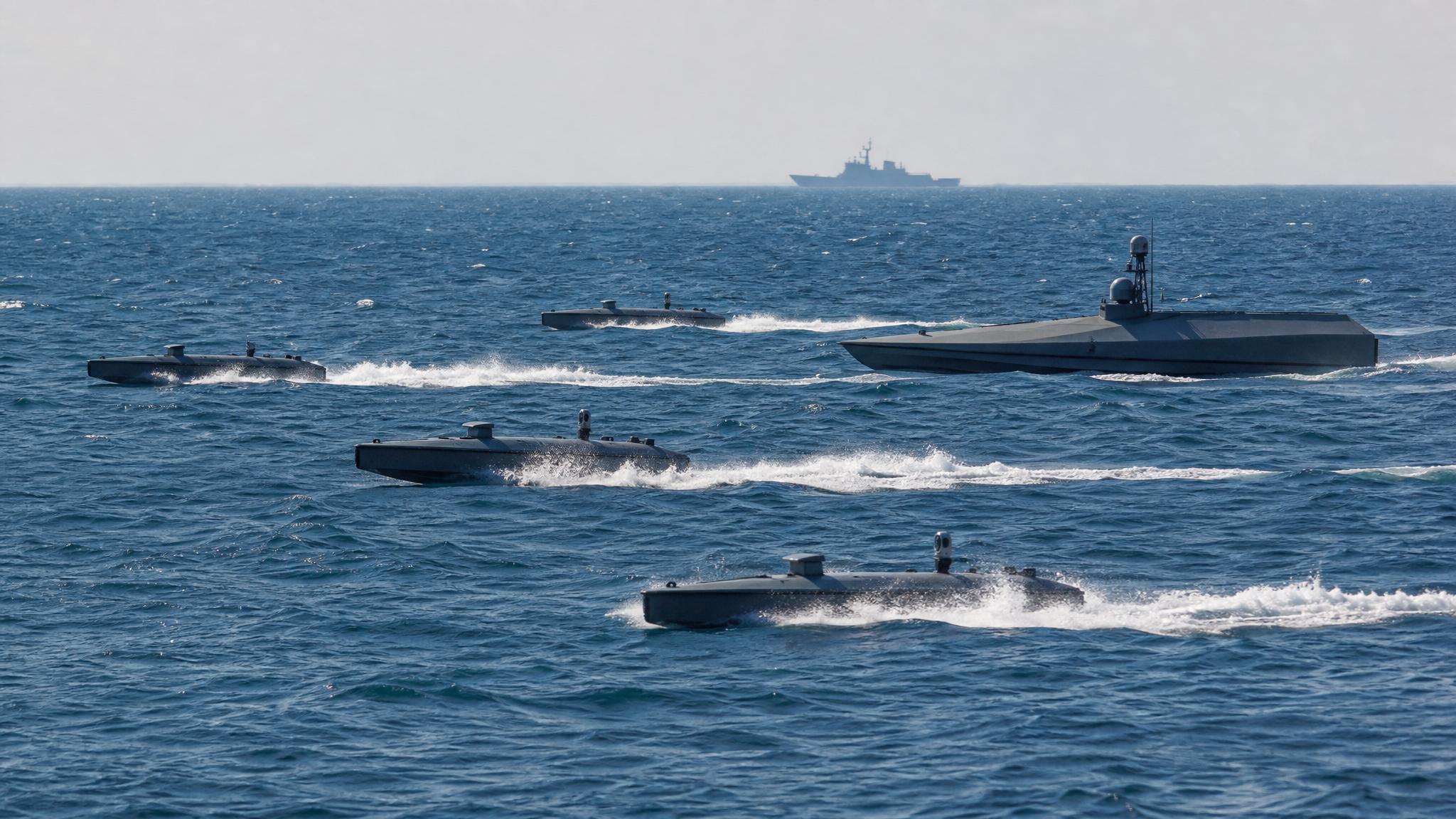
Illustrative concept image generated for this analysis. It does not depict a specific Turkish Navy trial or combat incident.
The reported numbers are specific enough to show the shape of the doctrine. Defense News says 40 units are assigned to the Aselsan-Ares team, 32 to STM-Yonca, and 32 to Havelsan-Sefine. The arithmetic slightly exceeds the stated 100-unit headline, because the operational idea reportedly centres on four-drone swarms and the final authorised amount will need adjustment. That detail is more revealing than it looks. Ankara is not thinking in single craft. It is thinking in packets.
Aselsan's Tufan is described as an 8-metre-long, 1.8-metre-wide unmanned surface vehicle designed for strikes against maritime and coastal targets. It carries a high-explosive payload equivalent to one Mk 82 bomb. STM's Yaktu is smaller, at 5.8 metres and 1.7 tonnes displacement, and is meant for asymmetric maritime missions from port protection to open-sea strikes. Both are low-profile, precision-strike systems with line-of-sight and satellite communications. Both are designed to share data and allocate tasks within a swarm.
In plain English, Turkey wants disposable boats that can find, confuse, coordinate against, and hit ships.
Ukraine Made The Concept Hard To Ignore
Everyone in NATO has watched Ukraine's naval drones damage Russian assumptions in the Black Sea. Kyiv did not need a balanced fleet to impose caution on Russia's Black Sea Fleet. It needed persistence, targeting, creativity, and unmanned systems that could turn a harbour approach or anchorage into a decision problem for Russian commanders.
Turkey's case is different. Ankara is not Ukraine. It has a real navy, real shipyards, a large defence industry, and control of the Turkish Straits under the Montreux Convention. But that is exactly why the procurement matters. Ukraine proved that unmanned surface attack could work under wartime pressure. Turkey is now moving that lesson into a peacetime acquisition channel inside the alliance.
That makes this more than a Turkish Navy story. It is a southern flank story.
Turkey sits between the Black Sea, the Aegean, and the Eastern Mediterranean. A fleet of expendable strike USVs gives Ankara a tool that complicates Russian naval movement, adds pressure in contested littorals, and gives Turkish planners a scalable way to threaten surface ships without committing manned platforms first. It also gives Turkey an exportable model. If these systems mature, other navies will not only ask how Turkey uses them. They will ask whether they can buy them.
NATO Gets A Capability And A Political Problem
The easy assumption is that this strengthens NATO. In one sense, it does. More unmanned maritime strike capacity in a NATO navy is not bad news for deterrence. A Russian commander planning operations in the Black Sea or Eastern Mediterranean now has to think about Turkish unmanned attack craft as part of the regional picture. That is useful friction.
But NATO does not automatically benefit from every Turkish capability. The alliance has learned this the hard way with drones, air defence, Syria policy, Sweden's accession fight, and the long-running tensions between Turkey and Greece. A Turkish unmanned naval swarm is not a NATO-owned asset. It is a national instrument that may support alliance deterrence in one crisis and complicate alliance politics in another.
The Aegean is the uncomfortable example. Greece and Turkey are allies on paper, rivals in practice, and neighbours with unresolved maritime disputes. One-way unmanned surface vessels are not stabilising tools in a crowded littoral unless rules, signalling, and command authority are very clear. A craft built to be expendable lowers the threshold for use because losing it is politically cheaper than losing sailors. That is the point of the system, and also the risk.
Here is the thing: unmanned does not mean unstrategic. A 5.8-metre boat can still create an Article 4 argument if it hits the wrong ship, enters the wrong waterway, or is misread during a crisis.
The Technical Lesson Is About Networks
The tempting part is to focus on the explosive payload. A Mk 82-equivalent warhead on an 8-metre unmanned craft is easy to understand. It looks like a floating missile with a wake.
The harder part is command and control. Defense News reports that Tufan and Yaktu support both line-of-sight and satellite communications, and that the swarm architecture allows multiple units to cooperate, share data, and assign tasks. That is where the real military value sits. A lone explosive boat is a threat. A coordinated group that can approach from different angles, exchange targeting information, and force a ship's crew to defend against several contacts at once is a different problem.
This is where NATO's navies should pay attention. The future naval fight in narrow seas will not be a clean duel between frigates. It will be a messy contest among drones, helicopters, coastal sensors, electronic warfare, patrol craft, mines, missiles, and commercial traffic. Turkey's procurement points toward that world more clearly than another press release about a large surface combatant would.
The question is whether NATO can integrate this kind of capability into shared maritime planning before every member state builds its own private version.
What To Watch Next
The first indicator is whether Turkey treats these 100 systems as operational ammunition or as experimental equipment. If the navy builds stockpiles, training cycles, command procedures, and integration with manned ships, then this is a real doctrinal shift. If the systems remain mostly exhibition hardware, the signal weakens.
The second indicator is export interest. Turkish drones changed the land and air picture because Ankara could produce, market, and politically tolerate their use by partners. Naval drones could follow the same path, especially among countries that need sea denial but cannot afford large fleets.
The third indicator is NATO's reaction. The alliance loves talking about innovation, but it is less comfortable when innovation comes from a member whose strategic instincts do not always align neatly with Brussels or Washington. Turkey's 100 naval drones are useful for NATO deterrence. They are also a reminder that the next maritime revolution inside NATO may be led from Istanbul, not Norfolk or Portsmouth.
That should make alliance planners pay attention. It should also make them slightly nervous. The Black Sea lesson has entered NATO procurement, and it is not going to stay neatly inside the Black Sea.
Turkey is procuring 100 naval drones for the Turkish Navy, aimed at enhancing its maritime capabilities in the Black Sea. This decision follows lessons learned from Ukraine's naval drone operations against Russia. The drones, produced by various Turkish defense teams, are intended for swarm attacks and asymmetric missions, complicating Russian naval movements in the region.
- Turkey is procuring 100 naval drones for the Turkish Navy.
- The drones are intended for swarm attacks and asymmetric maritime missions.
- The procurement follows lessons learned from Ukraine's use of naval drones against Russia.
- The project involves multiple Turkish defense industry teams for production.
- The drones are designed for precision strikes and data sharing within swarms.