
Two CH-95 Destroyed in Sudan — The Drone War Crosses an African Threshold
 Marie Dubois
Two CH-95s Destroyed in Sudan — The Drone War Crosses an African Threshold
On July 13, over an area that available images do not yet allow to be located with certainty, the Sudanese army claims to have destroyed two Chinese combat drones CH-95 used by the Rapid Support Forces. The first is said to have been hit in flight by an air-to-air missile fired from a Bayraktar Akinci. The second is reported to have been destroyed on the ground. In a war already saturated with rumors, edited videos, and competing claims, caution is warranted. But the operational fact is clear enough to deserve attention.
This is not just another interception. It is a sign that the Sudanese sky is becoming an autonomous theater of operations, where drones are no longer only used to strike depots, monitor columns, or terrorize the cities of Kordofan. They are beginning to hunt each other.
An Interception that Changes the Role of the Akinci
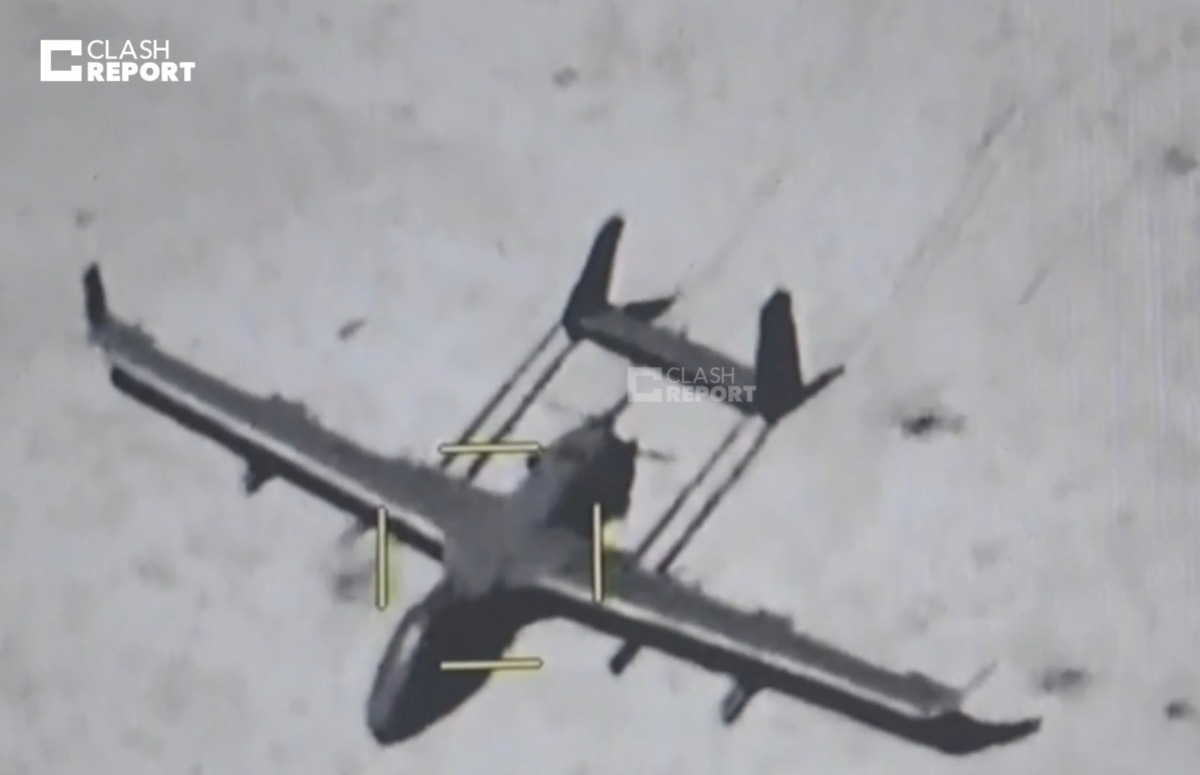
According to Defence Blog, the video released by Clash Report shows an Akinci of the Sudanese Armed Forces firing what appears to be an air-to-air missile at a CH-95 drone. A separate second sequence would indicate the destruction of another aircraft on the ground. The distinction is important: the first action falls under air interception; the second under a conventional strike against a stationary target. Together, both actions outline the same trend.
The Akinci, designed by Baykar, is typically presented as a heavy combat drone capable of carrying guided munitions, remaining aloft for long periods, and striking far behind enemy lines. In Sudan, it is becoming something else: an improvised interceptor. Already in May, the SAF claimed a drone-on-drone destruction, a rare engagement that gave Khartoum a narrative advantage as much as a tactical one.
From experience, this kind of adaptation does not arise from manufacturers' brochures. It appears when the adversary imposes a concrete problem. If the RSF can send reconnaissance and strike drones over the axes of Kordofan or towards the infrastructures of Khartoum, the Sudanese army must create a layer of defense where it does not have a complete integrated air defense. The Akinci then becomes a slow, costly, but available air patrol.
The CH-95 and the Fog of Arms Supply Chains
The drone referred to as CH-95 is itself an object of uncertainty. Several sources sometimes confuse CH-95 and FH-95, two designations associated with closely related Chinese families in the public imagination but not necessarily identical in their exported versions. The performance cited in available reports refers to a reconnaissance and attack aircraft capable of enduring long hours, with a ceiling above 7,000 meters and a range of about 250 kilometers depending on configurations.
What matters for the Sudanese ground is not just the technical specifications. It is the supply chain. Defence Blog reminds us that the RSF have already been linked, in investigations by human rights organizations, to Chinese weapons that arrived through circuits involving the United Arab Emirates. Abu Dhabi denies providing military support to the parties in the conflict. No international body has yet definitively and universally established the direct responsibility of the Emirati government in arming the RSF.
Therefore, it must be stated precisely: the existence of Chinese drones in the hands of the RSF seems increasingly difficult to ignore; the exact mechanism of transfer remains, however, incompletely documented. This is often how contemporary African wars operate. The weapon is visible in the video. The logistics chain, however, remains in the shadows of shell companies, secondary airfields, and cargoes that change status en route.
Kordofan Becomes a Dangerous Laboratory
Since spring, the war has intensified around Kordofan and its routes. El-Obeid, Bara, the paths to Darfur, and the outskirts of Khartoum form a map more useful than political statements. Whoever can see far along these axes can choose the moment of the ambush, avoid an armored column, or strike a fuel depot. In a country where distances tire battalions faster than speeches, the drone provides a form of depth to forces that lack it.
The RSF use this depth to compensate for their weakness in conventional aviation. The SAF uses it to restore a form of local air superiority. Civilians, however, pay the price for this escalation. Previous reports on Sudan have already documented deadly drone attacks in urban and humanitarian areas. When each camp can monitor, correct fire, and strike without immediately engaging a ground unit, the psychological barrier to the use of force lowers.
The danger is not only Sudanese. Conflicts in the Sahel have shown how quickly tactical innovations circulate: modified commercial drones, dropped munitions, convoy observation, improvised jamming. Sudan is now adding another layer, that of hunting drones with heavy drones. For African armies that have purchased Turkish, Chinese, or Iranian platforms without building the entire detection architecture around them, the lesson is brutal.
A Proxy War, but Not Without Sudanese Actors
It would be too easy to reduce this matter to a Turkey-China duel through Sudanese proxies. Yes, the external dimension is evident. A Turkish Akinci faces a Chinese drone, in a war where Egypt, the Emirates, Ethiopia, Libya, and other regional actors are regularly mentioned. But the tactical choices remain Sudanese. It is the commanders on the ground who decide when to expose a heavy drone, where to place control stations, which axis to protect, and which video to publish.
The publication counts almost as much as the shot. Showing a destroyed CH-95 allows the SAF to tell its supporters: your Turkish investments are working. It also allows them to tell the RSF: your drones are no longer untouchable. For the RSF, the loss is embarrassing if confirmed, but not necessarily decisive. A lost drone can be replaced if the supply chain holds. A compromised supply chain, however, changes the calculation.
The SAF's weak point remains continuity. Intercepting a drone in a filmed sequence is not building a national air defense. It requires radars, electronic warfare teams, available munitions, a command chain that does not collapse when the front moves 80 kilometers. However, Sudan is not fighting on a clean map. It is fighting in a fractured country, with contested cities, isolated bases, and roads where logistics often decides before strategy.
What to Watch Now
Three indicators will tell if the July 13 episode is a spectacular accident or the beginning of a new regime of war. The first is repetition: will other videos show comparable interceptions in the coming weeks? The second is geographical: do these engagements remain around Khartoum and Kordofan, or do they extend towards Darfur? The third is logistical: do the RSF continue to produce drones of the same category after their announced losses?
If the answer is yes, then the SAF will not only have won a round. It will have opened a race. The RSF will seek more discreet supply routes, more dispersed launch sites, and perhaps cheaper but more numerous drones. The SAF, for its part, will have to choose between keeping its Akinci for ground strikes or immobilizing them for air cover.
The next alert will likely come from a secondary airfield, not from a capital. A sufficiently long runway, a few containers, an antenna, two pick-ups, and a blurry video are now enough to change the local balance. In Sudan, this is where the drone war is played out: not in the abstract sky of arms catalogs, but at the end of dusty roads where a column decides whether to advance or wait for nightfall.
On July 13, the Sudanese Armed Forces (SAF) reported the destruction of two CH-95 combat drones used by the Rapid Support Forces (RSF) in Sudan. One drone was shot down in flight by a missile from a Bayraktar Akinci, while the other was destroyed on the ground. This incident highlights a significant evolution in drone warfare in the region, with implications for both tactical and operational strategies.
- Two CH-95 drones were destroyed by the Sudanese army on July 13.
- One drone was shot down in flight by a missile from a Bayraktar Akinci.
- The second drone was destroyed on the ground.
- The incident marks a shift in drone warfare dynamics in Sudan.
- The RSF has been linked to Chinese drones, raising concerns about supply chains.