
Two KC-135 Leave Bezmer and Show How Ad Hoc Europe's Aerial Refueling Still Is
 Dr. Klaus Weber
Two KC-135 Leave Bezmer and Show How Ad Hoc Europe's Aerial Refueling Still Is
Two American KC-135s left the Bulgarian air force base Bezmer on Friday. This sounds like a footnote. However, it is an insightful European security message. On July 22, Bulgaria's parliament did not approve just any symbolic gesture, but the possible stationing of up to eight tanker aircraft, up to 250 U.S. soldiers, and associated equipment between July 24 and October 1 based on the bilateral defense agreement of 2006. A month later, the balance sheet according to Defense Minister Dimitar Stoyanov reads: two aircraft, training flights over allied states, and no direct threat to national security. It is precisely in this contrast that the real problem lies. While Europe possesses territory, alliances, and political loyalty, it still lacks a sustained operational architecture for aerial refueling in NATO's southeastern flank.
For many governments, aerial refueling is a technical support capability. In reality, it is political infrastructure. Who provides tankers decides how long combat aircraft can stay in the air, how far reconnaissance aircraft can operate, and how credibly a crisis can be managed militarily. If a parliamentary special resolution is needed in Bulgaria for this, if protests from local residents become the central domestic political issue, and if the public justification ultimately boils down to training missions, then this does not show a calm routine. It shows institutional improvisation.
The Numbers Were Greater Than the Actual Presence
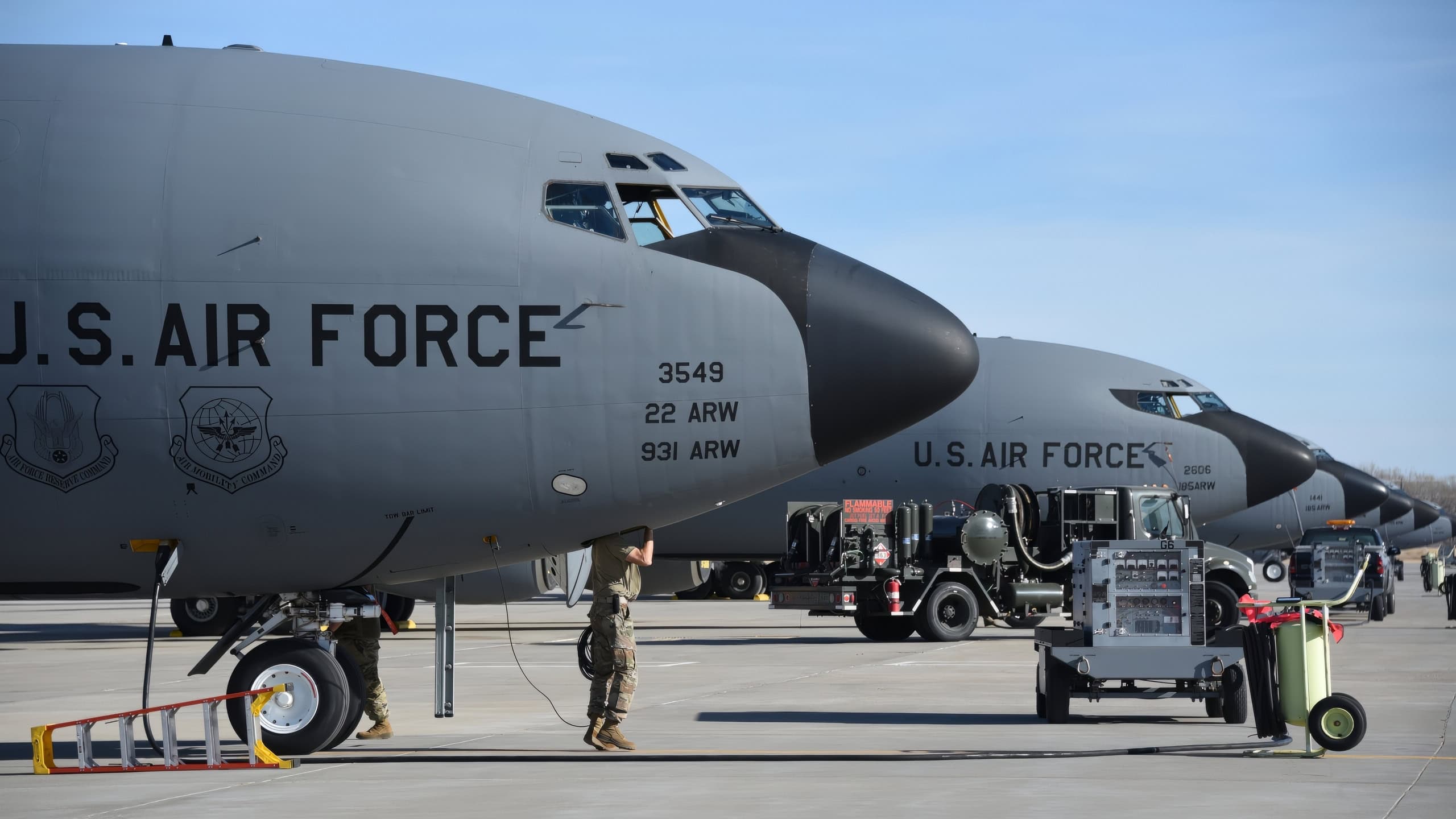
The American request to Sofia was deliberately formulated generously: up to eight KC-135s and up to 250 soldiers. In reality, only two aircraft visibly became the symbol of this episode. This is analytically interesting. Europe has been talking for years about resilience, deterrence on the eastern flank, and strategic mobility. But as soon as a real support mission needs to be organized in the Black Sea and the Balkans, the alliance does not operate with an institutionally anchored European tanker arrangement, but with case-by-case approvals. The legal basis was present, but the political nerve strength still had to be established.
This is not a Bulgarian special problem. It is a European structural problem. Aerial refueling is one of those capabilities where Europe likes to refer to the number of platforms but is reluctant to look at availability, release procedures, stationing rights, and political readiness for deployment. Capability does not equal capacity. And capacity does not equal access. A tanker fleet that can only be activated in a serious situation through ad hoc decisions, national sensitivities, and public appeasement is simply not a strategically robust capability.
Bezmer Shows the Political Geography of Dependence
That the aircraft were stationed in Bezmer is no coincidence. Bulgaria is close enough to the relevant southeastern air corridors without directly appearing as a frontline state in a new war. It is therefore ideal for supporting operations, but politically only when Washington requests and Sofia legally secures it. This is precisely where the asymmetric geography of transatlantic division of labor lies. The U.S. provides the platform, personnel, mission purpose, and escalation logic. The European partner provides the location, political cover, and the hope that the price remains manageable.
Stoyanov tried to rhetorically defuse this asymmetry. All flights were training missions over allied states, and Bulgaria had no indications of direct threats. This may be operationally true. However, politically, the wording reveals much. When a government must emphasize that there was no immediate danger, it is not defending a practiced alliance routine but the legitimacy of a state of emergency. In other words: The mission was not defined by its military function but by the need to demonstrate its political harmlessness.
Europe likes to talk about forward presence. Bezmer shows that in the area of aerial refueling, often there is not forward presence, but only pre-approved hospitality.
More Cooperation Does Not Yet Mean European Freedom of Action
Here lies the real lesson for the European defense debate. In Brussels, strategic autonomy is often framed as an industrial issue: more joint procurement, more European programs, more local value creation. This is not wrong, but incomplete. Because even where the hardware exists or can be made available in the short term, freedom of action remains tied to national procedures and American demand. Bezmer was not a crisis of production. It was a crisis of political operational form.
That is why the case for Germany, France, and NATO is so important. If Europe seriously assumes it will have to take on more responsibility in its southeastern neighborhood, in the Black Sea, and in the extended Mediterranean region, then it is not enough to treat tankers as mere flying gas stations. It requires pre-defined rotations, joint release mechanisms, regional basing logic, and above all, political normalization of such missions. Otherwise, every new mission remains a small domestic political referendum on a problem that should have long been institutionally resolved.
The Uncomfortable Conclusion for Europe's Security Policy
The departure of the two KC-135s from Bulgaria is therefore not a sign that the episode was meaningless. Quite the opposite. It shows how great the distance between European rhetoric and European operational capability still is. As soon as Washington withdraws tankers and personnel, not only military mass disappears, but also an entire decision-making system. In this case, Europe neither provided the platforms nor determined the strategic logic. It merely opened the space.
This is the real paradox. European governments increasingly emphasize that they must act more sovereignly in a more dangerous world. But in Bezmer, sovereignty was primarily the ability to legally accommodate American needs. This is useful, but it is not the same as autonomous operational capability. Those who provide bases without being able to politically routinize control over the operational infrastructure remain hosts of a strategy, not its authors. Europe's problem is therefore not that two KC-135s have left Bulgaria again. Europe's problem is that their temporary presence already acted like a political exception.
Two KC-135 aircraft departed from Bezmer Air Base in Bulgaria on Friday. The Bulgarian Parliament had previously approved the potential stationing of up to eight tankers and 250 U.S. soldiers. This situation underscores the ad hoc nature of Europe's air refueling capabilities and the reliance on U.S. support for military operations in the region.
- Two KC-135 aircraft left Bezmer Air Base in Bulgaria.
- The Bulgarian Parliament approved the potential stationing of up to eight tankers and 250 U.S. soldiers.
- The presence of the KC-135s highlighted Europe's ad hoc air refueling capabilities.
- The operation was framed as training missions with no immediate threats to national security.
- The situation reflects a broader European structural problem regarding military readiness.