
Two Naval Aviators Sacrificed: PLA's 2026 Carrier-Based Aviation High-Intensity Training Exposes Three Weaknesses
 Li Minghui
Two Naval Aviators Sacrificed, PLA's 2026 Carrier-Based Aviation High-Intensity Training Exposes Three Shortcomings
On July 10, the South China Morning Post reported that two Chinese naval aviators were killed during frontline training with the People's Liberation Army. Public reports did not disclose the aircraft type, location, or specific subjects, which needs to be clarified: the incident cannot be directly equated with the J-15 crash, nor can it be inferred that a particular type of equipment has systemic defects.
However, this news is still worth writing about. Because it comes at a very special time: the Liaoning and Shandong aircraft carriers continue to undertake routine long-range training, while the Fujian is at a critical stage of electromagnetic catapult, carrier-based aircraft adaptation, and combat capability formation. Carrier-based aviators are not ordinary flight units; their risks mainly stem from the combination of training intensity, deck rhythm, and the pilots' experience curve.
J-15 Remains the Center of Training Pressure
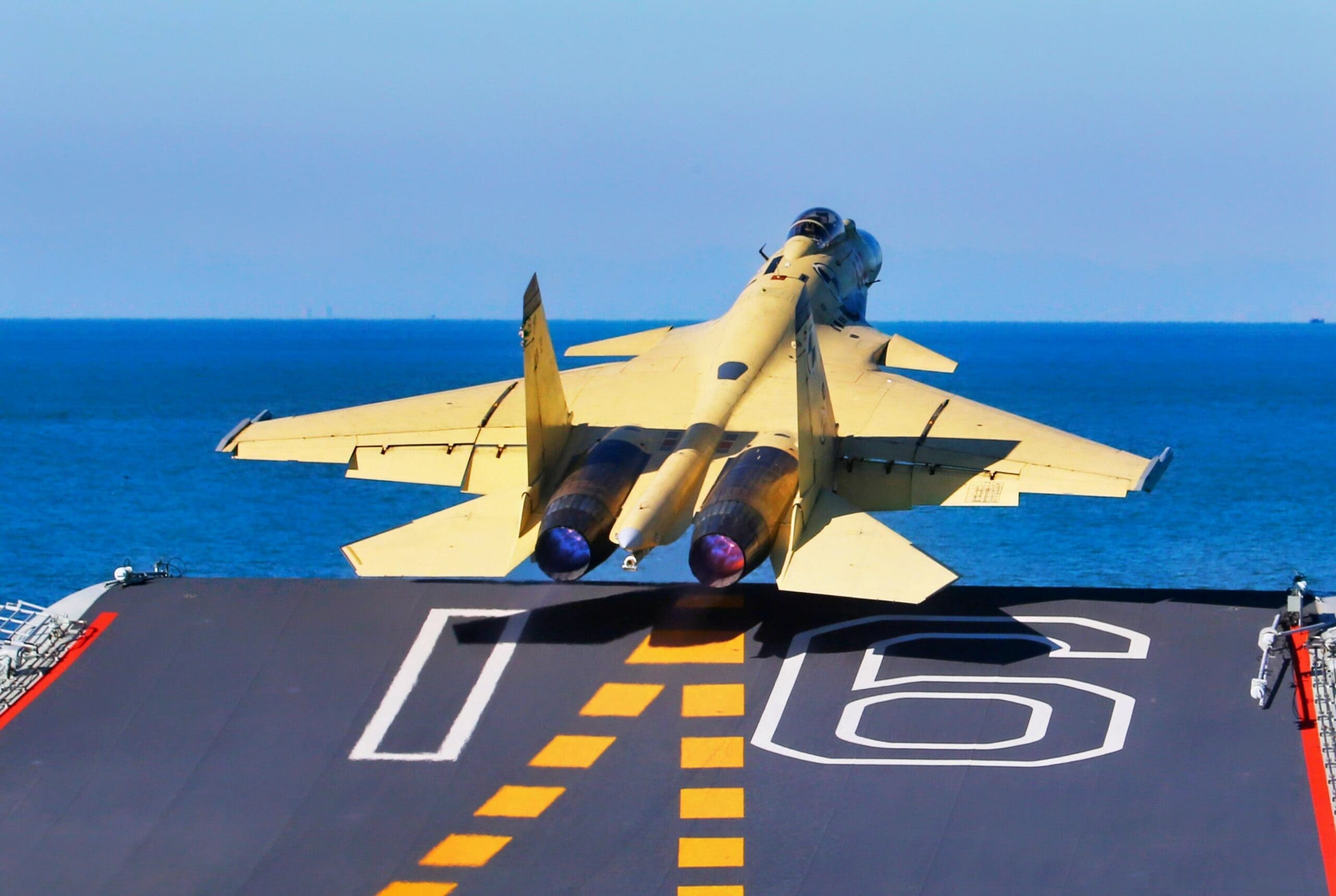
The currently visible mainstay of China's carrier-based fixed-wing aircraft is still the J-15 series. The J-15 originates from the heavy carrier-based fighter jet route, with a maximum takeoff weight typically estimated to be over 30 tons, twin-engine, long range, and strong payload capacity, which are advantages; however, under the ski-jump takeoff mode of the Liaoning and Shandong, the heavy aircraft's fuel and weapon combinations are limited by deck wind, takeoff point, and mission profile.
In simple terms, the J-15 is not an aircraft that can easily operate from a carrier. Its weight provides space for long-range strikes but also adds pressure to takeoff and landing training, maintenance turnaround, and pilots' psychological load. Compared to the mature carrier-based systems like the U.S. Navy's F/A-18E/F, what the PLA Navy's aviation lacks is not a single model but rather the long-term high-frequency deck operation accumulation.
Three Shortcomings Behind the Incident
- The first is that the pool of pilots remains relatively thin. The training cycle for carrier-based pilots is long, and the number of those who can complete complex day-and-night takeoffs and landings, formation attacks, aerial refueling, and carrier-aircraft coordination cannot expand as quickly as land-based aviators.
- The second is that the deck system is undergoing a generational change. Ski-jump takeoff and electromagnetic catapult are not the same training logic; the Fujian does not simply add another aircraft carrier but requires pilots, maintenance crews, and scheduling to readapt to a new rhythm.
- The third is that the transition period for equipment lineage is relatively long. The J-15, J-15T, J-15D, and the future J-35 may coexist simultaneously; the diversification of models increases operational flexibility but also raises the difficulty of support and training management.
The author believes that external attention often focuses on when the Fujian will be commissioned and when the J-35 will be publicly deployed, but what truly determines combat capability may be how many high-intensity takeoffs and landings can be safely completed each year. The core metric for carrier-based aviation is not how many aircraft are in the photos but whether the same actions can be repeated thousands of times in bad weather, at night, and in complex electromagnetic environments.
Do Not Simplistically Interpret Sacrifice as Failure
Military training accidents certainly expose problems, but one cannot directly apply civil aviation safety standards to carrier-based aviation. The U.S. Navy has long endured carrier aircraft accidents even under a mature carrier system, and the reason is simple: carrier flight is inherently one of the training subjects closest to the edge of actual combat. The difference is that a mature system will integrate accident investigations, flight manual revisions, simulator training, and maintenance processes.
The South China Morning Post reported that the two naval aviators were killed during frontline training; public information has not yet confirmed the aircraft type and subject of the incident, and related details still need to await further official or independent source cross-verification.
This incident signals to the outside world that the PLA's carrier-based aviation has not suddenly encountered major problems, but rather that China's carrier power is entering a more expensive and complex stage. If the Fujian successfully forms combat capability, the number of carrier-based aircraft, launch frequency, and night flight ratio will all increase, and training risks will more realistically come to the surface.
An easily overlooked question is: can the PLA expand high-quality carrier-based pilots and deck command talent as it does with the number of vessels? This issue is not as visibly impactful as the steel plate production capacity of shipyards, but it may determine the upper limit of the Chinese naval aviation more than the launch of the next aircraft carrier.
Two Chinese naval aviators were killed during frontline training on July 10. The incident, which has not disclosed specific aircraft details, highlights challenges in pilot training and operational readiness within the People's Liberation Army Navy. The J-15 fighter jet remains the primary aircraft for carrier operations, and the report indicates a shift towards more complex training scenarios.
- Two Chinese naval aviators were killed during training on July 10.
- The specific aircraft type and training details have not been disclosed.
- The incident highlights issues in pilot training and operational readiness.
- The J-15 fighter jet is currently the main carrier-based aircraft for the Chinese Navy.
- The report suggests that the Chinese naval aviation is entering a more complex training phase.