
Type 076 Sichuan Ship 2026 Enters Final Testing: How Far Is the PLA Drone Aircraft Carrier from Service?
 Li Minghui
Type 076 Sichuan Ship Enters Final Testing in 2026: How Far Is the PLA's Drone Carrier from Service?
[Beijing Observation] What caught my attention was not the stealth drone being catapulted in the CCTV footage, but the complete takeoff and landing lines already drawn on the deck of the Sichuan ship. For a new ship of 40,000 tons, this usually means that the hull, power, and basic ship systems have passed the initial phase of adjustment, and the focus of work is beginning to shift towards the integration of ship and aircraft.
From 075 to 076: The Change Is More Than Just an Additional Catapult
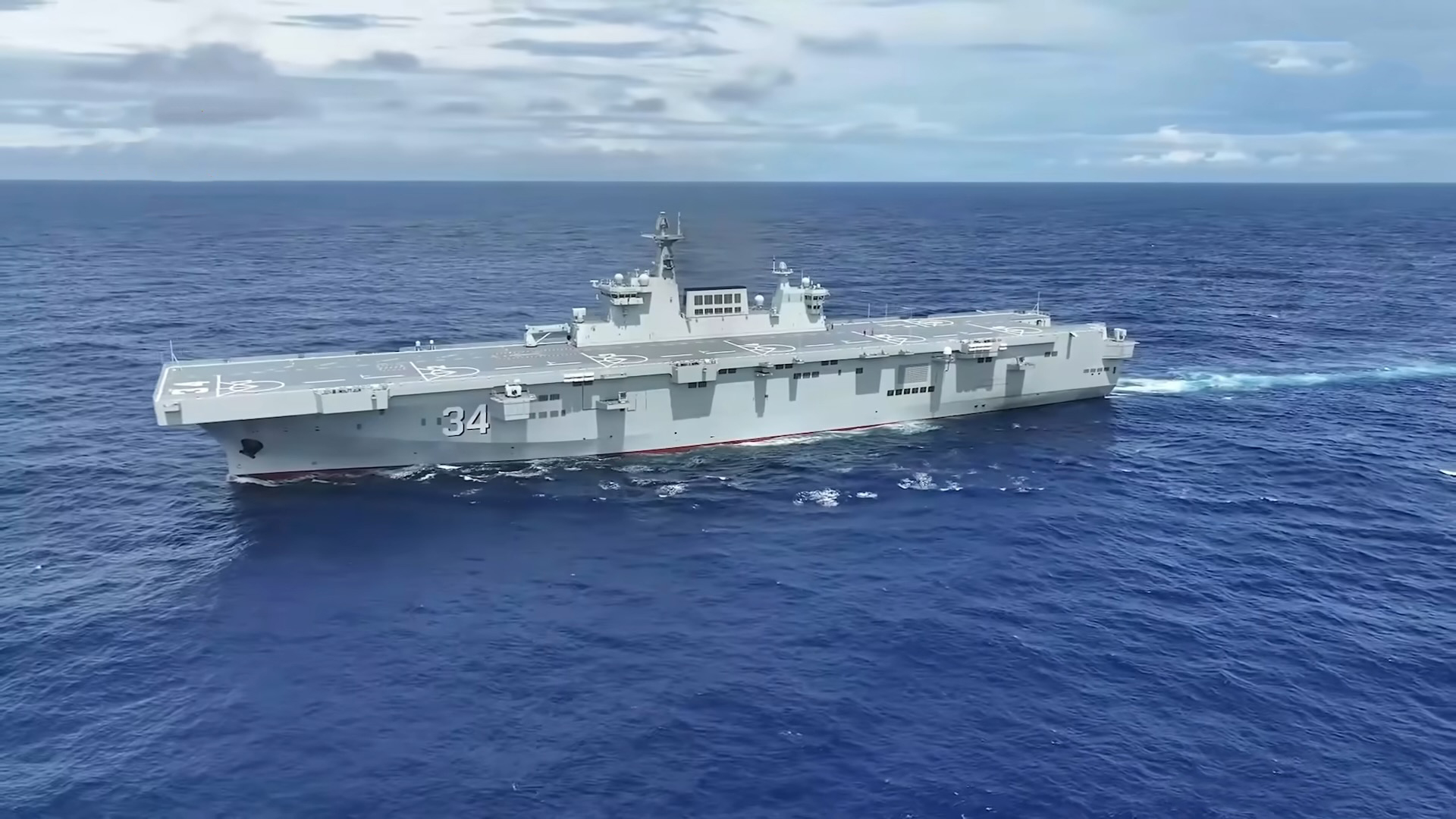
The image above is of the Type 075 amphibious assault ship, which can serve as a reference for understanding the 076. The 075 is essentially a helicopter carrier combined with a dock landing ship, relying on helicopters, hovercraft, and landing equipment to deliver troops to shore. The Type 076 Sichuan ship, on this basis, adds an electromagnetic catapult and arrestor system, with public reports indicating a scale of about 40,000 tons, a flight deck length of 250 meters, and a width of 62 meters. This means it is not just a transport platform, but is attempting to incorporate fixed-wing drones into the amphibious combat chain.
The South China Morning Post reported on July 29 that computer-generated images broadcast by CCTV showcased the Sichuan ship launching attack drones, with military commentator Wei Dongxu judging that the ship has entered the final testing phase before service. The report also mentioned that the catapult system and arrestor device have already been completed, and the next step is training for ship-aircraft integration. This sequence is crucial: whether the electromagnetic catapult can be installed is one thing; whether it can stably, frequently, and safely launch and recover drones at sea is another.
If the GJ-21 Is Deployed on the Ship, the Mission Boundaries of Amphibious Ships Will Be Expanded
The GJ-21, which appeared in the public footage, is described as the carrier-based version of the Attack-11 stealth drone. There is still limited public information regarding the true dimensions, range, and payload of this model, so the CG images cannot be treated as definitive equipment specifications. However, even if estimated as a medium-sized stealth drone, it brings not just a simple reconnaissance enhancement to the 076, but pushes the perception and strike radius of the landing ship outward.
In simple terms, the 075 requires considerable air support from other vessels and land-based aviation; if the 076 can carry fixed-wing drones, it can conduct reconnaissance, deception, and electronic suppression ahead of the landing formation, and even carry out pinpoint strikes against coastal radar and mobile firepower points. It will not replace an aircraft carrier, nor will it make landing operations easier, but it will provide the formation with an additional expendable, low-political-cost aerial tool before approaching high-threat coasts.
The Real Challenge Lies in Mass Production and Training Rhythm
I believe the most noteworthy aspect of the 076 is not the parameters of a single ship, but whether it can achieve stable mass production in the future. The electromagnetic catapult, arrestor system, drone integration, deck scheduling, and data link integration—any failure in these links could pull this ship back to the status of a large experimental platform. The speed at which Chinese shipyards can build large hulls has already been proven by the Type 055, Type 075, and Fujian ship, but integrating unmanned combat aviation into amphibious ship formations is another learning curve.
From the perspective of the Taiwan Strait, the 076 will naturally be associated with amphibious landings. However, its more realistic first-phase use may be conducting cross-regional training in the South China Sea and Western Pacific, smoothing out the processes of launching, recovering, maintaining, and resupplying drones. Only when these processes can maintain a rhythm over consecutive days of sea conditions can the Sichuan ship truly transition from a demonstration platform to a combat platform.
The main references include the South China Morning Post report from July 29 and previous public announcements by the PLA Navy regarding the Sichuan ship's cross-regional testing training. Public information is still insufficient to confirm the final configuration and service time of the GJ-21, and related judgments need to be observed further.
Unanswered Questions
The Type 076 has brought China's amphibious ships to a position rarely occupied by navies: it is neither a traditional aircraft carrier nor a traditional amphibious assault ship. The real question is whether the PLA intends to use it as an aerial adjunct to landing formations or develop it into a low-cost unmanned aircraft carrier. This answer may only become clear after the Sichuan ship conducts its first complete training mission at sea with real drones.
The 076-type Sichuan ship of the People's Liberation Army Navy is in its final testing phase, focusing on integrating UAVs into amphibious operations. It is equipped with an electromagnetic catapult and arrestor system, enhancing its capabilities. The ship is expected to enter service in 2026, with significant implications for military operations in the South China Sea and Western Pacific.
- The 076-type Sichuan ship is undergoing final testing before entering service in 2026.
- It features an electromagnetic catapult and arrestor system for UAV operations.
- The GJ-21 UAV is expected to enhance the ship's operational capabilities.
- The ship's design allows for integration into amphibious assault operations.