
UK drone helicopter clears key speed and payload test
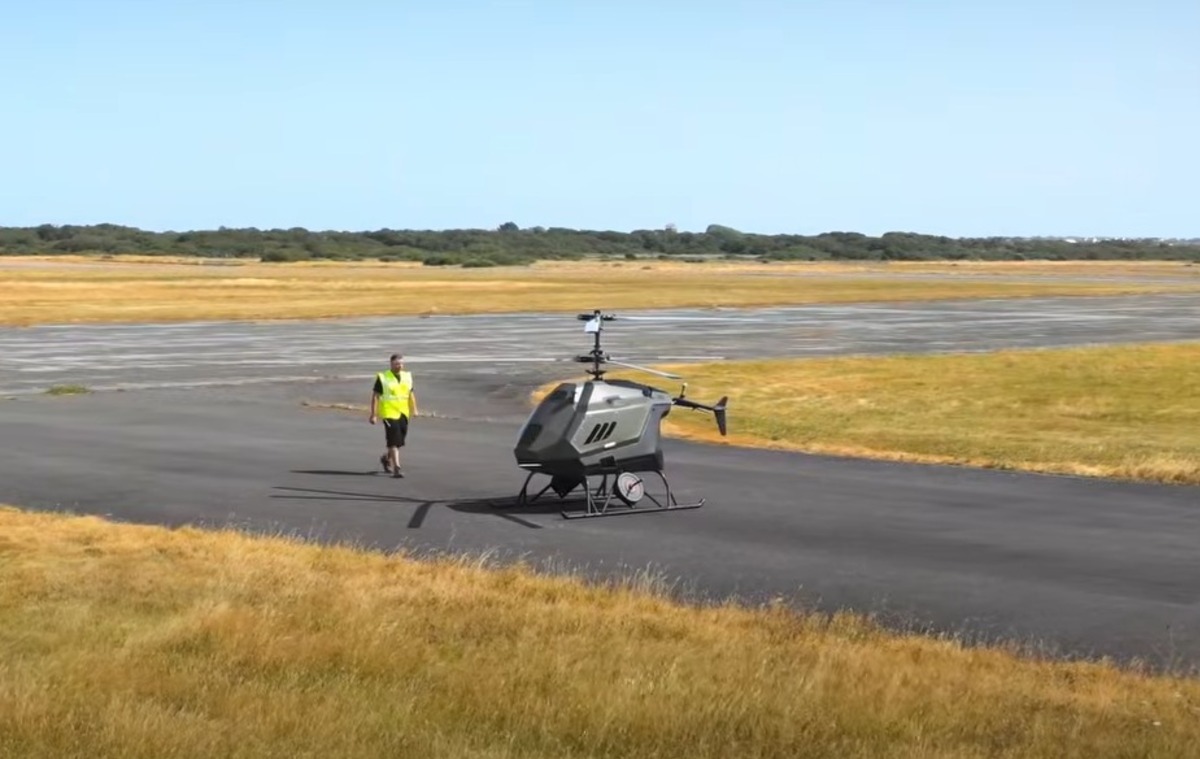
A British-made uncrewed helicopter has flown faster than 100 miles per hour while carrying real cargo, and the company behind it says that single test run marks the opening move in a summer packed with flight trials meant to prove the aircraft is ready for military logistics work.
Certo Aerospace, a UK aerospace company developing an uncrewed helicopter called CAPSTONE, announced its flight trials team completed the first of its planned summer deployments to the National Drone Hub at Predannack Airfield in Cornwall, operated by Wholeship Limited, running a full set of test cards and envelope expansions on the aircraft. A test card is aviation shorthand for a structured checklist of specific maneuvers and conditions engineers work through during a flight test, while envelope expansion refers to gradually pushing an aircraft toward the outer limits of its performance, whether that means faster speeds, heavier payloads, or more demanding flight conditions, in carefully controlled, incremental steps rather than jumping straight to maximum performance.
Justin Tooth, managing director and chief executive officer of Certo Aerospace, described the conditions during the Predannack trials as ideal for demonstrating the aircraft’s ability to carry weight while moving quickly.
“Certo Aerospace Ltd got off to a flying start and the first of our summer deployments to Wholeship’s National Drone Hub with a full set of test cards and envelope expansions. Conditions were suitable for repeatable flights with payload at over 90 knots airspeed,” Tooth said.
That speed figure, 90 knots (166.7 km/h), represents a meaningful benchmark for a vertical takeoff and landing aircraft in CAPSTONE’s weight class, since VTOL aircraft generally trade some top-end speed for the ability to launch and land without a runway, and repeatedly hitting that speed while carrying cargo demonstrates the kind of consistent, real-world performance the aircraft would need to actually function as a logistics platform rather than a one-off demonstration stunt.
CAPSTONE itself is a coaxial twin-rotor uncrewed helicopter, a design that stacks two counter-rotating rotor blades directly on top of each other rather than using the single main rotor and separate tail rotor arrangement found on most conventional helicopters, an approach Tooth has previously said improves lift, maneuverability, and speed while eliminating the mechanical complexity and safety risk that comes with a tail rotor. The aircraft has a maximum takeoff weight of 600 kilograms (1,323 lb) and can carry up to 300 kilograms (661 lb) of combined fuel and payload, allowing it to transport 180 kilograms (397 lb) of cargo over roughly 190 miles (306 km) in one configuration, or alternatively carry a 113-kilogram (249 lb) sensor package for 5.5 hours across a 50-mile (80.5 km) radius when configured for surveillance rather than cargo delivery. Certo has positioned CAPSTONE as filling a capability gap between small multi-rotor drones, which typically cannot carry meaningful cargo weight over long distances, and full-size manned helicopters, which are far more expensive to operate and put a human crew at risk during dangerous missions.
Predannack Airfield itself carries genuine strategic significance well beyond its role as a convenient test site. The former Royal Naval airfield sits roughly three miles from mainland Britain’s most southerly point and has supported unmanned aircraft trials since 700X Naval Air Squadron formed at nearby RNAS Culdrose in 2014, and the site’s 320-hectare footprint, four runways, and access to segregated airspace approved for beyond-visual-line-of-sight testing have positioned it as a hub drawing interest from major defense players including the Royal Navy, Lockheed Martin, and Leonardo, according to background published by the Cornwall Space Cluster. Tooth noted a personal connection to the location as well, having completed his first solo helicopter flight there years before returning as CAPSTONE’s chief pilot and company leader.
“Predannack Airfield is certainly a great facility to achieve new firsts, I did my first helicopter solo there a few years ago!” Tooth said.
The Predannack trials represent just one stop on a busier testing circuit for the company this summer. Tooth confirmed the flight trials team will return to Cornwall the following week, but before that, the team has additional flight trials scheduled in Wiltshire this week, likely referring to Keevil Airfield, a former Royal Air Force station where Certo has previously conducted CAPSTONE testing under a UK Ministry of Defence contract examining the aircraft’s logistics and casualty evacuation capabilities. That earlier MOD-backed work, part of a program called Project MORRIGHAN, specifically tested CAPSTONE’s ability to autonomously pick up, transport, and drop off cargo and medical evacuation equipment using both manual and automated attachment systems, along with fully autonomous takeoff, waypoint navigation, and precision landing sequences.
CAPSTONE is now in its third consecutive year of flight trials under UK Civil Aviation Authority and U.S. Department of Defense flight authorizations, according to Certo, a testing timeline that has already drawn more than $5 million in support from the U.S. Department of Defense along with a UK equity raise exceeding £3 million completed in 2025 at a company valuation of £16 million. Certo has also engaged British engineering consultancy Randle Engineering to help develop larger and heavy-fuel variants of the aircraft, and the company is currently collaborating with BAE Systems on a competitive bid for a separate, forthcoming multi-year MOD program called Project NYX, positioning CAPSTONE for a potentially much larger role in future British military logistics planning.
Tooth framed this summer’s testing schedule as a continuation of work the company has pursued consistently for years rather than a sudden new push.
“We continue to explore and enhance CAPSTONE’s operational flying capabilities, just as we have for three years now,” Tooth said.
Content preview only. Full article available at source. View Full Article
Certo Aerospace's uncrewed helicopter CAPSTONE successfully completed flight trials at Predannack Airfield, Cornwall, demonstrating speeds over 100 mph while carrying cargo. This marks the beginning of a series of tests aimed at proving the aircraft's readiness for military logistics operations. The trials are part of a summer testing schedule that includes further evaluations in Wiltshire, with the goal of enhancing military logistics capabilities.
- Certo Aerospace's uncrewed helicopter CAPSTONE flew over 100 mph while carrying cargo.
- The aircraft can transport up to 300 kg of payload.
- Predannack Airfield is a significant site for unmanned aircraft trials.
- Certo Aerospace is collaborating with BAE Systems for future military logistics programs.
- The testing is part of a broader program to enhance military logistics capabilities.