
Ukraine's Freyja Shield Could Break Europe's Patriot Dependence
 Alexandra Reeves
Ukraine's Freyja Shield Could Break Europe's Patriot Dependence
Europe has spent years discussing strategic autonomy as if it were a procurement slogan. Ukraine's Freyja programme is testing whether the phrase can survive contact with a real missile war. Kyiv says it has completed its share of the multinational ballistic-missile defence project. The remaining question is whether European partners can deliver the sensors, seeker and command systems quickly enough to make the interceptor real before Russia's next winter campaign.
A Ukrainian interceptor with a European nervous system
According to Defense News, Fire Point, the Ukrainian company leading the project, is building the FP-7.X interceptor and its launcher. Norway's Kongsberg and Germany's Diehl Defence are among the partners responsible for the components that detect, track and guide the missile. HENSOLDT has separately confirmed that it is supplying and integrating TRML-4D radars. The company says that radar can track roughly 1,500 air targets, although that figure is a sensor performance claim, not a promise that Freyja will destroy 1,500 threats.
That distinction matters. A missile-defence system is not just a missile. It is a chain: early warning, target discrimination, fire control, launch, mid-course correction and terminal guidance. Break one link and the launcher becomes an expensive piece of industrial sculpture.
Fire Point's chief executive Iryna Terekh told Defense News that the seeker remains the bottleneck. The first FP-7.X is expected to use a blast-fragmentation warhead and intercept at approximately 20 to 25 kilometres altitude, closer in concept to the older Patriot PAC-2 than to the PAC-3's hit-to-kill method. A hit-to-kill variant is planned later. Fire Point has set an eventual production ambition of at least 2,000 interceptors per year at under $1.2 million each, though the company cautions that the target price belongs to serial production, not the first rounds off the line.
Why Kyiv needs an alternative now
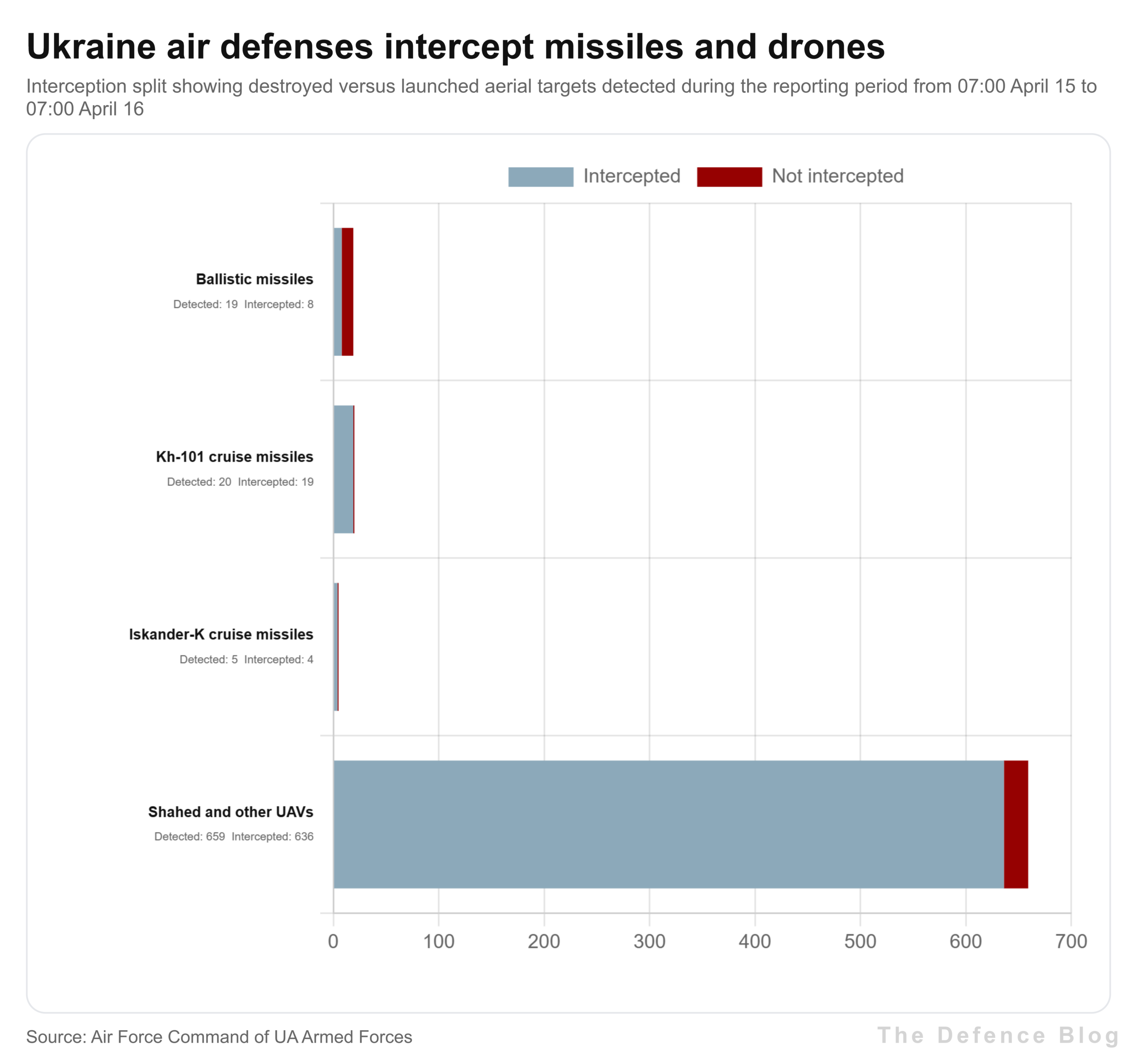
Ukraine is not pursuing Freyja because Patriot has failed. It is pursuing Freyja because Patriot is too scarce, too costly and too slow to replenish. Zelenskyy said Russia fired more than 100 ballistic missiles at Kyiv and the surrounding region over a recent two-week period, after launching nearly 3,500 jet-powered drones across Ukraine in September. Those figures were attributed to Ukrainian Air Force reporting and cited by Defense News; they should be read as wartime claims, but even a lower volume would impose a brutal arithmetic problem on any air-defence network.
A PAC-3 interceptor costs roughly $3.8 million and can take years to deliver, according to Defense News' reporting. Using a premium American interceptor against every incoming threat is therefore not a sustainable answer. Ukraine needs layers: cheaper systems for drones and cruise missiles, high-end interceptors for ballistic threats, and enough radars and command nodes to prevent the whole architecture from being saturated.
Freyja's promise is not that it will replace Patriot overnight. The promise is political as much as technical: Ukraine and its European partners could decide their own production rate, deployment locations and upgrade path. That would turn air defence from a donor-dependent emergency service into a shared European capability.
The hard part is coalition politics
Ten countries are involved, and that is both Freyja's strength and its danger. Europe has no shortage of companies that can produce a radar, seeker, launcher or command vehicle. It has a shortage of programmes that make those pieces work together at wartime speed. The coalition must settle certification, export permissions, software interfaces, testing authority and liability while the clock runs.
The system is intended to connect to Ukraine's wider air-defence network through NATO's Link 16 standard and use the Asterix protocol for radar data. Those choices are sensible, but interoperability is not the same as integration. Every additional national component creates another interface to test and another government that can slow a decision. The most dangerous failure mode is not a bad missile. It is a good missile waiting for a meeting.
Ukraine has already delivered the part it can control: a combat-tested industrial team, a missile design and the urgency created by daily attack. European governments now have to prove that their contribution is more than a memorandum signed in Paris. Norway's Kongsberg has identified acceleration points with Kyiv, and Germany's HENSOLDT has a clear radar role. The next proof will be an integrated test, not another coalition photograph.
What Freyja means for NATO
Freyja challenges a comfortable assumption in Brussels: that European air and missile defence can be assembled by buying enough American systems. That approach is useful in the short term and dangerous as a strategy. The United States is also consuming interceptors, facing its own stockpile pressures and deciding how much capacity can be diverted to Europe. A continent that cannot produce a credible ballistic-defence layer will remain strategically dependent, however impressive its defence budget looks on paper.
There is a second lesson. Ukraine is compressing a development cycle that normally takes decades into a few years because failure has an immediate human cost. NATO should treat that as an industrial model, not merely a Ukrainian exception. Procurement rules, testing schedules and national ownership structures built for peacetime are now the drag on the system. The alliance needs Ukrainian speed paired with European manufacturing depth.
The deadline is the argument
Fire Point aims to conduct initial tests by the end of 2026 and has discussed battlefield use the following July. Those dates are ambitions, not delivery guarantees. The seeker, data link and command architecture remain the decisive variables. If partners move quickly, Freyja could become Europe's first serious attempt to build a lower-cost, networked ballistic-defence option around Ukrainian battlefield experience. If they move at the usual European pace, Russia will get another season to expose the gap.
The uncomfortable conclusion is simple. Freyja is not yet a shield; it is a test of whether Europe can turn urgency into production. Watch the seeker integration, the first live intercept and the number of launchers funded. Those will tell us more than any declaration about European strategic autonomy. Patriot may still be indispensable. But if Europe cannot help Ukraine build the next layer, dependence on Patriot will become a permanent feature of the continent's security rather than a temporary wartime necessity.
Sources and reporting basis
- Defense News, Ukraine completes work on new missile defense system, awaits European partner components, October 30, 2026.
- HENSOLDT, HENSOLDT and Fire Point announce Strategic Partnership for System for Ballistic Missile Defence FREYJA, June 16, 2026.
- Ukraine Presidential Office statements on the Freyja coalition and discussions with Norway, cited in the Defense News report.
Ukraine is developing the Freyja missile defense system to enhance its air defense capabilities and reduce reliance on Patriot systems. The first interceptor is expected to be operational by the end of 2026, with production ambitions of at least 2,000 units per year. This initiative involves collaboration with European partners and aims to address the urgent need for effective missile defense against Russian threats.
- Ukraine's Freyja program aims to develop a new missile defense system.
- The first FP-7.X interceptor is expected to be operational by the end of 2026.
- Freyja aims to reduce reliance on expensive and scarce Patriot systems.
- The system involves collaboration with European partners like Norway and Germany.
- Ukraine has reported significant missile threats from Russia, necessitating this development.