
UK firm tests robot sailboats to track hidden submarines
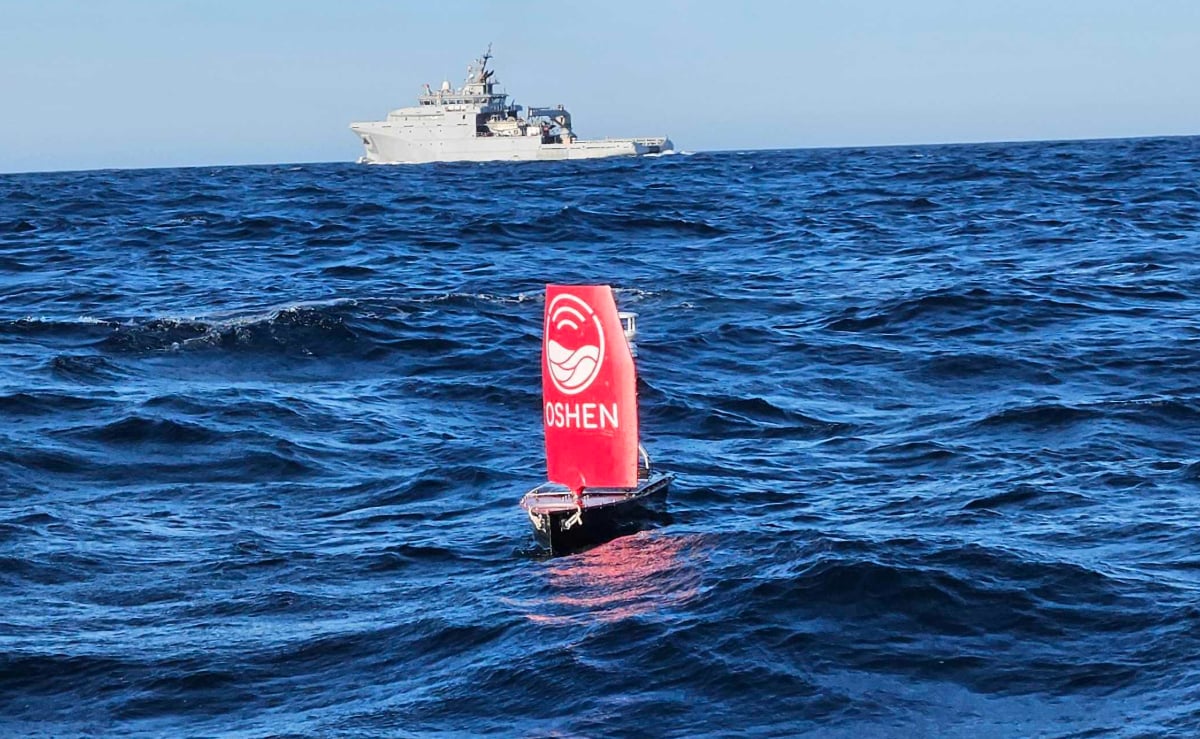
Oshen, a UK maritime technology company based in Plymouth, is testing what it calls the first “acoustic picket line” built from small robotic sailboats at REPMUS26, a monthlong multinational maritime robotics exercise underway in Portugal. The company has deployed six of its C-Star sailboats, each about 1.2 meters (4 feet) long and fitted with a hydrophone, to form a distributed underwater listening network, and is testing the concept against live targets for the first time.
Passive sonar detection has traditionally relied on towed arrays, long cables carrying up to 100 hydrophones pulled behind surface ships. Those arrays give precise local detection and bearing data but cover a limited area and pick up noise from the towing vessel itself. Oshen’s approach spreads many small, low-cost sensors across a wide stretch of ocean instead, using a fleet of C-Stars to form what the company describes as an acoustic barrier that can be reshaped based on the threat picture. Because the boats are spread across a wide area rather than clustered on one vessel, the network can pinpoint a target’s location rather than just its bearing, and can help direct other sensors such as towed arrays toward it.
“A defensive network built from a host of individual hydrophone platforms behaves very differently to one built from a handful of expensive towed arrays,” said Gordon Jones, Defence and Oceanography Lead at Oshen. “It is wider, more resilient and harder for an adversary to characterise. REPMUS is the first real test of that model against live targets, and it points the way to how persistent undersea surveillance can be evolved.”
“REPMUS embodies what our technology is designed to do: take a capability that normally depends on a handful of expensive assets and turn it into something that can be deployed at scale, cheaply and continuously,” said Anahita Laverack, CEO of Oshen. “There are many potential applications, including an acoustic picket line to help protect the GIUK Gap.”
The GIUK Gap, the stretch of ocean between Greenland, Iceland, and the United Kingdom, has been a chokepoint for tracking submarines transiting between the North Atlantic and open ocean since the Cold War, when the U.S. Navy’s SOSUS seabed hydrophone network monitored the same waters.
Oshen says its C-Stars are built to survive extended missions in rough conditions, and the company has said one of its boats transmitted data from inside a Category 5 hurricane. Being small and low in the water, the boats are difficult to detect, and Oshen argues that even if individual units are spotted or lost, the wider network can keep functioning and makes it harder for an adversary to work out which vessels are carrying active sensors.
REPMUS is designed to test more than new hardware. The exercise brings together vessels ranging from Oshen’s 50-kg C-Stars to 3,000-tonne manned frigates, and organizers use it to check whether command and control systems can coordinate across that range of platforms in a congested environment. Oshen said its engineers worked with naval partners ahead of the exercise to integrate its software with NATO systems and make sure data from the C-Stars would not overwhelm communication channels.
Oshen currently runs three active projects with the Royal Navy, including one through the UK’s Defence and Security Accelerator program, and holds a Cooperative Research and Development Agreement with the U.S. Navy covering single-beam sonar applications. The company plans to bring eight C-Stars to the Maritime Big Play exercise in San Diego next month to test the same acoustic picket line concept in a U.S. setting.
Content preview only. Full article available at source. View Full Article
Oshen is testing six C-Star sailboats equipped with hydrophones during the REPMUS26 exercise in Portugal to establish an acoustic picket line for submarine detection. This innovative approach aims to enhance undersea surveillance capabilities, particularly in the strategically important GIUK Gap. The exercise also evaluates the integration of these systems with NATO command and control.
- Oshen is testing its C-Star sailboats at the REPMUS26 exercise in Portugal.
- The C-Stars are designed to create an acoustic picket line for submarine detection.
- The technology aims to provide a more resilient and wide-reaching surveillance capability.
- The GIUK Gap is identified as a critical area for submarine tracking.
- Oshen has integrated its systems with NATO for improved command and control.