
Ukraine F-16 First Kill Exposes Russia Su-35 Problem
 Alexandra Reeves
Ukraine F-16 First Kill Exposes Russia Su-35 Problem
One air-to-air kill does not make Ukraine an air-superiority power. It does, however, puncture a Russian assumption that mattered: that its advanced fighters could keep bullying the edge of Ukrainian airspace without meeting a Western-armed Ukrainian jet on equal tactical terms.
Defense News reported on July 23 that Gen. Dan Caine, chairman of the U.S. Joint Chiefs of Staff, told a Senate Appropriations Committee hearing that a Ukrainian F-16 had recently shot down a Russian fighter for the first time. Caine did not identify the Russian aircraft. Ukraine earlier announced the loss of a Russian Su-35 on the eastern front, while Russian military channels acknowledged an Su-35 loss but disputed the kill mechanism. That caveat matters. The cleanest verified fact is narrower but still important: according to the top U.S. general, a Ukrainian F-16 has now scored its first air-to-air kill against a Russian fighter.
The Better Jet Did Not Necessarily Win
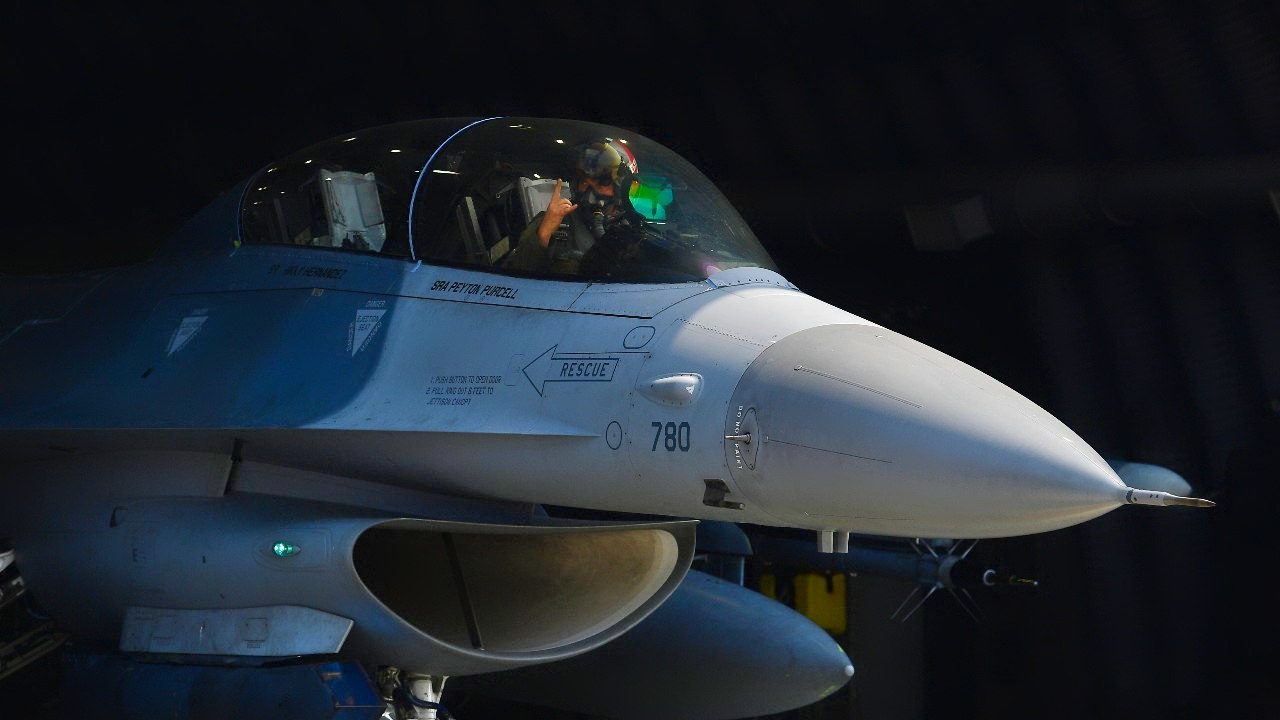
The tempting headline is that the F-16 beat the Su-35. That is probably too neat. The Su-35S remains one of Russia’s most capable operational fighters, with a powerful Irbis-E radar, long-range air-to-air weapons, and kinematics that outclass the older F-16AM/BM airframes transferred to Ukraine by the Netherlands and Denmark. Sandboxx noted that Ukraine’s F-16s are upgraded 1970s and 1980s aircraft, closer to early-2000s U.S. Air Force Vipers than to modern Block 70 jets.
On paper, Russia should still prefer this fight. The Su-35 can detect fighter-sized targets at far longer ranges than the mechanically scanned AN/APG-66(V)2 radar fitted to many older F-16 variants. It can also carry long-range missiles such as the R-77M. Ukraine, by contrast, is known to use AIM-120 AMRAAM variants including the AIM-120C-8, which The War Zone assessed as a modern and capable missile but not a magic eraser for the sensor gap.
That is exactly why the episode is interesting. If the Russian aircraft was indeed a Su-35, then Ukraine did not win because it suddenly possessed the superior fighter. It won because the engagement geometry, ground-based sensors, electronic warfare, pilot discipline, and missile employment created a local advantage. Modern air combat is rarely a duel in a clean sky. It is a network ambush, and Ukraine appears to be getting better at building those ambushes.
Ukraine Is Turning F-16s Into Air Defense Nodes
Western commentary spent years asking whether F-16s would allow Ukraine to conduct offensive counter-air operations. That was the wrong question. The aircraft arrived too late, in too small a number, and with too many maintenance constraints to transform the air war by themselves. The better question is whether they can strengthen Ukraine’s layered defense enough to make Russian strike packages and glide-bomb operations more expensive.
The early evidence says yes, with limits. Ukrainian air force spokesman Yuriy Ihnat told NOS that F-16s had shot down 2,200 of roughly 3,000 Russian drones and missiles intercepted by Ukrainian forces. That figure should be treated carefully because it comes from a Ukrainian official, but it aligns with how the aircraft have actually been used: defending cities and infrastructure from Shahed drones and cruise missiles, rather than roaming deep into contested airspace.
This first reported fighter kill suggests an incremental shift. The F-16 is no longer only a defensive clean-up tool against drones and missiles. It can also participate in a wider kill chain against Russian tactical aviation, especially when paired with ground-based air defense, radar coverage, and timely cueing. That does not mean Ukrainian pilots will start sweeping the skies. It means Russian pilots may have to treat the threat envelope with more respect.
Russia Still Has the Glide Bomb Advantage
Here is the uncomfortable part for Kyiv: this kill does not solve the glide-bomb problem. RUSI airpower analysts quoted by NOS have argued that the F-16 was never the ideal answer to Russian stand-off bombing. Justin Bronk said Ukraine has faced more than 150,000 Russian glide-bomb attacks, including 500 kg, 1,500 kg, and sometimes 3,000 kg weapons. Those bombs have done more to break Ukrainian positions than many Western debates about fighter deliveries admitted.
To stop that campaign, Ukraine needs to push Russian aircraft farther from launch points, protect scarce Patriot and SAMP/T interceptors, and preserve enough short- and medium-range missiles for daily attacks. A single F-16 kill helps tactically and psychologically, but it does not close the missile stockpile problem. Nor does it make maintenance easier for an air force operating Western jets under wartime pressure, with limited spares and a pilot pipeline that cannot be rushed indefinitely.
Still, Moscow has a problem of its own. If Ukrainian F-16s can occasionally threaten Russian fighters while also intercepting drones and cruise missiles, Russia has to plan around a more complicated defensive system. That may force Su-35 and Su-34 crews to launch from safer distances, rely more heavily on stand-off profiles, or accept higher risk near the front. None of those choices are free.
The Alliance Lesson Is About Integration
NATO should resist congratulating itself too loudly. The alliance delivered F-16s slowly, trained pilots cautiously, and paired the jets with a missile supply chain that remains politically fragile. But Ukraine has again shown that imperfect Western equipment can matter when absorbed into a combat-tested network.
The lesson is not that old F-16s can defeat modern Russian fighters in a fair fight. The lesson is that fair fights are for airshow brochures. Ukraine is learning to combine Western missiles, Soviet-era habits, ground-based air defense, dispersed operations, and real battlefield feedback into a system that keeps surprising Russia.
The next thing to watch is whether Russia changes its tactical aviation behavior along the eastern front. If Su-35 and Su-34 crews start operating more cautiously, the kill will have achieved more than a symbolic milestone. If they do not, Ukraine will try to repeat the ambush. Either way, the old Russian comfort zone near Ukrainian airspace just got smaller.
A Ukrainian F-16 recently shot down a Russian Su-35 fighter on the eastern front, marking a significant development in air combat dynamics. This engagement demonstrates Ukraine's improved capabilities in air defense and tactical operations, despite the ongoing challenges posed by Russian glide-bomb attacks. The incident suggests a shift in the operational environment, requiring Russian pilots to adapt their tactics in response to the emerging threat from Ukrainian F-16s.
- A Ukrainian F-16 shot down a Russian Su-35 fighter for the first time.
- The engagement geometry and electronic warfare contributed to Ukraine's success.
- Ukrainian F-16s have intercepted 2,200 out of 3,000 Russian drones and missiles.
- Russia has conducted over 150,000 glide-bomb attacks against Ukraine.
- The F-16's role is evolving from purely defensive to offensive capabilities against Russian aviation.