
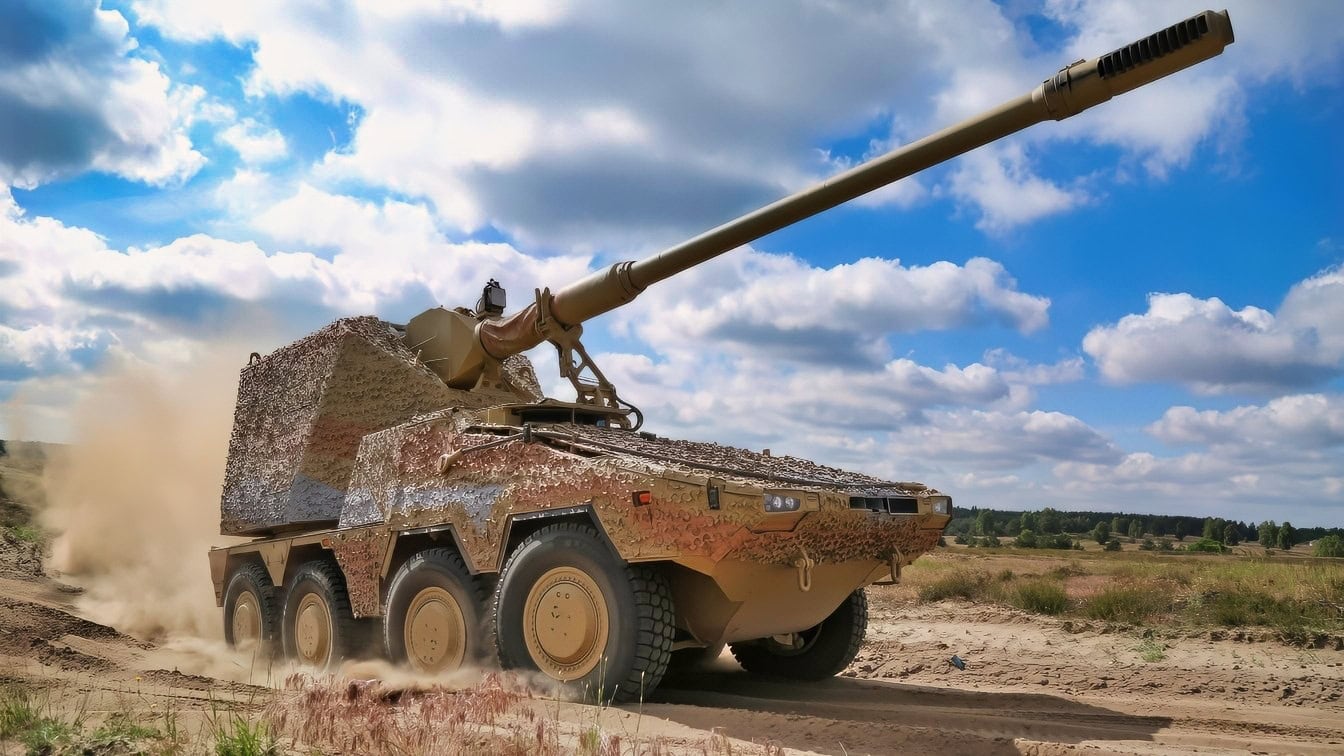
 RCH 155 Creative Commons Photo
Summary and Key Points: Ukraine has taken delivery of its first RCH 155 wheeled howitzers, nearly four years after ordering them, and in doing so has become the only country in the world operating the system. Germany, Britain, Qatar and Switzerland have all placed orders, and none of them have received anything yet — which means Berlin has sent Kyiv a weapon its own army does not have. The RCH 155 mounts a NATO-standard 155mm/L52 gun, the same family carried by the PzH 2000, on a Boxer 8×8 armored hull. It reaches about 40 kilometers with base-bleed ammunition and roughly 54 with V-LAP rounds, fires eight rounds a minute, and carries 30 rounds internally.
The RCH 155 Has Arrived in Ukraine
Nearly four years after they were ordered, Ukraine has received its first RCH 155 wheeled howitzers.
Thanks to information provided by German Aid to Ukraine, a tracker of Germany’s military assistance to Ukraine, the first batch of the wheeled howitzers has finally arrived, despite a remarkable gap between the initial order and first delivery.
Here’s what we know.
The Details
The RCH 155 is a self-propelled howitzer built around the Boxer 8×8 armored vehicle.
Its current version, the Artillery Gun Model, or AGM, is unmanned and fully automated.
The crew of two remains inside the protected hull, rather than working outside the vehicle in an exposed position.
It uses the same NATO-standard 155mm/L52 gun family as Germany’s PzH 2000. KNDS, the manufacturer, lists its range as 40 kilometers with base-bleed ammunition and roughly 54 kilometers with V-LAP rounds.
However, these numbers depend on specific projectiles, explosive charges, and environmental conditions.
But its rate of fire is more consistent, at eight rounds per minute, with 30 rounds carried internally.
The RCH 155’s most unique feature is its ability to fire while on the move.
That is not merely a marketing gimmick related to “shoot and scoot,” in which artillery vehicles fire from a stationary position and quickly move away.
Instead, the RCH 155 can begin a fire mission without deploying stabilizing legs, fire, and continue moving.
In theory, this significantly reduces the time available for counter-battery systems, drones, and loitering munitions to locate and attack the RCH 155.
Advantages and Limitations
Compared with a PzH 2000, the RCH 155 is lighter, at under 40 tons rather than 56 tons, and faster on roads, with a respectable 700-kilometer range.
It also needs only two crew members, compared to about five for the PzH 2000. The Boxer chassis also offers armored protection and commonality with an existing family of command, infantry, and support vehicles.
Those attributes make it attractive for medium forces and long-distance deployment.
A wheeled vehicle is generally cheaper and easier to move by road than a tracked vehicle, while automated loading and laying systems reduce manpower and can improve consistency.
Unmanned operation also separates the crew from the ammunition-handling machinery.
But the trade-off is mobility off-road.
Tracks distribute better over soft ground and generally perform better in mud, snow, and difficult terrain.
The RCH 155’s ammunition load is also smaller than that of the PzH 2000, and its sophistication brings a demanding maintenance and training burden to the vehicle.
Its ability to fire accurately while on the move is certainly a very valuable survivability feature, but it does not remove the need for camouflage, dispersion, electronic protection, or rapid relocation.
Compared to other similar platforms like France’s Caesar or Sweden’s Archer, the RCH 155 is better protected and more automated.
Caesar is lighter and easier to deploy, but its crew normally operate an exposed weapon system, and the vehicle must stop to fire.
Archer is also highly automated and easy to emplace, but the RCH 155 combines that automation with a Boxer armored hull and can fire while moving.
Current Operators
As of this year, Ukraine is the only country to have received and operated the RCH 155.
Germany, Britain, Qatar, and Switzerland have all placed orders, but their deliveries have not yet been fulfilled.
Ukraine’s program covers 54 RCH 155s in total, in three batches of 18 each. Britain has ordered 72 in total, with deliveries anticipated from 2028 onwards.
Switzerland has ordered only the artillery modules, with plans to mate them to its Piranha 10×10 chassis, while Qatar has contracted for the RCH 155.
German Aid to Ukraine
German aid to Ukraine was initially bumpy.
In the first months of 2022, following Russia’s full-scale invasion, Berlin moved extremely cautiously — many said slowly — initially supplying some body armor, then shifting to defensive weapon systems only, and eventually to anti-tank weapons, air-defense missiles, ammunition, and vehicles.
It then moved toward artillery and heavier armored vehicles, including Gepard anti-aircraft guns, PzH 2000s, Marder infantry fighting vehicles, Leopard 1 and Leopard 2 tanks, IRIS-T and Patriot air defense systems, and MARS II rocket launchers.
The financial scale rose as well, from about €1.68 billion in military assistance in 2022 to more than €5 billion in 2023, with Berlin allocating roughly €7.1 billion for military support in 2024.
By the summer of 2026, the German government had provided or earmarked €57.6 billion in military aid, making it one of the more significant contributors to Ukraine.
About the Author: Caleb Larson
Caleb Larson is an American multiformat journalist based in Berlin, Germany. His work covers the intersection of conflict and society, focusing on American foreign policy and European security. He has reported from Germany, Russia, and the United States. Most recently, he covered the war in Ukraine, reporting extensively on the war’s shifting battle lines from Donbas and writing on the war’s civilian and humanitarian toll. Previously, he worked as a Defense Reporter for POLITICO Europe. You can follow his latest work on X.