
Ukraine turns Shpatel decoy drone into cheap strike weapon
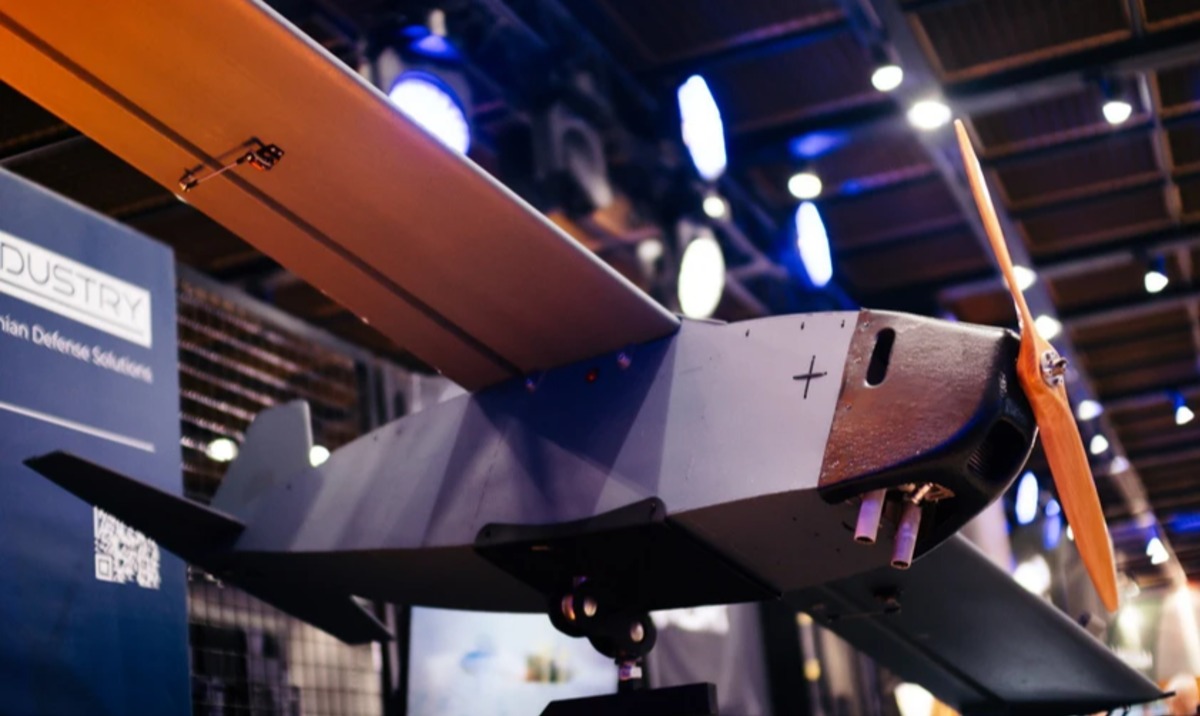
Ukraine’s DG Industry company has unveiled a “middle strike” version of its Shpatel decoy drone, turning a low-cost air defense distraction platform into a one-way attack drone with a warhead of up to 8 kg (18 lb) and a claimed range of up to 250 km (155 miles).
Company representatives described the new version to the Ukrainian defense outlet Oboronka at the Brave1 Advantage event, where domestic manufacturers showcased systems built for a battlefield that now consumes drones by the thousands. DG Industry said the modified Shpatel can fly at speeds of up to 130 km/h (81 mph), giving Ukrainian units another relatively inexpensive option for strikes beyond the immediate front line.
The original Shpatel was designed as a decoy, a category of unmanned aircraft meant to trigger, confuse, or saturate enemy air defenses rather than destroy a target directly. Russia and Ukraine both use decoys to force radar operators and missile crews to make costly choices under pressure. Even a cheap aircraft can matter if it causes an opponent to reveal an air defense position, waste an interceptor, or split attention during a larger strike package.
DG Industry’s new version changes that equation by adding a larger warhead and more flexible mission software. The company says the “middle strike” Shpatel can carry up to 8 kg (18 lb) of explosives, which places it below heavy long-range attack drones but above many small first-person-view strike drones used near the front. That payload would be enough for attacks against light vehicles, exposed equipment, radar components, fuel points, ammunition handling areas, or other soft targets, depending on fuse design and accuracy.
“Thanks to the updated control system, we can use this aircraft for different missions. It can serve as a relay, circling at an altitude of more than 1 km (3,280 ft), or as a strike drone,” a DG Industry representative told Oboronka.
That communications role may prove as important as the warhead. A drone flying in a circular pattern above 1 km (3,280 ft) can act as an airborne relay, extending the control range of other unmanned systems operating closer to the ground. This matters in Ukraine, where electronic warfare has become one of the defining features of the war, and where drone operators often lose signals because of terrain, jamming, or the curvature limits of low-altitude radio links.
The company says the updated Shpatel uses a modern communications system that can maintain a stable control channel over a considerable distance. DG Industry did not disclose the radio architecture, anti-jamming features, guidance method, or whether the aircraft can complete missions autonomously if the control link is lost. Those details matter because a 250 km (155 mile) drone needs more than endurance and fuel; it needs navigation and communications that can survive Russian jamming long enough to reach the target area.
The baseline Shpatel decoy drone has already been used by some units of Ukraine’s Defense Forces since 2025, according to the company information provided to Oboronka. That version launches from a pneumatic catapult, can fly up to 420 km (261 miles), and carries about 1 kg (2.2 lb) of explosives for self-destruction. The longer range of the decoy variant compared with the strike version likely reflects the payload tradeoff, since adding a heavier warhead usually reduces endurance or requires changes to fuel, structure, or flight profile.
DG Industry says one Shpatel decoy costs about $5,000, and the company told Oboronka that the middle-strike version costs roughly the same. If that figure holds in production, the drone would sit in a price category closer to expendable battlefield systems than to cruise missiles or larger long-range strike drones. That is exactly where Ukrainian industry has been pushing since 2022: weapons cheap enough to build at scale, but capable enough to impose real costs on Russian forces.
Ukraine’s “middle strike” category has become a growing layer between short-range FPV drones and deep-strike systems that can hit targets hundreds of kilometers inside Russia. These drones are usually designed for operational depth rather than tactical trench-line attacks, giving commanders a way to strike logistics sites, air defense support equipment, command posts, and staging areas that sit beyond artillery range. They are not strategic weapons, but they can pressure the rear areas that keep front-line formations supplied.
A 250 km (155 mile) range is enough to reach many targets in occupied Ukrainian territory from launch areas well behind friendly lines. It also gives units more room to move launch crews away from predictable positions, especially if the drone can be fired from a compact catapult rather than a runway. The catapult launch method lowers infrastructure needs and lets operators disperse launch points across fields, roads, or concealed areas.
The new strike system reflects a broader Ukrainian habit of repurposing platforms quickly once battlefield demand becomes clear. A decoy aircraft already has an airframe, launch method, and production line. Turning it into a strike drone means trading some range for payload, while keeping the basic economics and logistics of a known platform. That is faster than starting from a clean sheet design, especially in a war where useful systems often move from prototype to front-line adaptation in months.
Content preview only. Full article available at source. View Full Article
Ukraine's DG Industry company unveiled a modified Shpatel decoy drone that can now function as a strike drone with a warhead of up to 8 kg and a range of 250 km. This new version can fly at speeds of up to 130 km/h and serves dual purposes as a strike weapon and a communications relay. The drone is designed to be cost-effective, with a price tag of around $5,000, making it suitable for large-scale production and deployment by Ukrainian forces.
- DG Industry has developed a 'middle strike' version of the Shpatel decoy drone.
- The new drone can carry a warhead of up to 8 kg and has a range of 250 km.
- The modified Shpatel can fly at speeds of up to 130 km/h.
- The drone can serve as both a strike weapon and a communications relay.
- The cost of the new drone is approximately $5,000.