
Ukraine's F-16s Are Burning Hours Killing 2,500 Russian Drones
 Alexandra Reeves
Ukraine's F-16s Are Burning Hours Killing 2,500 Russian Drones
Ukraine has found a very expensive way to solve a cheap Russian problem. Its F-16s have reportedly destroyed more than 2,500 Geran and Gerbera one-way attack drones, according to Justin Bronk's new RUSI assessment cited by Defense News. That sounds like success, and tactically it is. Strategically, it is also a warning light.
A fighter jet can shoot down a drone. The harder question is whether it should. Russia is producing more than 6,000 one-way attack drones per month, according to RUSI. Ukraine has an estimated 39 F-16s in service, out of roughly 79 promised by European donors, plus a small Mirage 2000-5 force and a shrinking Soviet-legacy fleet. Those numbers do not describe an air force with spare capacity. They describe an air force being asked to be interceptor, strike platform, cruise-missile hunter, morale symbol and maintenance miracle all at once.
Here is the uncomfortable part for NATO: Ukraine is not misusing the F-16 because it misunderstands airpower. It is using the F-16 this way because the alliance has not given Ukraine enough cheaper layers to keep the jets out of the drone-killing business.
The Drone Math Is Brutal
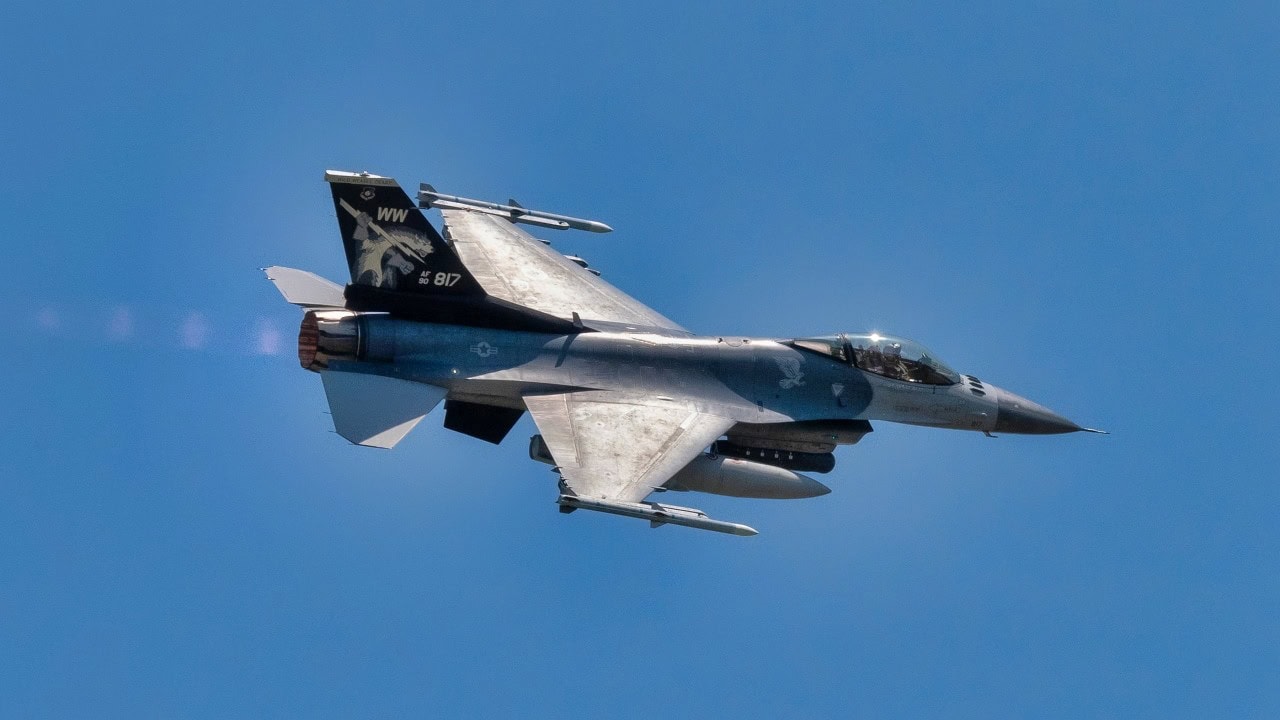
RUSI describes the 2026 air war as fundamentally different from the first two years after Russia's full-scale invasion. Western fighters now form the core of Ukraine's combat aviation, with F-16s in the 107th Wing and Mirage 2000-5s in smaller numbers. Air defence sorties are the most common mission because Russia is launching massed strike waves several times per week.
Those waves are built to exhaust systems, not merely to hit targets. They begin with hundreds of propeller-powered Geran-2 drones, jet-powered Geran-3 drones and Gerbera decoys. Then come cruise missiles such as Kh-101 and 9M728 Iskander-K. Ballistic missiles - Iskander-M, S-400 in a ground-attack role and Kh-47M2 Kinzhal - follow in smaller but much harder-to-stop numbers.
ISW's August 1 assessment gives the scale of the latest pattern. It reported that Russian forces launched 35 missiles and 185 drones overnight from July 31 to August 1, mainly targeting Kyiv Oblast. Ukrainian air defences intercepted or suppressed 154 strike drones but only a small number of missiles, while President Volodymyr Zelensky tied the ballistic missile problem to Patriot interceptor shortages.
That is where the F-16 gets dragged into the wrong fight. It can engage drones with AIM-9 Sidewinders, its 20-mm cannon and US-supplied AGR-20 APKWS II guided rockets. But every sortie consumes airframe hours. Every missile fired at a cheap drone is a missile unavailable for a cruise missile. Every maintenance cycle pulls scarce aircraft out of a fleet that Ukraine cannot regenerate quickly.
SHORAD Is Not Glamorous, So It Gets Underfunded
The cheaper answer is dense short-range air defence. Ukraine has built belts of mobile teams using machine guns, anti-aircraft artillery, Gepard and Shilka guns, MANPADS such as Stinger and Igla, and thousands of interceptor drones. RUSI notes that these systems now destroy a majority of the Russian Geran and Gerbera drones that are shot down.
That is the good news. The bad news is that this model is brutally labour-intensive. A short-range weapon covers a small patch of airspace. To make the system work, Ukraine needs depth, density and people - lots of people - across a 745-mile front line and around rear-area cities.
NATO should be paying attention. Bronk told Defense News that NATO cannot simply copy Ukraine's SHORAD density because the personnel requirement is too high to sustain. That is a rare sentence that should make Brussels uncomfortable. The alliance has spent years talking about lessons from Ukraine. One of the biggest lessons is that modern air defence is not just a procurement problem. It is a manpower, training, munitions and basing problem.
The F-16 is not failing in Ukraine. It is being made to do too many jobs because cheaper defensive layers remain too thin.
The Fighter Should Be Reserved for Higher-Value Work
Ukraine needs F-16s for missions that cheaper systems cannot do well. They are useful against cruise missiles. They can deliver JDAM, GBU-39 Small Diameter Bombs and French AASM Hammer glide bombs against Russian battlefield and logistics targets. They also impose risk on Russian aircraft. In July, Defense News reported the first confirmed destruction of a Russian Su-35 by a Ukrainian F-16, an important event given the Su-35's radar and missile-range advantages and the presence of Russian long-range ground-based air defences near the front.
Those are high-value missions. Shooting down endless drones is not. It may be necessary on a given night, but if it becomes routine, it turns the F-16 into a very costly flying SHORAD battery.
The maintenance issue is not a footnote. Fighter aircraft have finite airframe hours before deep maintenance is required, and that work is not something Ukraine can do casually at dispersed wartime strips. RUSI's warning is blunt: the fighter-drone interception model is unsustainable if Russia keeps producing drones at scale.
Russia Is Also Being Stretched
This is not a one-sided exhaustion story. Ukraine's own long-range drone campaign is forcing Russia to defend oil and gas infrastructure across a much larger area. RUSI argues that these strikes are straining Russian ground-based air defence, especially Pantsir and Tor systems used for counter-UAV work, and pulling coverage deeper inside Russia.
The Guardian's August 2 Ukraine briefing reported Ukrainian claims of drone strikes on three oil refineries in Bashkortostan nearly 1,600 kilometres from Ukraine, along with a strike on the sanctioned Russian container ship Yanina in the Black Sea. Whether every claim survives independent confirmation is less important than the operational pattern: both sides are using cheap long-range drones to make the other side spend scarce defensive capacity.
That is the air war now. It is not a clean contest between exquisite aircraft. It is a contest over who can force the other side to spend the wrong interceptor, launch the wrong sortie and wear out the wrong system.
The NATO Lesson Is Awkward
Everyone likes the elegant answer: more F-16s, more Patriots, more high-end interceptors. Ukraine needs all of those. But the cheaper answer may matter more over time: radar-guided guns around airbases, more interceptor drones, more APKWS-class cheap air-launched options, more trained mobile air-defence teams and more mundane ammunition production.
If NATO only buys the prestigious layer, it will repeat Ukraine's problem at alliance scale. Airbases in Poland, Romania, the Baltics and Germany will not be protected by a handful of glamorous batteries if Russia opens a war with decoys, drones and cruise missiles designed to empty magazines before the serious weapons arrive.
The key finding is simple. Ukraine's F-16s are proving their value, but their value is being diluted by drone attrition work that cheaper systems should absorb. The next thing to watch is whether Ukraine's partners fund the unglamorous layers quickly enough to preserve fighter hours for cruise-missile defence and strike missions. If they do not, Russia does not need to defeat the F-16 in air combat. It only has to keep making Ukraine fly it against targets that cost a fraction of the sortie.
Ukraine's F-16s have destroyed over 2,500 Russian drones while engaging in air defense sorties against massed strikes targeting Kyiv Oblast. The Ukrainian Armed Forces are utilizing their limited F-16 fleet, alongside other systems, to counter a significant increase in Russian drone production. This operational strain highlights the need for more effective and cheaper air defense solutions to preserve fighter capabilities for higher-value missions.
- Ukraine's F-16s have destroyed over 2,500 Russian drones.
- Russia produces over 6,000 drones per month.
- Ukraine has 39 F-16s in service out of 79 promised.
- Ukrainian air defenses intercepted 154 strike drones in a recent attack.
- The F-16 is being used for drone interception, which is not its primary role.