
Ukraine's FPV Strike on Mi-28 Should Worry NATO
 Alexandra Reeves
Ukraine's FPV Strike on Mi-28 Should Worry NATO
A cheap Ukrainian FPV drone hitting a Russian Mi-28 attack helicopter is easy to treat as another clever battlefield clip. That would be a mistake. The point is not that one helicopter went down near Belgorod. The point is that a weapon class NATO still tends to file under "small drones" is now reaching into missions that used to belong to air defence missiles, fighters, and very lucky machine-gunners.
The Strike Was Small, But Not Minor
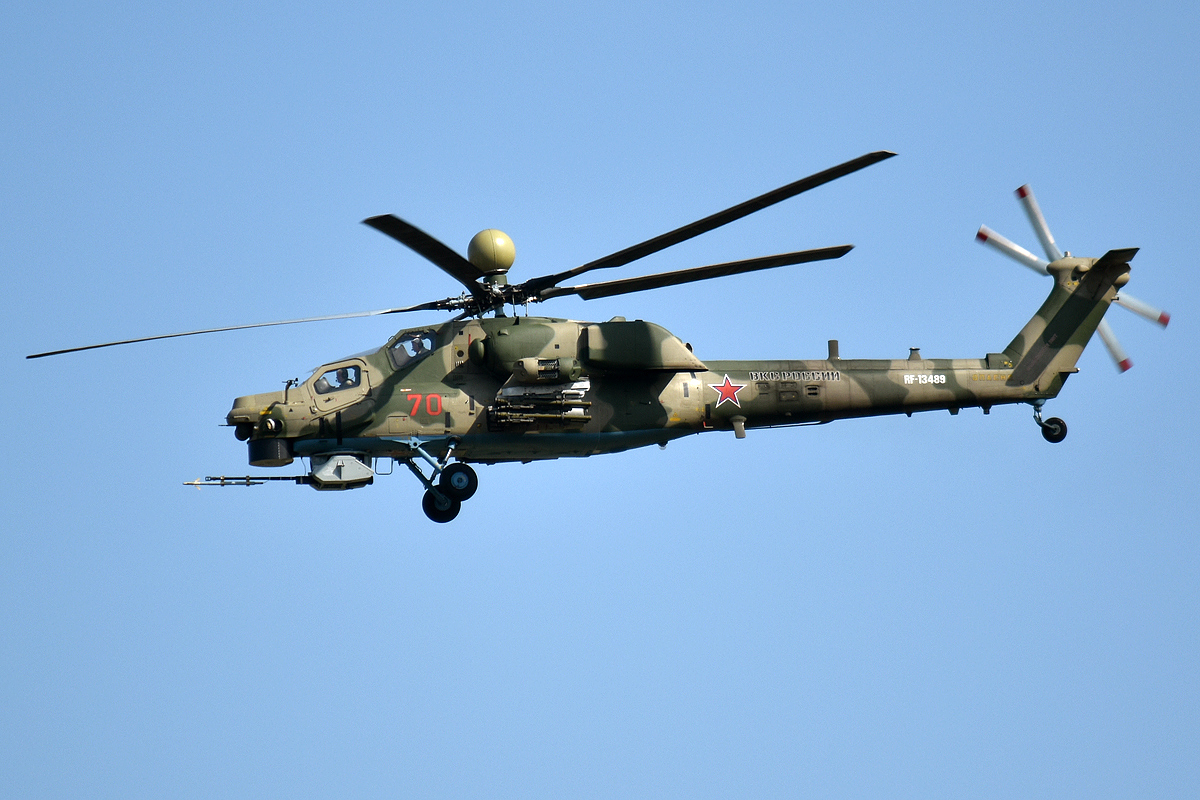
According to Defence Blog, Ukraine's Unmanned Systems Forces said operators from the Rarog unit struck a Russian Mi-28 attack helicopter with an FPV drone near Vyazovoye in Russia's Belgorod region at around 10:00. The reported impact point matters: the drone hit the tail boom, not the armored cockpit. Robert Brovdi, the Ukrainian commander better known as Madyar, released footage and described the helicopter's end in five blunt words.
"Nose-first into the ground," Brovdi said, according to Defence Blog's account of the video release.
The Mi-28, NATO reporting name Havoc and often marketed by Russia as the Night Hunter, is not a light reconnaissance aircraft. It is a dedicated attack helicopter designed to hunt tanks and provide fire support under hostile conditions. Open-source specifications cited by Defence Blog put the type at up to 324 km/h, powered by two Klimov TV3-117 turboshaft engines rated at roughly 2,200 horsepower each, with armor intended to protect the cockpit from 12.7 mm and 14.5 mm fire. In other words, it was built to survive the kind of battlefield that existed before every squad could improvise a precision air-to-air threat from a racing drone, a warhead, and a video link.
The Economics Are Brutal
This is where the usual Western comfort language breaks down. A Mi-28 costs millions of dollars. Open-source estimates commonly place individual aircraft in the $16 million to $18 million range, depending on variant and package. An FPV drone costs a tiny fraction of that. Even if the strike required reconnaissance, relay links, trained operators, and several failed attempts, the exchange ratio is obscene.
Oryx, the open-source loss tracker, lists 20 Russian Mi-28 attack helicopters destroyed or damaged since the start of the full-scale invasion, including both destroyed aircraft and airframes damaged on the ground. Not every loss came from a drone. That is not the point. The trend is that Russia's rotary-wing fleet is being forced into an environment where traditional helicopter strengths, low-altitude flight, pop-up attacks, armor, and proximity to the front, now create new vulnerabilities.
Ukraine has been here before. Defence Blog notes earlier Ukrainian FPV or drone strikes on Mi-28s, including a 2024 Kursk-region hit, a 2025 Mi-28N destruction near Kotliarivka in occupied Donetsk Oblast, and an April 2026 strike on Mi-28 and Mi-8 aircraft at a Russian airstrip in Voronezh Oblast more than 150 kilometers from the front. The Belgorod event is therefore not an isolated trick. It is part of an emerging method.
NATO Still Thinks Too Much Like the Helicopter Age
Everyone in NATO says they understand the drone lesson from Ukraine. I am less convinced NATO has absorbed the rotary-wing lesson. Attack helicopters remain embedded in Western concepts for close air support, anti-armor defence, reconnaissance by fire, and rapid reaction along an exposed flank. The U.S. Apache, the British Apache AH-64E, the French Tiger, and several eastern European helicopter fleets are not Mi-28s, but they share the same problem: they were designed around threats that are bigger, louder, more expensive, and easier to model.
A helicopter can carry electronic warfare equipment. It can use terrain masking. It can fly fast relative to a quadcopter. None of that makes it immune to a patient drone team waiting near a route, landing zone, refuel point, or border approach. The danger is not a single FPV drone outrunning a helicopter in open sky. The danger is a dense hunting zone where drones, observers, signals intelligence, and social-media-speed targeting compress the aircrew's decision window to seconds.
That matters especially for NATO's eastern flank. In a Baltic or Polish scenario, helicopters would be asked to move quickly through cluttered airspace under jamming, artillery threat, and mass drone presence. The old assumption was that low altitude helped aircraft hide from radar and long-range missiles. Ukraine is showing the uncomfortable update: low altitude also puts helicopters inside the kill box of small, cheap, visually guided systems.
Russia Is Learning Too
There is a second uncomfortable point. This is not only a Ukrainian advantage. Russia watches the same footage. Russian forces have spent years adapting Lancet loitering munitions, FPV drones, fiber-optic drones, and reconnaissance-strike loops. If Ukraine can hunt a Mi-28 with a drone, Russia can apply similar logic against Ukrainian and NATO-style aviation if it gets the chance.
For NATO, the answer is not to scrap helicopters. That is a lazy conclusion. Helicopters still move firepower and sensors in ways ground forces need. But NATO has to stop treating counter-drone defence as a base-protection problem or a procurement category for jammers and shotguns. It is becoming an airworthiness problem. If a helicopter cannot detect, evade, blind, or defeat a $1,000-class drone before the drone reaches its tail rotor or engine area, then the aircraft's survivability model is outdated.
What To Watch Next
The immediate question is whether Ukrainian units can repeat this against moving helicopters rather than aircraft hovering, landing, or operating predictably near the border. The broader question is whether Russia changes its helicopter tactics in Belgorod, Kursk, and occupied Ukraine by pulling aircraft farther back, flying higher, leaning harder on glide bombs, or adding drone screens around aviation routes.
The answer NATO should care about is probably simpler. Ukraine is not just destroying Russian equipment. It is stress-testing assumptions Western armies still carry into exercises. The Mi-28 was armored for the battlefield it expected. It was apparently killed by the battlefield that arrived instead. That is the part Brussels should find difficult to sleep on.
Ukrainian FPV drone operators from the Rarog unit struck a Russian Mi-28 attack helicopter near Vyazovoye at around 10:00, hitting the tail boom and causing it to crash. This incident highlights the growing effectiveness of drones against traditional air assets, raising concerns for NATO about the vulnerability of helicopters in combat. The Mi-28, valued at millions, was taken down by a relatively inexpensive drone, indicating a significant shift in battlefield dynamics.
- Ukrainian FPV drone struck a Russian Mi-28 helicopter near Vyazovoye at around 10:00.
- The drone hit the tail boom of the helicopter, causing it to crash.
- The Mi-28 is a dedicated attack helicopter designed for combat.
- This incident is part of a trend of increasing drone effectiveness against traditional air assets.
- The cost-effectiveness of the drone strike raises concerns for NATO regarding helicopter survivability.