
Ukraine's Novorossiysk Strike Just Broke Russia's Last Black Sea Safe Harbor
 Alexandra Reeves
Ukraine's Novorossiysk Strike Just Broke Russia's Last Black Sea Safe Harbor
Russia's Black Sea Fleet has spent the better part of four years running from Ukraine. It fled Sevastopol after Ukrainian missiles and naval drones made Crimea's main base uninhabitable. It packed its remaining warships into Novorossiysk, a commercial port on the Russian mainland, on the theory that a target in the motherland would be safer than one in occupied territory. On Wednesday night, Ukraine called that theory's bluff.
In what President Volodymyr Zelensky called a “unique operation,” Ukrainian forces hit Novorossiysk with rockets, jet drones and naval drones, according to the BBC. Local officials said three people, including an eight-year-old child, were killed and 24 more injured. The Russian agriculture ministry confirmed damage to two major grain export terminals. Ukraine's military claims four Russian warships were struck, including two frigates — a claim Moscow has not commented on.
A Fleet With No Port Left
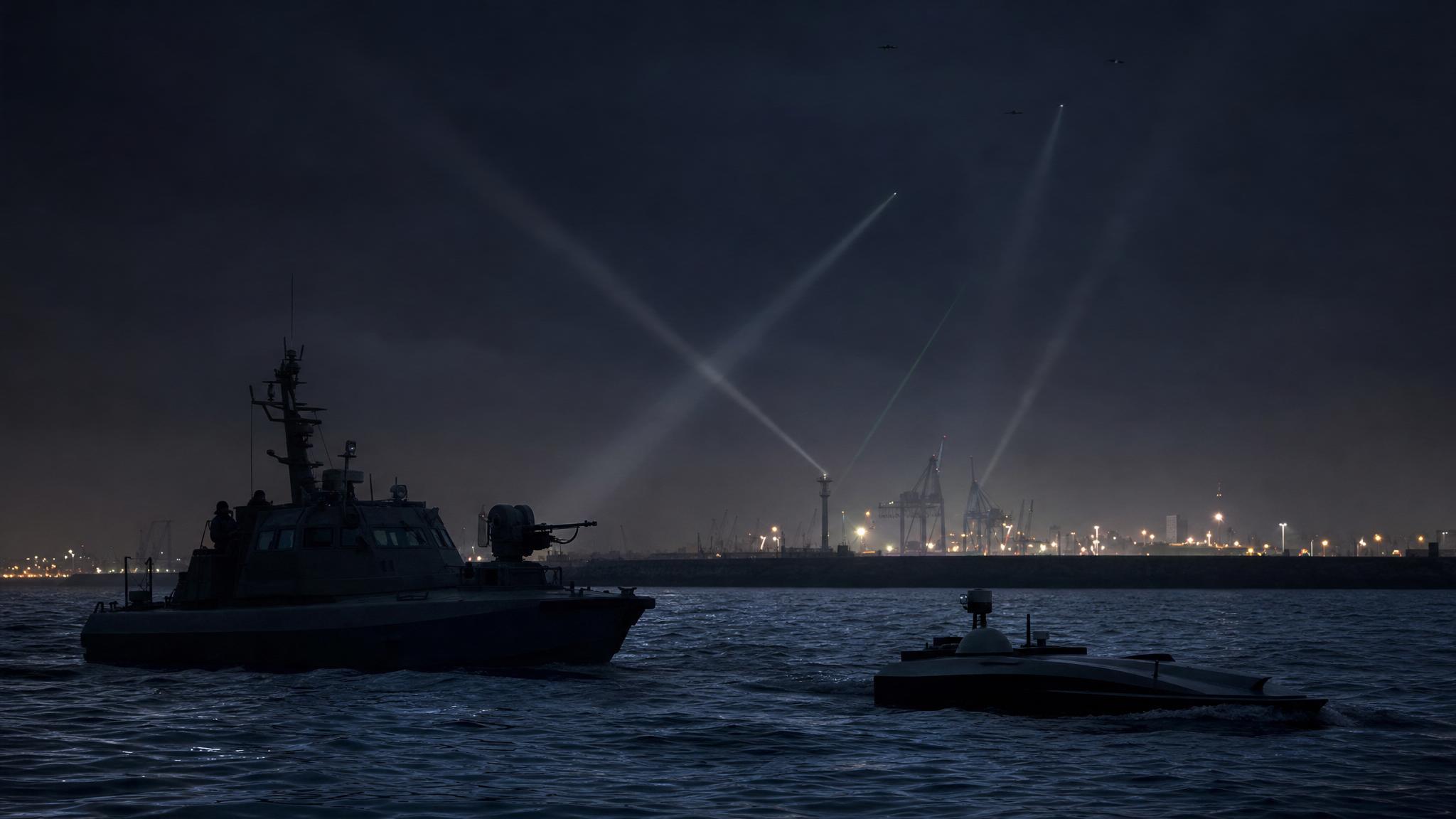
Here's the part that should worry Moscow more than the damage report. Novorossiysk was the Black Sea Fleet's designated safe space — the place it retreated to after Sevastopol proved too exposed. The Russian navy has spent the war trading bases for distance, and now the distance is gone. An emergency was declared in the city after drones struck around the port, damaged pipelines and suspended water supply. Regional governor Veniamin Kondratyev said “several hundred drones” hit the Krasnodar region overnight.
If Ukraine can reach Novorossiysk with this kind of combined-arms package — and it just did — then the Black Sea Fleet is effectively portless. Every warship that survives now has to ask which harbor is next. That's not a tactical problem. That's an existential one for a fleet whose entire reason for existing is to contest the sea it can no longer safely sail.
The Grain War Comes Home
The strike wasn't just about warships. Two major grain export terminals took direct hits, and the Russian agriculture ministry is now “working to redirect cargo flows” to Baltic and Caspian ports and land routes — a phrase that translates as “our main export channel just got a hole punched in it.”
Russia is the world's largest wheat exporter. Moscow-based analytics firms estimate August exports could fall by more than half compared with the five-year average because of Black and Azov Sea disruption. That's the mirror image of what Russia has been doing to Ukraine's Odesa corridor all year — deadly strikes on cargo ships, a 23% drop in Ukrainian exports in July, per the Ukrainian Agribusiness Club. The port war has gone symmetrical, and the side with the vulnerable mainland export infrastructure just discovered it.
Russian foreign ministry spokeswoman Maria Zakharova spun the attack as Ukraine pushing global food prices up. She's not wrong that prices will move. She's just omitting who lit the match — a point that matters enormously for grain buyers in North Africa, the Middle East and Asia who don't care which flag the drone flew.
What It Means
Zelensky, in a CNN interview, gave the numbers that frame the bigger picture: Ukraine has two and a half times fewer interceptors than it did last year, and Russia is firing twice as many ballistic missiles per month as before. A tenth of the current US interceptor stockpile would stop Russia's ballistic missile attacks, he said; five percent would get Ukraine through winter.
Read those two facts together with Novorossiysk and you get the real story. Ukraine can't fully defend its own sky, so it's spending its precision capability on taking away the things Russia needs to keep fighting — ports, grain revenue, and the last naval base that made the Black Sea a Russian lake. That's not a strategy of symmetry. That's escalation by denial, aimed at the single most painful target Moscow has: its own export economy.
“The occupying fleet and all the infrastructure that supports it will not be safe as long as Russian aggression continues.” — Volodymyr Zelensky
What to Watch
Three things. First, whether Russia can actually make the Baltic and Caspian reroute work — every grain ship that has to sail around Europe adds cost and delay, and Moscow's economy is not built for that friction. Second, whether Ukraine sustains the Novorossiysk campaign; a one-off strike is a headline, a repeated one is a strategic fact. Third, how the Black Sea Fleet reacts when its last harbor stops feeling like a sanctuary — a fleet with no safe port is either a fleet that fights or a fleet that rusts.
The uncomfortable judgment: Russia moved its navy to Novorossiysk because it believed geography would protect it. Ukraine just demonstrated that in this war, there is no geography left to hide behind. The question now is not whether Novorossiysk can be defended. It's where Russia's fleet goes when it finally admits that nowhere on the Black Sea is safe.
Ukrainian forces struck Novorossiysk on Wednesday night, targeting four Russian warships and damaging two grain export terminals. The attack resulted in three fatalities and 24 injuries, prompting an emergency declaration in the city. This operation undermines the Russian Black Sea Fleet's safety, as Novorossiysk was its last secure harbor, raising concerns about the fleet's operational viability.
- Ukrainian forces struck Novorossiysk, hitting four Russian warships and two grain export terminals.
- Three people were killed, including an eight-year-old child, and 24 were injured.
- The Russian agriculture ministry confirmed damage to grain export infrastructure.
- An emergency was declared in Novorossiysk due to the drone strikes.
- The strike signifies a shift in the operational environment for the Russian Black Sea Fleet.