
Ukraine's Patriot License 2026 Reveals Europe's Freya Dilemma in Ballistic Defense
 Dr. Klaus Weber
Ukraine's Patriot License 2026 Highlights Europe's Freya Dilemma in Ballistic Defense
Five Russian ballistic missiles were fired at Ukraine the night before Trump's announcement; none of them were intercepted according to Ukrainian reports. Two days later, the American president promised in Ankara to grant Kyiv a license to produce Patriot interceptors. Between these two figures lies the real problem of European security policy: a license is not yet a production line, and a production line is not yet a closed air defense system.
Nonetheless, the announcement is significant. Washington only releases Patriot technology to very few partners. Japan is already producing under license, Germany, the Netherlands, and Spain are working on a European line, and Berlin is additionally negotiating its own rights. The fact that Ukraine is now to be included in this circle would be politically more than just symbolism. It would take Kyiv out of the role of a supplicant and bring it into an industrial co-responsibility. But is that enough?
The License Does Not Solve the Bottleneck
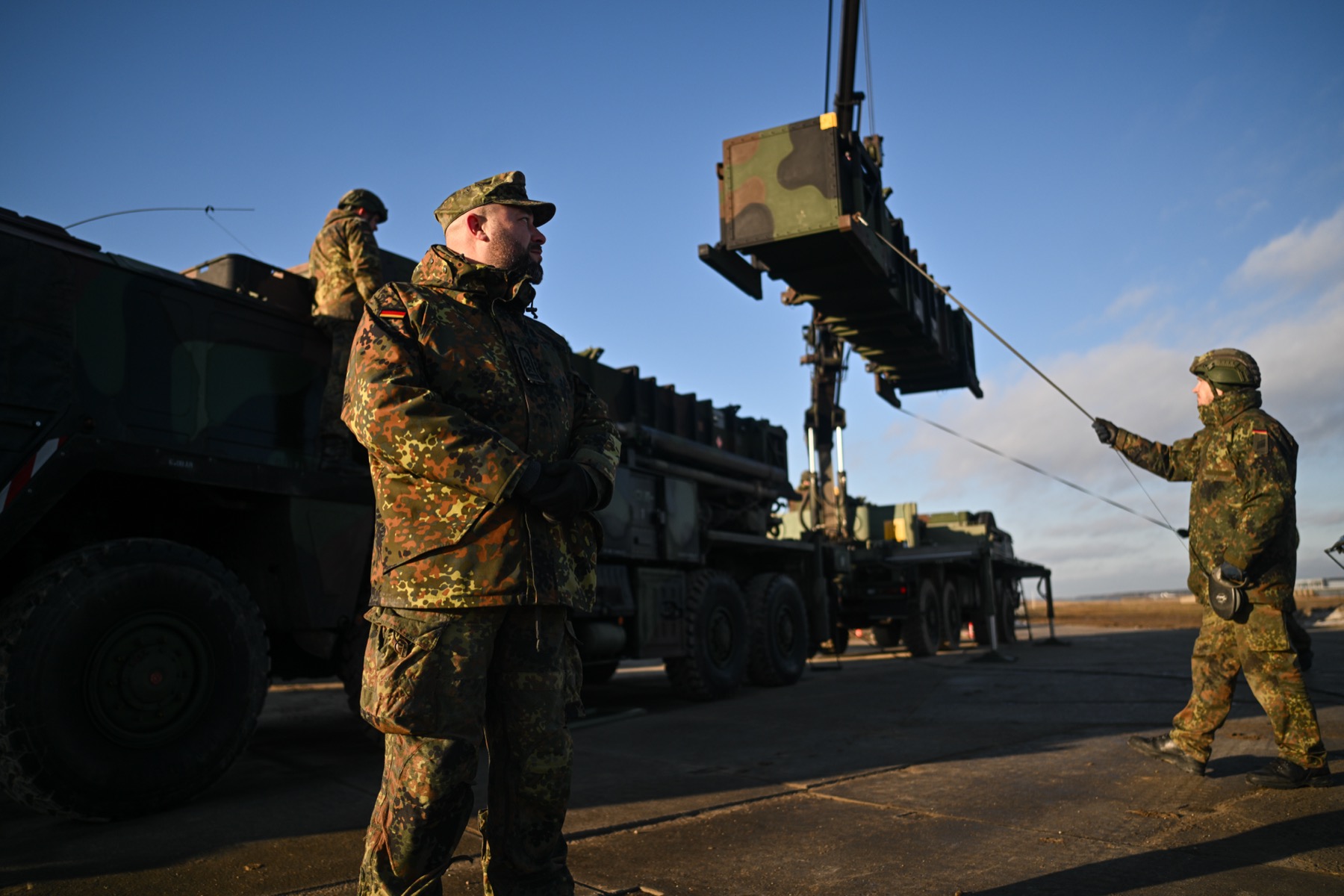
The sober answer is: not in the short term. Defense News reported on July 10 that central technical questions are still open and that Lockheed Martin was apparently not fully involved in the political announcement. It remains unclear whether the license pertains to the older PAC-2 family or the more modern PAC-3 MSE. For Ukraine, this distinction is crucial because the PAC-3 MSE, with its hit-to-kill principle, is one of the few available interceptors against ballistic missiles.
Production data show why political commitments should not be confused with military effectiveness. According to the cited analyses, a Patriot interceptor takes about 24 months to build, while the solid rocket motor takes around 30 months. The seeker head currently comes from a single Boeing plant in Huntsville, Alabama, which was last able to produce about 650 to 700 units per year. Lockheed delivered around 620 PAC-3 interceptors in 2025; a new framework is expected to increase production to 2,000 per year by 2030. This is industrially significant but strategically slow.
For comparison: The United States fired between 1,060 and 1,430 Patriot interceptors during the Iran War this year, according to the same reports, at about $3.9 million each. This figure is uncomfortable for Europe because it reveals the stockpiling nature of modern air defense. It is not the technical elegance of the system that matters, but the ability to reproduce it in large quantities. This is precisely where Europe's defense policy regularly fails.
Freya as a European Test Case
Therefore, the almost simultaneously reported Freya initiative is more important than it appears at first glance. President Volodymyr Zelensky announced that the first coalition meeting for a Ukrainian anti-ballistic system would be held in France in the coming days. Freya is supposed to work with the Ukrainian FP-7.X interceptor from Fire Point, targeting ballistic objects at about 15 miles in altitude and costing approximately $700,000 per shot. This would be significantly less than a PAC-3 shot.
The term homeland system should not be romanticized. Zelensky himself articulated the problem precisely: a defense system consists not only of a missile and launcher but also of radar, guidance, fire control, integration, and ongoing production. Fire Point has therefore signed a memorandum with the German sensor manufacturer Hensoldt and is in talks with Thales, Leonardo, and Kongsberg about detection, command, and control components. Freya is thus not a purely Ukrainian project but a test of whether European companies can integrate faster than traditional procurement normally allows.
The goals are ambitious. The interceptor was flight-tested in early June, and from August, three missiles per day are expected to be produced, with the first ballistic missile interception planned by the end of 2027. This timeline sounds quick compared to Patriot. However, it is only plausible if European partners provide not just press releases but also production capacities, export approvals, test sites, software integration, and funding. This is where the institutional question begins.
Europe Finances Faster Than It Integrates
At the NATO summit in Ankara, the allies pledged €70 billion in military aid for Ukraine this year, according to Defense News. Such sums are politically impressive. From a Weberian perspective, however, they are only the input, not the output. If the money flows into American queues, Europe buys time but not autonomy. If it flows into Freya, Europe buys risk: an unproven system, multiple national industries, open interfaces, and the compulsion to build an air defense architecture in wartime.
This difference should not be read morally but institutionally. Patriot is expensive, scarce, and proven. Freya is cheaper, potentially scalable, and uncertain. The American system offers capability without European control; the European-Ukrainian model offers control without guaranteed capability. Europe's strategic autonomy has been oscillating between these two unsatisfactory poles for years.
Germany plays a key role in both variants. With Patriot, Berlin is part of the European licensing and production path, while German systems are already relevant on the eastern flank and in the Ukraine architecture. With Freya, it is about sensors through Hensoldt, which is one of those areas where European industry can actually contribute something beyond checkbook politics. However, sensors alone do not secure the sky. Integration is the rare resource.
The Real Benchmark is 2027
From Ukraine's perspective, the logic is compelling. Russian ballistic missiles cause not only military damage but also target the political resilience of a society. According to UN data, long-range missiles and drones accounted for 45 percent of civilian casualties in May, the highest monthly figure since April 2022. If Kyiv does not build its own countermeasure, every negotiation line remains dependent on American stockpiles and European procurement cycles.
For Europe, the lesson is more uncomfortable. The Patriot license proves that Washington can move technology under pressure. Freya will have to prove whether Europe can move industrial cooperation under pressure. The difference is crucial: an American license can be politically promised on a summit day; a European defense system only emerges if ministries, companies, and export authorities work against their own slowness for months.
The question is not whether Europe spends more money on air defense. The question is whether this will result in an additional intercepted ballistic missile before 2027.
This is the hard benchmark. If Freya actually intercepts a ballistic target by the end of 2027 and then grows in numbers, Europe will have learned more than from ten strategy papers on defense autonomy. If the project gets stuck in national jurisdictions, approvals, and industrial protectionism, the Patriot license will only be a more elegant form of the old dependency: Kyiv may build, but the critical bottlenecks remain elsewhere. More sovereignty does not begin with a license. It begins with the ability to deliver the next interceptor on time.
Five Russian ballistic missiles were fired at Ukraine, with no interceptions reported. The U.S. announced plans to grant Ukraine a license for Patriot interceptor production, although significant technical questions remain. Concurrently, Ukraine is pursuing the Freya initiative to develop a European anti-ballistic system, with ambitions to intercept ballistic targets by 2027. NATO allies pledged substantial military aid to Ukraine, highlighting the ongoing challenges in European defense integration.
- Five Russian ballistic missiles were fired at Ukraine, none intercepted.
- The U.S. plans to provide Ukraine with a license to produce Patriot interceptors.
- The production timeline for Patriot interceptors is approximately 24-30 months.
- The Freya initiative aims to develop a European anti-ballistic system in collaboration with Ukraine.
- The NATO summit pledged 70 billion euros in military aid to Ukraine.