
Ukrainian drones hit Russian fighters at Crimea’s Saki air base

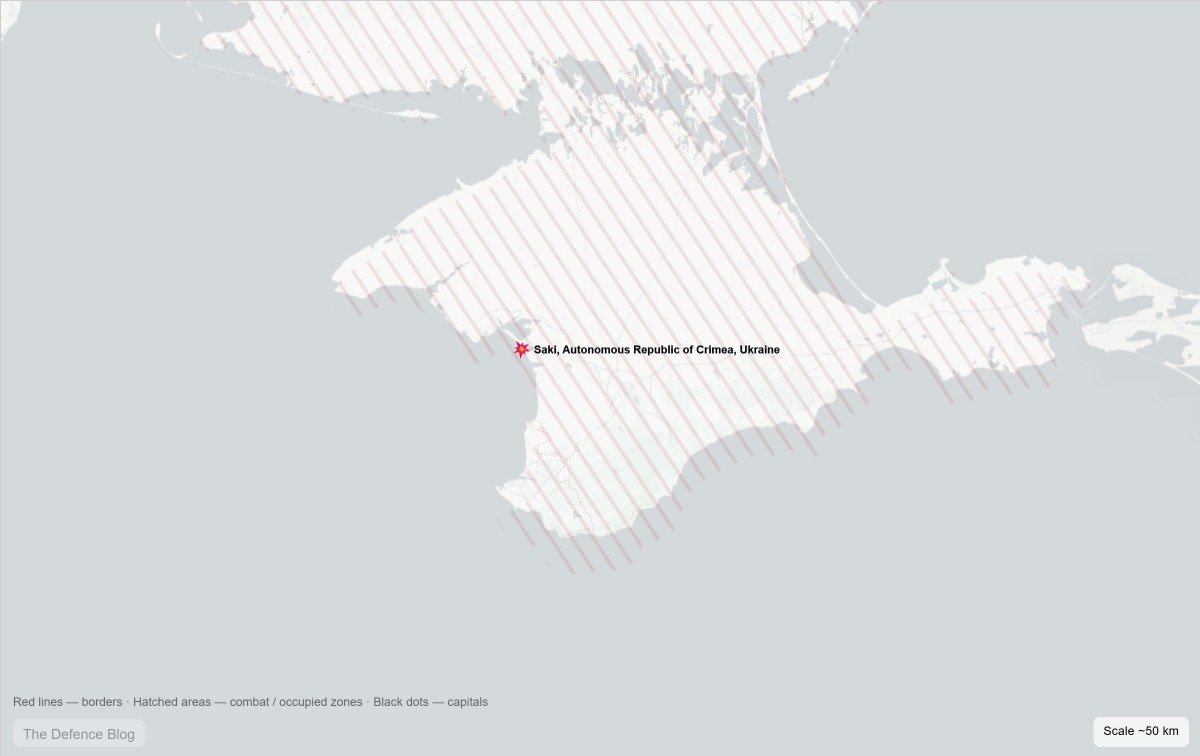
Ukraine’s Security Service, the SBU, confirmed five drone strikes on aircraft hangars at the Saki military air base in Russian-occupied Crimea on July 1, 2026, as part of what Kyiv described as a 40-day influence operation directed by President Volodymyr Zelenskyy.
The SBU confirmed that the hangar strikes were deliberate targeting of aircraft storage infrastructure, that two hangars held Su-30 and Su-30SM fighters at the time of the attack, and that a fire broke out in the hangar containing the Su-30SM after the strike, which the SBU described as confirming successful target engagement. Each Su-30SM aircraft carries an estimated value of $30 to $50 million, depending on configuration.
Saki, located on the western coast of Crimea near the town of Novofedorivka, roughly 60 km (37 miles) southwest of Simferopol, is one of the most operationally significant Russian air bases in the Black Sea theater and has been a recurring target of Ukrainian long-range operations throughout the war. Russia occupied and converted the facility after annexing Crimea in 2014, transforming what had been a Ukrainian naval aviation base into a primary hub for fixed-wing combat aircraft operating over the Black Sea, the northwestern approaches to Crimea, and the southern sectors of the front in Ukraine. The base gained international attention on August 9, 2022, when a series of explosions destroyed at least eight Russian aircraft on the flight line, an incident Ukrainian officials initially declined to officially claim but which subsequent reporting consistently attributed to Ukrainian covert action, becoming one of the most spectacular single-event losses of Russian airpower in the entire war to that point.
The Su-30SM that the SBU confirmed was in the targeted hangar is Russia’s most capable swing-role fighter in theater, a heavily upgraded variant of the original Su-30 Flanker-C that Russia’s Irkut Corporation produces for the Russian Navy and Air Force. The aircraft carries a maximum weapons payload of approximately 8,000 kg (17,637 lb) across twelve external hardpoints, flies at a top speed of 2,120 km/h (1,317 mph), and has a combat radius of approximately 1,500 km (932 miles) without aerial refueling, giving aircraft based at Saki the range to strike targets across Ukraine from the relative safety of Crimean airspace. The Su-30SM’s integration of the N011M Bars passive electronically scanned array radar and its compatibility with long-range air-to-air missiles including the R-77 and the extended-range R-77-1 make it one of the more dangerous platforms Ukraine’s air defense network faces in the south, particularly as Russia has used Crimea-based aircraft to launch guided aerial bombs and cruise missiles against targets in Zaporizhzhia, Kherson, and Odesa oblasts.
The basic Su-30, the airframe from which both the Su-30SM and its predecessor derive, was confirmed in one of the other targeted hangars alongside the Su-30SM. The original Su-30 designation encompasses several variants with different avionics and weapons configurations, but all share the same fundamental twin-engine, twin-seat configuration that gives Russian aviation planners both an air superiority and ground attack capability in a single platform, reducing the number of aircraft types a base like Saki needs to maintain to cover its assigned mission spectrum.
The SBU’s confirmation came with unusually direct and quantified language for a Ukrainian intelligence service whose operations in Crimea are inherently sensitive. Five confirmed strikes on hangars, two specific aircraft types named, a fire confirmed in the Su-30SM hangar, and a cost estimate provided per aircraft are all details that go beyond what Ukrainian authorities typically release immediately after a sensitive strike in occupied territory, and the inclusion of the per-aircraft valuation suggests a deliberate effort to frame the operation in economic terms that resonate beyond purely military audiences. At a minimum of $30 million per aircraft and a maximum of $50 million, a single confirmed Su-30SM kill would represent more direct cost imposition on Russia’s defense industrial base in a single strike than dozens of smaller drone attacks against individual ground vehicles or fuel depots.
Content preview only. Full article available at source. View Full Article
Ukrainian drones conducted five strikes on aircraft hangars at the Saki air base in Crimea on July 1, 2026, targeting Russian Su-30 and Su-30SM fighters. The Ukrainian Security Service confirmed the strikes, which resulted in a fire in one hangar. This operation is part of a broader influence campaign directed by President Zelenskyy.
- Five drone strikes confirmed by the SBU
- Targeted hangars contained Su-30 and Su-30SM fighters
- A fire broke out in the hangar with Su-30SM after the strike
- Each Su-30SM aircraft valued between $30 to $50 million
- Saki air base is a significant Russian military installation in Crimea.