
U.S. Air Force expands Blue Origin’s role in rocket cargo program
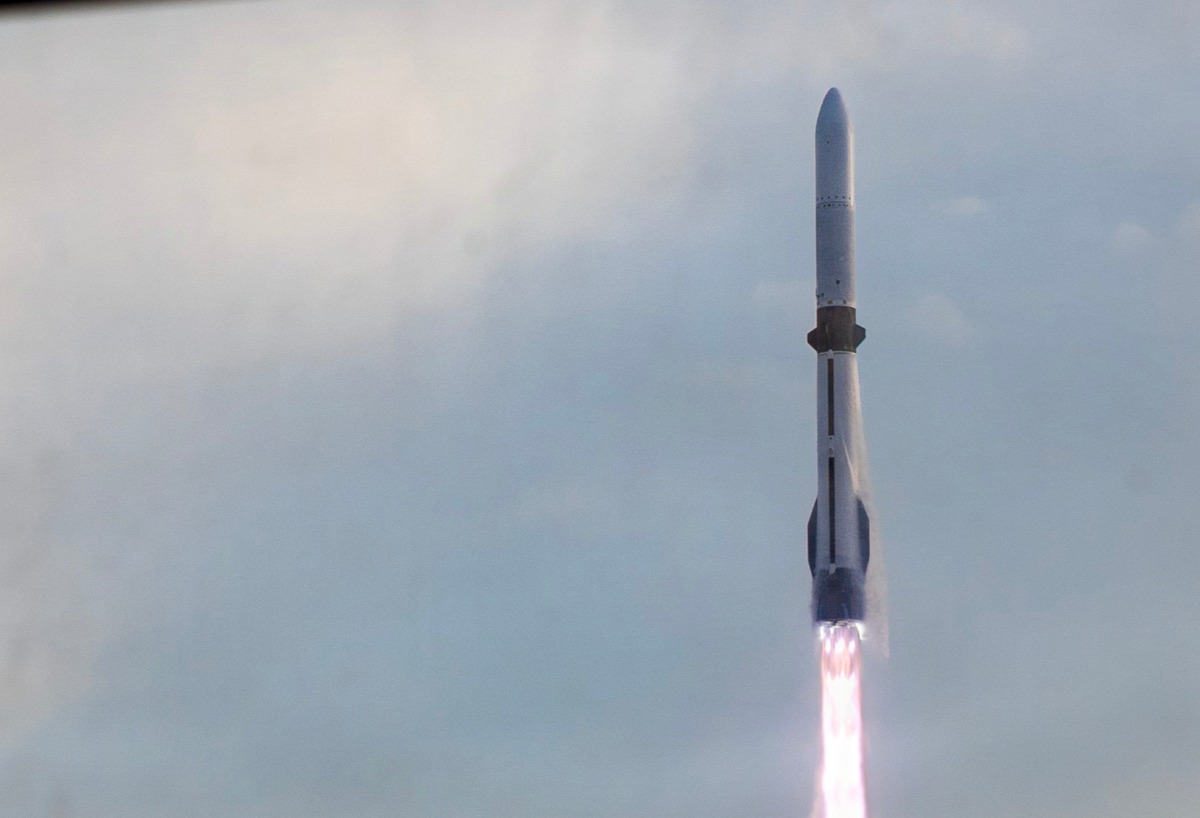 New Glenn rocket
The Pentagon just handed Blue Origin nearly $12 million more to figure out whether the company’s rockets could someday deliver military cargo to anywhere on Earth within about an hour, a concept that sounds like science fiction but has quietly moved from an experimental sketch to a funded engineering study.
Blue Origin LLC, based in Merritt Island, Florida, has been awarded an $11,707,762 contract modification to define requirements for how the company’s rockets and related technology could support what the Air Force calls the rocket cargo mission, according to a Department of War contract announcement.
The modification brings the total cumulative value of Blue Origin’s underlying contract to $13,074,453, up sharply from the original $1,366,691 award, and work will be split between Merritt Island, Florida, home to Blue Origin’s Space Coast operations, and Kent, Washington, where the company runs additional engineering and manufacturing facilities. The Air Force Research Laboratory, based at Wright-Patterson Air Force Base in Ohio, is managing the contract, with work expected to run through October 29, 2027.
Rocket Cargo began in 2021 as one of four Vanguard programs the Air Force launched to rapidly push transformational technology from concept toward actual military use, and the idea behind it remains genuinely striking even years later. Rather than loading military supplies onto a cargo plane that takes many hours to cross an ocean, the program studies whether a reusable rocket could launch, briefly enter space, and land somewhere else on the planet carrying a payload the size of what a C-17 cargo aircraft normally hauls, all within roughly an hour. Then-Air Force Materiel Command commander Gen. Arnold W. Bunch Jr. described the motivation behind the program as tied directly to rapid logistics underpinning the military’s ability to project power, with early use cases envisioned around swiftly restoring operational capability for forces in remote, austere locations and dramatically cutting the time needed to deliver humanitarian aid after a disaster.
The program has since evolved and rebranded more than once as it matured from a purely experimental effort into something closer to an actual acquisition program. The Air Force Research Laboratory now also refers to the effort as REGAL, short for Rocket Experimentation for Global Agile Logistics, while the Space Force separately established a related effort called Point-to-Point Delivery, or P2PD, in its fiscal 2025 budget request, giving the broader concept formal program status rather than treating it as a purely speculative research exercise. Blue Origin first entered this effort in August 2025, receiving an initial $1.3 million award alongside a separate $1 million contract given to Anduril Industries, with Blue Origin’s original scope focused on examining how its space vehicles might be adapted for point-to-point cargo transport and Anduril’s work centered on designing systems to integrate government payloads into a reentry container capable of surviving the trip back through the atmosphere.
That earlier, much smaller award has now grown nearly tenfold with this latest modification, reflecting a level of Air Force investment that suggests officials see genuine promise in Blue Origin’s approach rather than treating the earlier study as a dead end. Blue Origin’s New Glenn rocket, a heavy-lift, partially reusable vehicle the company has been developing and test-flying in recent years, represents the most likely candidate platform for this kind of mission, given its scale and Blue Origin’s stated ambitions for the vehicle beyond traditional satellite launches.
Blue Origin is not the only company the Air Force has funded to explore this concept, and understanding that broader field helps explain why the government keeps spreading relatively modest sums across multiple contractors rather than committing fully to a single vendor this early in development. SpaceX received a much larger $102 million contract back in January 2022 specifically to study how its massive Starship vehicle could support the same rocket cargo mission, and the U.S. Transportation Command has separately signed no-cost cooperative research agreements with SpaceX, Blue Origin, Sierra Space, and Rocket Lab, giving the government a formal collaborative research relationship with each company without committing significant funding until a given approach proves technically viable. Rocket Lab has said it plans to debut its own point-to-point cargo transportation capability during a 2026 Air Force mission, indicating the broader field of competing contractors continues advancing their respective concepts in parallel rather than waiting for a single winner to emerge first.
Whether Blue Origin’s rockets ever actually deliver military cargo anywhere in the world within an hour remains, even after this funding increase, a genuinely open question the contract notice does not resolve, since this phase of work covers requirements definition and engineering analysis rather than an actual flight demonstration or operational commitment. What the contract does confirm is that a concept once dismissed by some observers as an expensive novelty continues attracting real, growing investment from the Air Force, and each additional study contract like this one pushes the idea of rocket-delivered military logistics a step closer to finding out whether the physics and economics can actually make the concept work outside a PowerPoint slide.
Content preview only. Full article available at source. View Full Article
The U.S. Air Force awarded Blue Origin an $11.7 million contract modification to explore the feasibility of using rockets for military cargo delivery. This initiative aims to enable rapid logistics capabilities, allowing military supplies to be delivered globally within an hour. The contract, managed by the Air Force Research Laboratory, is expected to run through October 29, 2027, and reflects a growing investment in innovative military logistics solutions.
- Blue Origin received an $11.7 million contract modification from the U.S. Air Force.
- The total value of Blue Origin's contract is now $13.1 million.
- The contract aims to define requirements for rocket cargo delivery.
- The program is part of the Air Force's Vanguard programs initiated in 2021.
- The work will be split between Merritt Island, Florida, and Kent, Washington.