
U.S. Navy orders $107M in new rotor blades for Marine One
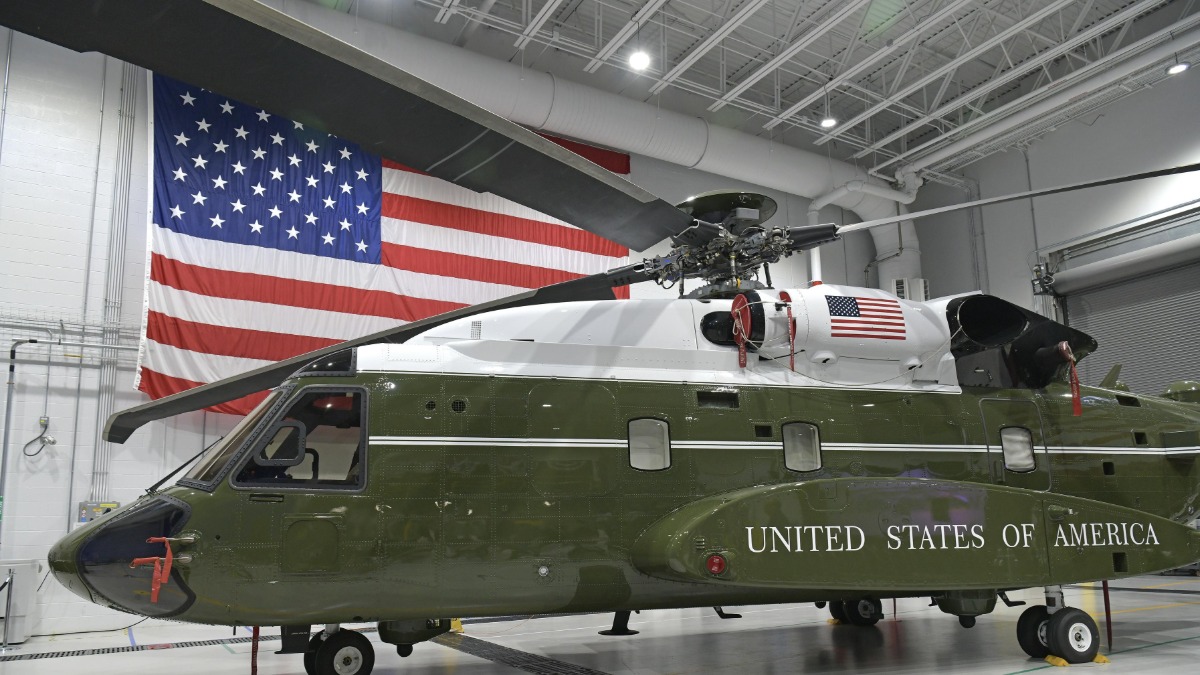 Photo by Owen Hoffmann
The helicopter that carries the President of the United States is getting new rotor blades, and the U.S. Navy has committed more than $107 million to make sure Marine One has enough raw power to do its job reliably for decades to come.
Sikorsky Aircraft Corp., a Lockheed Martin company based in Stratford, Connecticut, has been awarded a $107,289,338 order to design, build, and test a new generation of main rotor blades for the VH-92A Presidential Helicopter, known by its call sign Marine One whenever the president is aboard.
The order covers what the Navy calls Power Margin Increment Two, an engineering effort focused specifically on developing an improved main rotor blade design that increases the aircraft’s power margin, meaning the buffer of extra lifting power available beyond what the helicopter needs for routine flight, giving pilots more capability to handle heavier loads, hotter weather, higher altitudes, or emergency situations without pushing the aircraft to its absolute performance limit. Work under the order will run through March 2031, giving Sikorsky roughly five years to complete the design, integration, and testing process.
The VH-92A Patriot entered service to replace two aging helicopter types, the VH-3D Sea King and the VH-60N White Hawk, both of which had served presidents for decades before the Navy selected Sikorsky in 2014 to develop a modern successor built on the FAA-certified S-92 commercial helicopter airframe, then customized with a specialized mission communications system and an executive interior appropriate for transporting the commander in chief and visiting heads of state. The Marine Corps declared initial operational capability for the VH-92A in December 2021, and the program calls for a total of 23 aircraft, 21 operational helicopters plus two dedicated test airframes, at an overall program cost that has climbed toward roughly $5 billion since Sikorsky first won the contract.
This new $107 million rotor blade order is not the program’s first investment in the Power Margin Increment Two effort. The Navy issued an earlier $16 million order to Sikorsky in September 2025 covering material to construct and assemble main rotor blade test articles along with ground and flight testing support tied to the same power margin upgrade, work that took place across multiple states including Connecticut, Pennsylvania, Massachusetts, Utah, Georgia, and Ohio. That earlier funding focused on building the initial test hardware and infrastructure needed to prove the new blade design, while this latest, far larger order moves the effort into full-scale design, integration, and testing of the finished rotor blade system itself.
Work under the new order will spread primarily across Sikorsky’s home base in Stratford, Connecticut, which accounts for 72 percent of the effort, followed by 25 percent performed in West Palm Beach, Florida, and smaller shares of 2 percent in Fort Worth, Texas, and 1 percent in King of Prussia, Pennsylvania. Fiscal Year 2026 research, development, test and evaluation funds from the Navy totaling $18,424,287 will be obligated at the time of award, representing the initial funding tranche against the order’s much larger total value, with additional funding expected as the multiyear effort progresses. The Navy did not open this order to competitive bidding, since it was issued directly against a previously established basic ordering agreement the Navy already holds with Sikorsky, a common arrangement for follow-on engineering work tied to an aircraft only the original manufacturer has the technical data and design authority to modify. Naval Air Systems Command, headquartered at Patuxent River, Maryland and responsible for managing naval aviation programs, is overseeing the order.
The VH-92A’s raw power has already created an unusual, very public problem back on the ground. President Trump announced on July 6, 2026, that a granite helipad would be built on the White House South Lawn specifically to accommodate the aircraft, after the VH-92A’s significantly stronger rotor wash, roughly two and a half times more powerful than the older VH-3D Sea King it replaced, repeatedly tore up the grass during routine landings, according to reporting from The War Zone. Sikorsky agreed to cover the estimated $5 million to $6 million construction cost for the new helipad, an unusual expense for a defense contractor to absorb but one that underscores just how much more powerful the VH-92A is compared to the helicopters it succeeded, even before this latest round of rotor blade upgrades adds further performance capability on top of that.
Content preview only. Full article available at source. View Full Article
The U.S. Navy has ordered $107 million worth of new rotor blades for the VH-92A Presidential Helicopter, known as Marine One. Sikorsky Aircraft Corp. will design, build, and test the new blades to enhance the helicopter's power margin. This order is part of a larger program to ensure the helicopter's reliability and capability for decades. Work is expected to be completed by March 2031, with significant portions of the effort taking place in Stratford, Connecticut.
- U.S. Navy orders $107 million in rotor blades for Marine One.
- Sikorsky Aircraft Corp. awarded the contract for VH-92A rotor blades.
- The order aims to improve the helicopter's power margin.
- Work will be completed by March 2031.
- Initial operational capability for VH-92A declared in December 2021.