
U.S. Air Force expands StormBreaker deal to $950 million
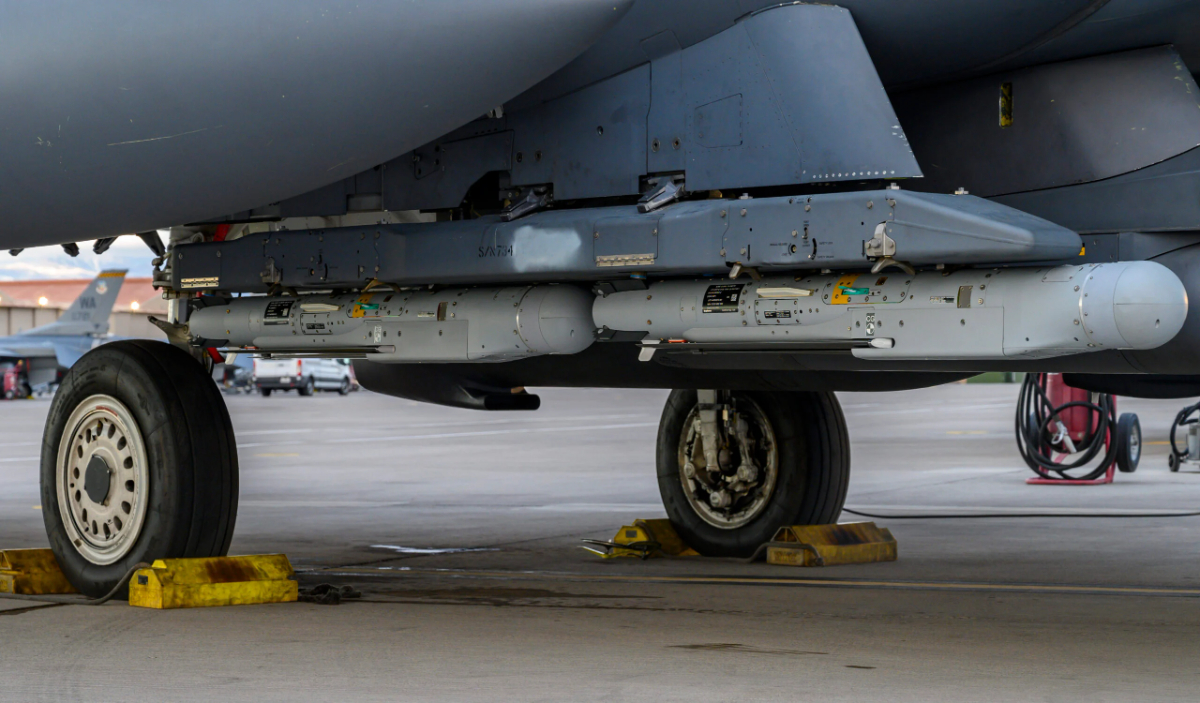
The U.S. Air Force has raised the ceiling on Raytheon’s life cycle support contract for the GBU-53/B StormBreaker, also known as the Small Diameter Bomb II, by $350 million, bringing the total potential value of the deal to $950 million.
The modification lifts the contract from $600 million and extends work at Raytheon’s plant in Tucson, Arizona, through Dec. 31, 2030. The ceiling increase gives the Air Force Life Cycle Management Center at Eglin Air Force Base, Florida, room to place more orders under the contract first awarded in 2019, with funds to be obligated as individual orders are issued.
StormBreaker is a small precision-guided glide bomb designed to hit moving targets in bad weather, smoke or dust, at night and from long range. It weighs about 93 kg (204 pounds) and is about 1.75 meters (69 inches) long, with wings that pop out after release so the bomb can glide to its target.
Its key feature is a tri-mode seeker that combines millimeter-wave radar, an imaging infrared sensor and a semi-active laser receiver, backed by GPS and inertial navigation. The radar lets the bomb find and track vehicles through clouds and rain, while the infrared sensor helps it pick out a specific target. When released from high altitude, StormBreaker can reach moving targets more than 72 km (45 miles) away and fixed targets beyond 100 km (62 miles). It can also receive updated target information during flight through Link 16 and UHF data links, which allows crews to redirect the weapon after launch.
Because of its compact size, an F-15E Strike Eagle can carry up to 28 StormBreakers on seven four-round racks, and the bomb is sized to fit inside the internal weapons bays of the F-35.
The U.S. Air Force cleared StormBreaker for operational use on the F-15E in September 2020 and declared initial operational capability in September 2022. The U.S. Navy approved it for operational use on the F/A-18E/F Super Hornet in February 2026. Integration on all three F-35 variants continues, and Raytheon recently reported an F-35B launching eight StormBreakers simultaneously during a flight test in Arizona, as The Defence Blog has followed since formal F-35 testing began.
In April 2026, the U.S. Department of War awarded Raytheon a $708.9 million contract for StormBreaker production, and the weapon has a growing list of international customers, including Australia, Norway, Germany, Italy, Finland and Belgium for their F-35 fleets. The United Kingdom approved its purchase in 2026 as an interim stand-off weapon for its F-35B jets.
Work under the expanded support contract will continue in Tucson through the end of 2030, supporting a weapon now in service with both the U.S. Air Force and the U.S. Navy.
Content preview only. Full article available at source. View Full Article
The U.S. Air Force expanded the life cycle support contract for the GBU-53/B StormBreaker to $950 million, extending work at Raytheon's Tucson plant through December 31, 2030. This modification allows for increased orders of the precision-guided bomb, which is operational on the F-15E and F/A-18E/F, with ongoing integration on the F-35. The StormBreaker is designed to engage moving targets in challenging conditions and has international customers.
- The U.S. Air Force raised the contract ceiling for the StormBreaker to $950 million.
- The contract extension allows for more orders until December 31, 2030.
- StormBreaker is designed for precision strikes in adverse conditions.
- The weapon has been cleared for operational use on multiple aircraft.
- International customers include Australia, Norway, and the UK.