
U.S. Army fields new cranes for Typhon, Dark Eagle units
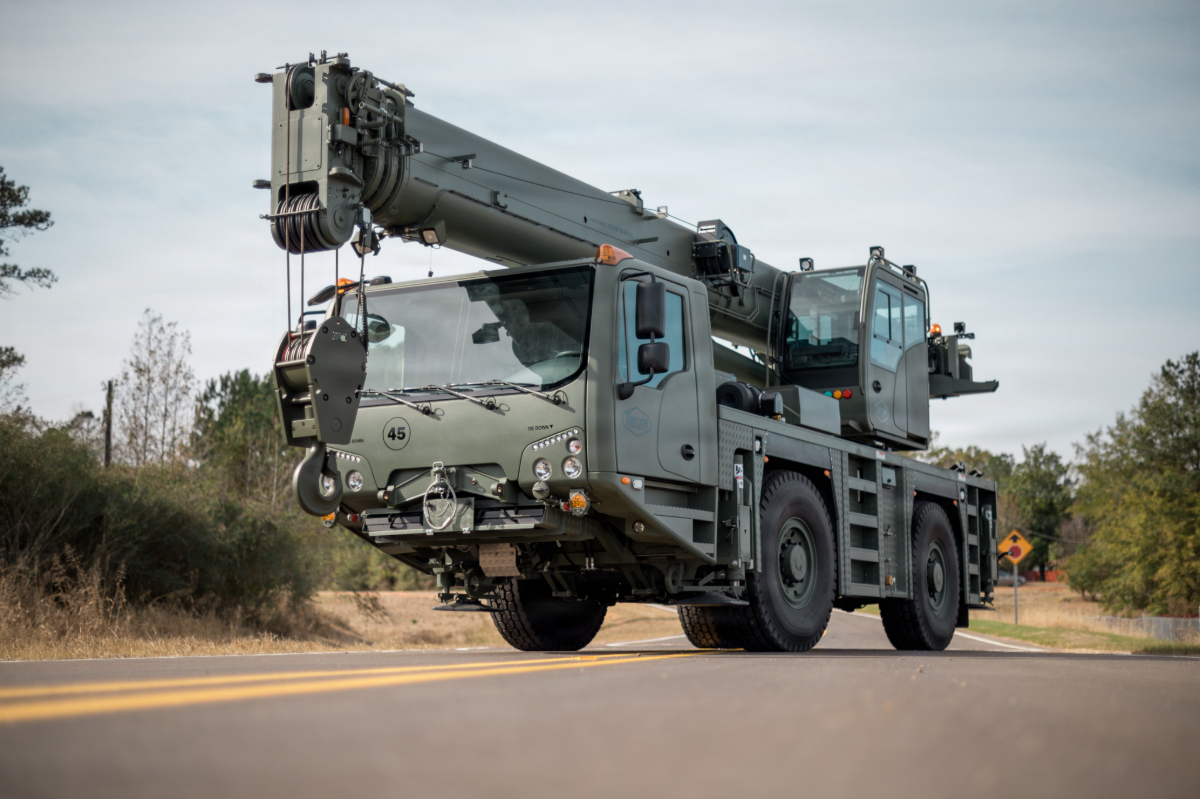
The U.S. Army has started giving its long-range missile battalions their own heavy cranes, delivering two 40-ton all-terrain cranes to Joint Base Lewis-McChord, Washington, in late August so the units can reload missile canisters and maintain launchers in the field without hiring outside equipment.
The Army’s Product Manager Engineer, Maintenance, Support Equipment said on Oct. 7 that six more cranes are due shortly. Once all eight arrive, 1st Battalion, 17th Field Artillery Regiment, and 5th Battalion, 3rd Field Artillery Regiment, will have their full authorized number of cranes by the end of October 2026. Both are long-range fires battalions within the U.S. Army’s Multi-Domain Task Forces, which are built around long-range missiles and are focused largely on the Pacific.
The cranes are the Type 1 model of the Family of All Terrain Cranes, which soldiers also call the All-Terrain Engineer Crane. According to the Army, they give units operating the Multiple Launch Rocket System family and the Long-Range Hypersonic Weapon, known as Dark Eagle, the ability to lift and swap heavy missile canisters, carry out field maintenance and support operations away from fixed bases or commercial lifting gear.
The commander of the battalion’s forward support company said the cranes have also been used to train for reloading the Army’s Mid-Range Capability, the Typhon launcher that fires Tomahawk and SM-6 missiles, and that they save the unit money.
“Operating forward in Japan, the ATEC (All-Terrain Engineer Crane) leverages the multi-role utility of the ATEC crane to streamline organic maintenance and logistical operations,” said Capt. Jacob A. Milton, commander of the 509th Forward Support Company, 1st Battalion, 17th Field Artillery (Long-Range Precision Fires), 3rd Multi-Domain Task Force.
“Beyond its primary role in mid-range capability reload training, the crane’s capability to internally move heavy tactical containers and equipment eliminates the operational requirement to contract external Material Handling Equipment. This self-reliance accelerates forward repair timelines, enhances battery agility, and secures substantial cost savings for the battalion,” Milton said.
The 3rd Multi-Domain Task Force, based in Hawaii, has repeatedly brought its Typhon battery to Japan for exercises, first to Marine Corps Air Station Iwakuni for Resolute Dragon in September 2025 and this year to Kanoya Air Base on Kyushu for Valiant Shield 2026. A Typhon launcher carries its missiles in large canisters, and without a crane of its own a battery has to rely on base facilities or contracted lifting equipment to reload them.
The deliveries fall under a U.S. Army headquarters execution order, EXORD 245-26, intended to close support-equipment gaps in priority strategic fires units. The Army said finishing the eight-crane delivery at Joint Base Lewis-McChord will give its long-range fires units in the Pacific a heavy-lift capability of their own in support of U.S. Indo-Pacific Command.
Program Manager Force Projection is preparing to field cranes to the Army’s other Multi-Domain Task Forces and plans to deliver an average of four units a month, along with operator training.
Content preview only. Full article available at source. View Full Article
The U.S. Army has begun equipping its long-range missile battalions with heavy cranes, delivering two 40-ton all-terrain cranes to Joint Base Lewis-McChord in late August 2023. Six additional cranes are expected soon, with all eight operational by October 2026. These cranes will enable the 1st Battalion, 17th Field Artillery and 5th Battalion, 3rd Field Artillery to perform maintenance and reloading operations independently, enhancing their operational capabilities in the Pacific region.
- U.S. Army delivered two 40-ton all-terrain cranes to Joint Base Lewis-McChord in late August 2023.
- Six more cranes are expected to arrive shortly, completing a total of eight by October 2026.
- The cranes will support the 1st Battalion, 17th Field Artillery and 5th Battalion, 3rd Field Artillery in missile operations.
- The cranes enhance self-reliance and reduce costs for maintenance and logistical operations in the field.
- The delivery is part of a U.S. Army initiative to improve support equipment for strategic fires units.