
U.S. Army gives its famous tank-killer missile new eyes
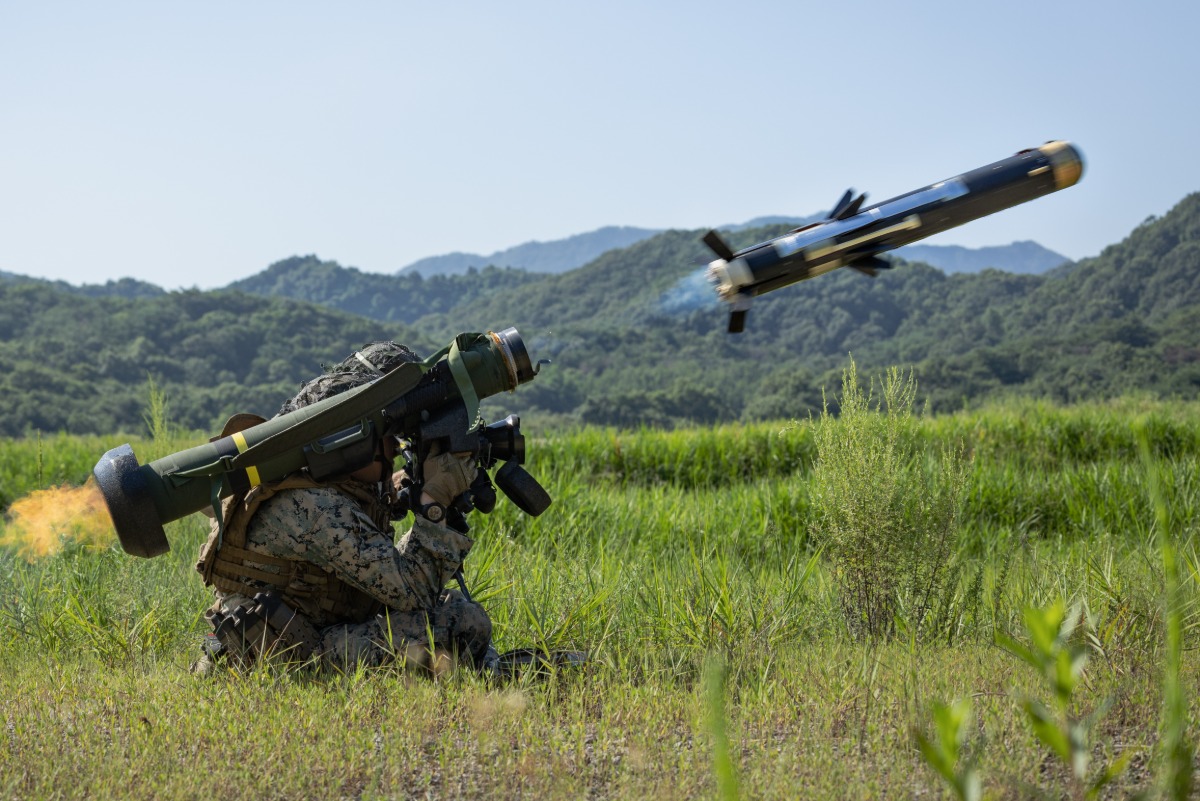
Kratos Defense & Security Solutions, a defense technology company from California, announced it was awarded a contract by the U.S. Army’s Combat Capabilities Development Command Center for Command, Control, Communications, Computers, Cyber, Intelligence, Surveillance and Reconnaissance, known by the shorthand C5ISR, to develop a next-generation infrared seeker for the Javelin Close Combat Missile System, the shoulder-fired anti-tank weapon American troops and dozens of allied militaries have relied on since the 1990s.
A missile’s seeker is the component that actually finds and tracks its target, essentially the weapon’s eyes, and Javelin’s current version relies on infrared imaging technology that has started to run into a common problem facing decades-old military hardware: some of the specific electronic components it depends on have become increasingly difficult to source as manufacturers stop producing them. Kratos said the new Enhanced Seeker it will develop specifically addresses that obsolescence in Javelin’s existing guidance section, work the company says will improve the missile’s overall lethality for the next 10 years of service.
The Javelin’s current seeker uses a two-dimensional infrared detector array built from mercury cadmium telluride sensors that require active cooling to function properly, a technical constraint that adds both cost and complexity to the missile’s guidance electronics, though the Army has already begun fielding a newer Javelin variant with an improved seeker that eliminates the cooling requirement entirely, suggesting Kratos’s work may build on lessons from that ongoing modernization effort.
Kratos will design, build, and test the new seeker at the company’s Advanced Manufacturing Center in Birmingham, Alabama, while the Army handles testing at its own government facilities, a split that lets the company focus on production while the military independently verifies the hardware meets its performance requirements before fielding it. That Birmingham facility falls under a Kratos subsidiary the company calls Kratos SRE, and Michael Johns, senior vice president at that subsidiary, framed the award as validation of investments the company has made specifically to compete for this kind of work.
“Kratos has made the investments, built the credentialed team, and delivered the capabilities to win, execute, and deliver a production-ready seeker that keeps Javelin lethal for the Soldiers who depend on it,” Johns said.
Johns tied that capability directly to the company’s broader positioning within the defense industry, framing the contract as consistent with how Kratos wants to be seen across its wider portfolio of work.
“We are proud to support the U.S. Army in sustaining one of its most important close combat weapons, and this award is a reflection of everything Kratos stands for: affordable, mission-critical hardware, delivered,” Johns said.
The Javelin itself has built one of the most consequential combat records of any American-made weapon system fielded in the past three decades. Jointly produced by Raytheon and Lockheed Martin through a partnership known as the Javelin Joint Venture, the missile entered U.S. service in 1996 as a replacement for the older, wire-guided M47 Dragon anti-tank system, trading that older weapon’s requirement for an operator to manually steer the missile all the way to impact for a fire-and-forget design that lets a soldier launch and immediately take cover. The missile pairs with a separate, reusable sighting unit called the Command Launch Unit, which provides day and thermal night vision with 4x and 9x magnification, and Javelin’s tandem-charge warhead, weighing 8.4 kilograms (18.5 pounds), can penetrate more than 760 millimeters (30 inches) of rolled homogeneous armor equivalent, making it capable of destroying even heavily armored main battle tanks by striking them from above in what the Army calls top-attack mode, targeting the thinner armor most tanks carry on their roofs rather than attempting to punch through much thicker frontal or side plating.
That top-attack capability, combined with an effective range that extends up to 4,750 meters (2.95 miles) when fired from a vehicle-mounted launcher, made the Javelin one of the defining weapons of Ukraine’s early resistance against Russia’s 2022 full-scale invasion, with Ukrainian forces using the missile extensively and effectively against Russian armored columns in a way that helped cement the weapon’s reputation as a genuine tank killer rather than simply another entry in the Pentagon’s anti-armor arsenal. More than 5,000 Javelins had already been fired in combat globally as of early 2019, well before the Ukraine war further expanded that total, and the missile currently serves militaries in more than 20 countries, including Australia, Estonia, Lithuania, Poland, Taiwan, the United Kingdom, and Ukraine, alongside the United States itself, giving the weapon an unusually broad international footprint for a system originally developed specifically for American infantry.
Kratos brings its own specialized track record to the new seeker contract, built on decades of missile seeker development work combined with what the company describes as vertically integrated manufacturing capability, meaning it can handle a larger share of the production process in-house rather than relying heavily on outside subcontractors for critical components. That combination, the company said, positions it to deliver production-ready hardware both affordably and on schedule, a pitch that matters directly to the broader goal the contract explicitly supports: strengthening the U.S. munitions industrial base, a priority the Department of War’s leadership has emphasized repeatedly as American and allied militaries work to rebuild ammunition and missile stockpiles that years of sustained support for Ukraine, alongside broader global demand, have steadily drawn down.
Content preview only. Full article available at source. View Full Article
Kratos Defense & Security Solutions was awarded a contract by the U.S. Army to develop a next-generation infrared seeker for the Javelin Close Combat Missile System in Birmingham, Alabama. This new seeker aims to enhance the missile's lethality and address sourcing issues for existing components. The Javelin has a notable combat record and is widely used by U.S. and allied forces, particularly in recent conflicts.
- Kratos Defense & Security Solutions was awarded a contract by the U.S. Army to develop a new infrared seeker for the Javelin missile system.
- The new seeker aims to address obsolescence issues in the current Javelin guidance system.
- The Javelin missile has been extensively used by U.S. and allied forces since the 1990s, with a significant combat record.
- The development will take place at Kratos's Advanced Manufacturing Center in Birmingham, Alabama.
- The Javelin missile system is known for its effectiveness against armored targets, particularly in the Ukraine conflict.