
U.S. Army paratroopers fly 3,000 miles from Alaska to jump into Hawaii
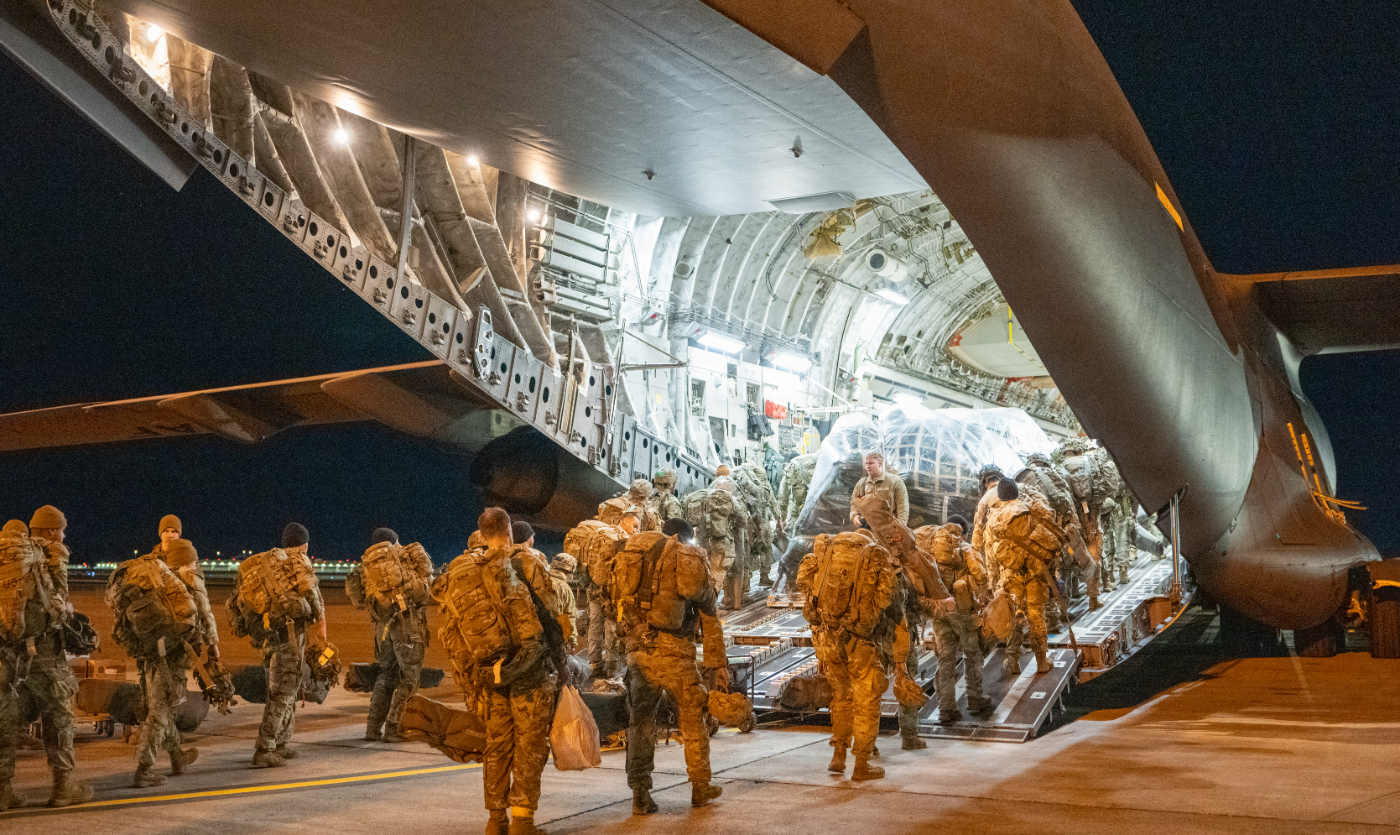
U.S. Army paratroopers from the 11th Airborne Division flew nearly 3,000 miles (4,800 km) from Alaska and jumped straight into a training assault in Hawaii, putting on their parachutes in the air along the way.
The operation, called “Arctic Aloha,” was the division’s part in Joint Pacific Multinational Readiness Center Rotation 27-01, a large Army combat training exercise in Hawaii, the U.S. Army said.
The paratroopers took off from Joint Base Elmendorf-Richardson near Anchorage and flew for close to eight hours. On the way, the main body linked up in flight with one of the battalion’s infantry companies flying in from Japan, where it had just finished the U.S.-Japanese exercise Keen Sword. The two groups then jumped together into Hawaii as a single battalion task force to seize key infrastructure.
To make the long flight possible, the troops rigged in the air. Instead of putting on parachutes and combat gear on the ground before takeoff, they strapped on and safety-checked their equipment inside the aircraft during the flight. That spared them from sitting under the heavy load for hours, so they could land fresh and ready to fight.
“This exercise gives us the opportunity to validate our ability to strategically deploy and project power across a large distance,” said Col. Matthew Adamczyk, deputy commanding officer for operations of the 11th Airborne Division. “We can project a battalion task force or larger from Alaska, execute an in-flight rig, and then insert directly into the Pacific AOR. Securing a key piece of infrastructure in this manner enables follow-on operations.”
Commanders also tested running the operation from the air. During the flight, the division kept a constant digital link with I Corps, U.S. Army Pacific headquarters and joint forces monitoring from Joint Base Pearl Harbor-Hickam, following the battlefield from inside the aircraft before the jump.
The exercise followed the Army’s new warfighting guidance, How the Army Fights, which organizes ground combat around four elements: convergence, strike, close battle and endurance. I Corps first coordinated space, cyber and electronic warfare assets, while theater forces and the 25th Infantry Division carried out strikes to knock out the simulated enemy’s air defenses. The paratroopers then jumped in to start the close battle and secure the ground.
The 11th Airborne Division, nicknamed the “Arctic Angels,” is the Army’s only airborne division focused on the Arctic and the Pacific. Its paratroopers have trained across the region, including when the U.S. Army conducted a mass paratrooper drop in Japan.
“Because we are the Arctic Airborne division, we can operate in the Pacific AOR, or we can fly over the pole and be in Northern Europe in eight to nine hours,” Adamczyk said.
The rotation brings together about 10,000 personnel from the U.S. Army, U.S. Air Force, U.S. Navy and U.S. Marine Corps, along with international allies and partners. Its main training audience is the 2nd Mobile Brigade Combat Team of the 25th Infantry Division.
After Hawaii, the paratroopers will fly back to Alaska and jump directly into their brigade’s field training at the Richardson Training Area. That builds up to JPMRC 27-02 in February at the Donnelly Training Area in interior Alaska, where the 11th Airborne’s 2nd Mobile Brigade Combat Team (Airborne) will train in temperatures that often fall to 40 degrees below zero.
Content preview only. Full article available at source. View Full Article
U.S. Army paratroopers from the 11th Airborne Division flew nearly 3,000 miles from Alaska and conducted a training jump into Hawaii as part of the Joint Pacific Multinational Readiness Center Rotation 27-01. The operation involved in-flight rigging of parachutes and coordination with forces from Japan. Approximately 10,000 personnel participated in this large-scale exercise, demonstrating the division's capability to project power across significant distances.
- U.S. Army paratroopers flew nearly 3,000 miles from Alaska to Hawaii.
- The operation was part of Joint Pacific Multinational Readiness Center Rotation 27-01.
- Paratroopers rigged their parachutes in-flight to prepare for the jump.
- The exercise involved coordination with U.S. forces in Japan and I Corps headquarters.
- The 11th Airborne Division is the Army's only airborne division focused on Arctic and Pacific operations.