
U.S. Army’s HADES spy plane prototype makes first flight
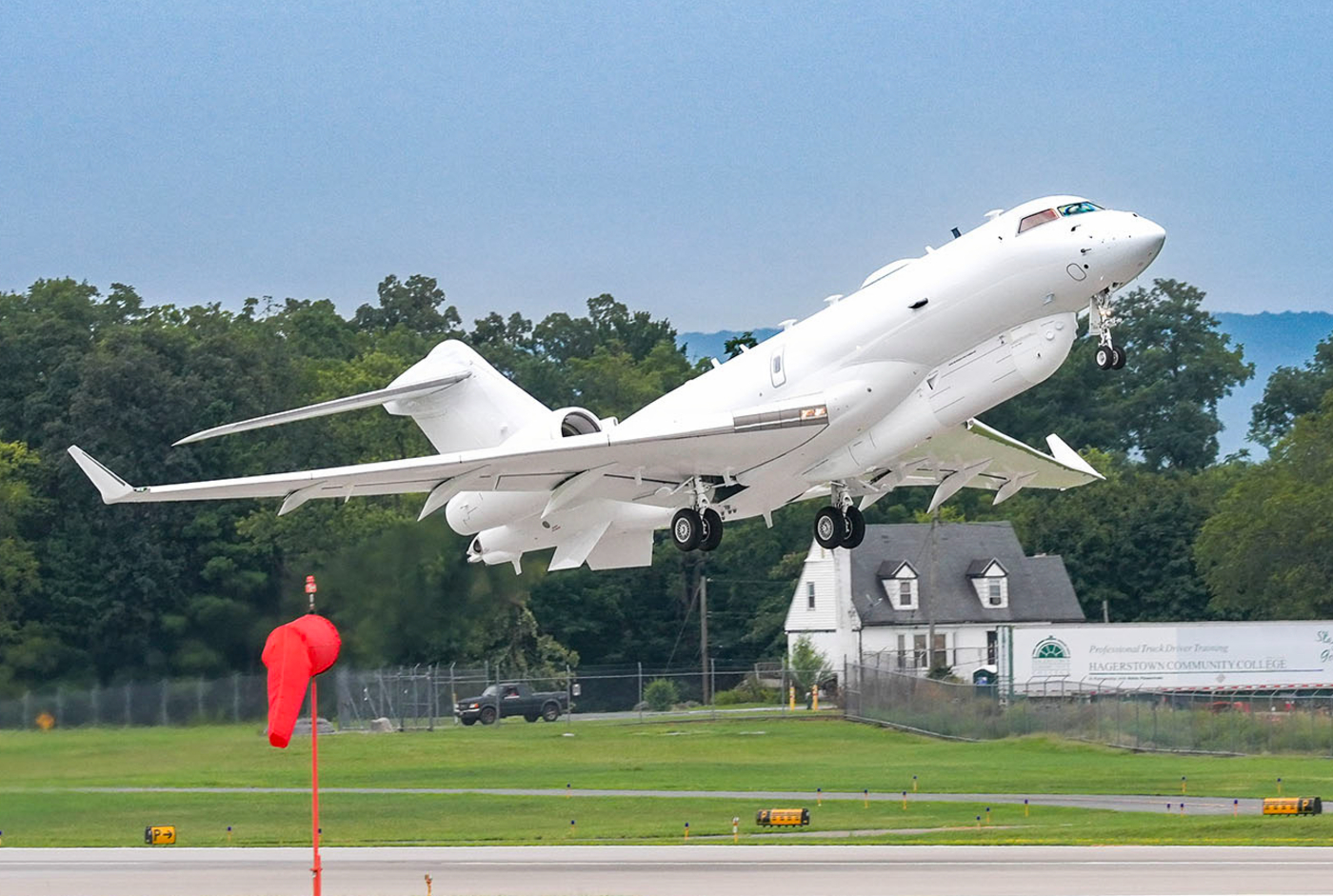
The U.S. Army’s first HADES prototype, a Bombardier Global 6500 business jet modified by Sierra Nevada Corporation for long-range signals intelligence and deep sensing, made its first flight on Sept. 11, the service announced on Oct. 30, seven weeks after the event.
The flight followed a flight readiness review and moves the High Accuracy Detection and Exploitation System into mission system integration and a developmental flight test program. The Army said those tests will check the aircraft’s multi-domain sensing and signals intelligence equipment ahead of operational demonstrations. It did not say where the aircraft flew, how long the flight lasted or what mission equipment was installed.
“The first flight of HADES Prototype 1 transitions our vision for deep sensing from concept to reality,” said Lt. Col. (P) James Hickey, project manager for the Fixed Wing Project Office. “This achievement reflects the dedication, technical precision, and shared mission focus of our military, civilian, and industry partners working to deliver transformational capabilities to the Army and joint force.”
The Fixed Wing Project Office ran the flight with SNC, the program’s lead systems integrator, and with the Project Director Sensors–Aerial Intelligence, part of the Army’s Portfolio Acquisition Executive for Command and Control/Counter-Command and Control. Before the flight, engineers, test pilots and mission system architects completed the structural modifications, installed mission system hardware and finished preliminary airworthiness checks. HADES is government-owned and contractor-operated, and SNC told Defense Daily in January that its own pilots and technicians would fly the tests alongside the Army.
Bombardier delivered the first Global 6500 for the program to the Army in Wichita, Kansas, in November 2024, and the Army passed it to SNC’s facility in Hagerstown, Maryland, for conversion. The Army had picked SNC as lead systems integrator in August 2024 under a 12-year contract worth $93.5 million at award, with a ceiling of $991.3 million, beating a team of L3Harris, Leidos and MAG Aerospace. L3Harris protested the decision, which stopped work until the Government Accountability Office denied the protest on Dec. 23, 2024. SNC received the second Army-owned jet in September 2025, and at the end of 2025 it bought a fourth Global 6500 with its own money to become the first non-prototype aircraft in the fleet.
The Army plans to field HADES in stages. In April 2026, Army officials said the program would deliver three prototypes, with the second adding an advanced radar and the third described as “combat credible”, and that the first aircraft would reach units later this year. The service also wants to pair HADES with launched effects, small unmanned systems released from the aircraft. In 2025, the Army said it would buy about half as many of the jets as it had previously planned, and it has not published a final fleet size.
When it announced the 2024 award, the Army said SNC would integrate communications intelligence, electronic intelligence, synthetic aperture radar and moving target indicator sensors on the Global 6500. A Pentagon budget reprogramming document approved in early 2025 confirmed that Raytheon’s Advanced Synthetic Aperture Radar System-2B, developed for the U.S. Air Force’s U-2, is part of the HADES sensor suite. The Oct. 30 release mentions only multi-domain sensing and signals intelligence for the current test phase.
HADES grows out of a string of contractor-owned bridging aircraft the Army has flown since 2020. Leidos built ARTEMIS on a Bombardier Challenger 650 and ARES on a Global 6500, and ARES deployed to the Indo-Pacific in 2022. Under the follow-on ATHENA effort, a MAG Aerospace and L3Harris team modified Global 6500s for radar collection, while SNC converted two jets to its RAPCON-X signals intelligence configuration, which became the basis for HADES. SNC says the HADES aircraft will be the first Army-owned large-cabin business jets used for aerial intelligence, surveillance and reconnaissance.
The jets are meant to replace the Army’s legacy turboprop intelligence aircraft. The Army says the Global 6500 airframe offers greater speed, range, payload and operating altitude than those platforms, which lets HADES collect from farther away and spend more time on station in large-scale operations.
“Deep sensing is critical to maintaining decision advantage in the future fight,” Hickey said. “HADES will help commanders see farther, understand faster, and act with greater precision across the multi-domain battlefield.”
Content preview only. Full article available at source. View Full Article
The U.S. Army's HADES prototype, a modified Bombardier Global 6500 for signals intelligence, completed its first flight on September 11, 2024, in Wichita, Kansas. This flight marks a significant step in the Army's development of advanced sensing capabilities. The program aims to integrate various sensors and systems to enhance operational effectiveness across multiple domains.
- The HADES prototype made its first flight on September 11, 2024.
- It is a modified Bombardier Global 6500 for signals intelligence.
- The Army plans to integrate advanced sensors and systems into the aircraft.
- The program aims to enhance multi-domain sensing capabilities.
- The first aircraft is expected to reach operational units later this year.