
U.S. Marine Corps wants new cargo drones that fly 100 pounds 40 miles out
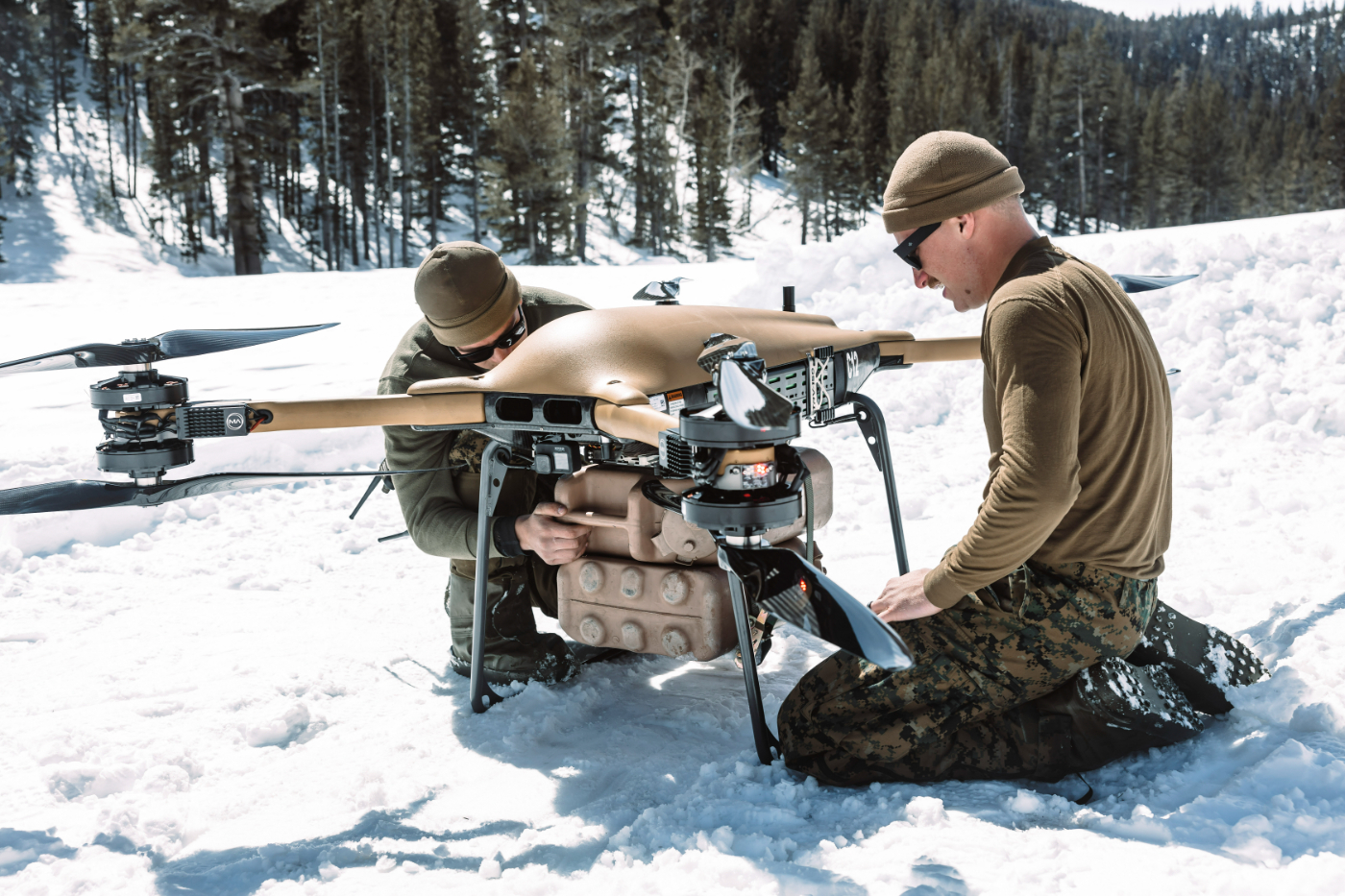
The U.S. Navy is inviting companies to bring cargo drones to Huntsville, Alabama, from Jan. 25 to Feb. 5, 2027, to compete for the U.S. Marine Corps’ second-generation Tactical Resupply Unmanned Aircraft System, or TRUAS Increment II, which must carry 100 pounds (45 kg) to a point 40 nautical miles (74 km) away and fly back without refueling. Applications to take part in the demonstration are due Nov. 30, 2026.
The Navy’s new Direct Reporting Portfolio Manager for Robotic and Autonomous Systems posted the notice on Oct. 30 through its Air Warfare program office at Naval Air Station Patuxent River, Maryland. Companies that perform well in Huntsville may receive an other transaction prototype agreement under 10 U.S.C. § 4022, and a successfully completed prototype can lead to a follow-on production agreement without further competition. The government may award no agreements, one or several, and the notice gives no dollar value or planned quantity.
Each selected company must show ground setup, flight preparation and refueling, then fly up to five autonomous sorties. On the first required flight, the drone carries a 100-pound load 40 nautical miles, releases it, flies 40 nautical miles back empty and lands at its launch point. On the second, it carries at least 150 pounds (68 kg) out 10 nautical miles (18.5 km) and returns empty, again without refueling. The aircraft must cruise at no less than 50 knots (93 km/h), stay below 1,000 feet (305 m) above ground, launch and recover without a catapult, net or arresting cable, and carry a transponder with at least Mode 3/C capability. Up to three more flights may be allowed to show other features.
Applicants must meet two threshold requirements just to be considered: the payload-and-range performance above and a powerplant that runs on heavy fuel such as JP-5, JP-8 or diesel, or on a hybrid fuel-battery system. The Navy also states a preference for aircraft with a maximum gross takeoff weight of up to 350 pounds (159 kg).
The Marine Corps’ current TRUAS is the TRV-150C, a battery-electric aircraft with eight rotors on four arms, designed by Malloy Aeronautics and sold in the United States by Survice Engineering. The Navy bought the first 21 in April 2023 for $8.4 million and declared initial operational capability on Oct. 27, 2023, with the 3rd Littoral Logistics Battalion at Marine Corps Base Hawaii. The Marine Corps later ordered 31 more TRV-150Cs in a $9.8 million contract modification. The Marine Corps rates the TRV-150C at about 9 miles (14 km) with a full 150-pound load. Increment II asks for the same load carried 18.5 km out and back, plus a 100-pound load over a round trip of 80 nautical miles (148 km).
Heavy-fuel engines would let the new aircraft draw from the same JP-8 or diesel supply that Marine vehicles and generators already use, instead of depending on charged battery packs in the field. The notice does not explain why the program chose that requirement.
Marine units have been using the TRV-150C for two years to work out how drone resupply fits into logistics formations. In October 2025, Marines pushed the TRUAS through field tests aimed at giving company and platoon commanders their own way to resupply small units in hard-to-reach places. In 2024, Marine officials said they planned to issue three to six TRUAS drones to every logistics battalion by 2028. The U.S. Army has also evaluated the TRV-150 at Fort Stewart, Georgia, in February 2026. The notice describes Increment II as an organic aerial distribution capability for small-unit logistics across the last tactical mile, in Expeditionary Advanced Base Operations and Distributed Operations.
The requirements tables attached to the notice go well beyond the demonstration flights. A single operator must be able to control up to four aircraft at once, and the system must accept natural-language voice commands such as changing heading or altitude. The complete system has to fit in one ruggedized container no larger than 4 by 3 by 2 feet and weighing no more than 150 pounds, be ready to launch within 20 minutes, and reach a mean time between failures of at least 30 flight hours, with 90 as the objective. By default, the aircraft must not launch without mission approval from the Marine Corps’ Multifunction Air Operations Center, though a designated supervisor can override that rule when no airspace control authority is available. It must also navigate without GPS, use encrypted radios that meet FIPS 140-3 Level 2, and keep its electrical components sealed to an IP-56 rating.
“Operating the TRUAS UCC shall be comparable in terms of ease and intuitiveness to common smartphone tasks, such as ordering food delivery or ride-sharing services,” the requirements table states.
Participation is limited to U.S.-based, U.S.-owned companies using U.S. manufacturing and repair facilities, or to firms that can show strict compliance with 10 U.S.C. § 4881 and the American Security Drone Act, which restrict the government’s purchase and use of foreign-made drones. Companies pay their own costs, must sign a cooperative research and development agreement before flying and must join the Naval Aviation Systems Consortium to be eligible for an award. There is no fee to apply.
The program has changed owners since Increment I, which was run by the Navy and Marine Corps Small Tactical Unmanned Aircraft Systems program office, PMA-263. Acting Secretary of the Navy Hung Cao established the Direct Reporting Portfolio Manager for Robotic and Autonomous Systems on Aug. 5, 2026, to bring requirements and acquisition of unmanned systems for the Navy and Marine Corps under a single office.
On request, the Navy may also share flight performance data with the Army-run Drones.mil Marketplace, an online storefront where U.S. units and allies can buy vetted drones. The Army said in October that the marketplace had generated more than $800 million in sales in its first four months.
Content preview only. Full article available at source. View Full Article
The U.S. Navy is inviting companies to demonstrate cargo drones for the U.S. Marine Corps' TRUAS Increment II program in Huntsville, Alabama, from January 25 to February 5, 2027. The drones must carry 100 pounds to a point 40 nautical miles away and return without refueling. Applications are due by November 30, 2026, and the current TRUAS is the TRV-150C, which has been operational since October 2023.
- U.S. Navy is inviting companies to demonstrate cargo drones in Huntsville, Alabama from January 25 to February 5, 2027.
- The drones must carry 100 pounds to a point 40 nautical miles away and return without refueling.
- Applications for participation are due by November 30, 2026.
- The current TRUAS is the TRV-150C, with initial operational capability declared on October 27, 2023.
- Marine Corps plans to issue three to six TRUAS drones to every logistics battalion by 2028.