
US, Japan fund $745 million deal for SM-3 missile interceptors
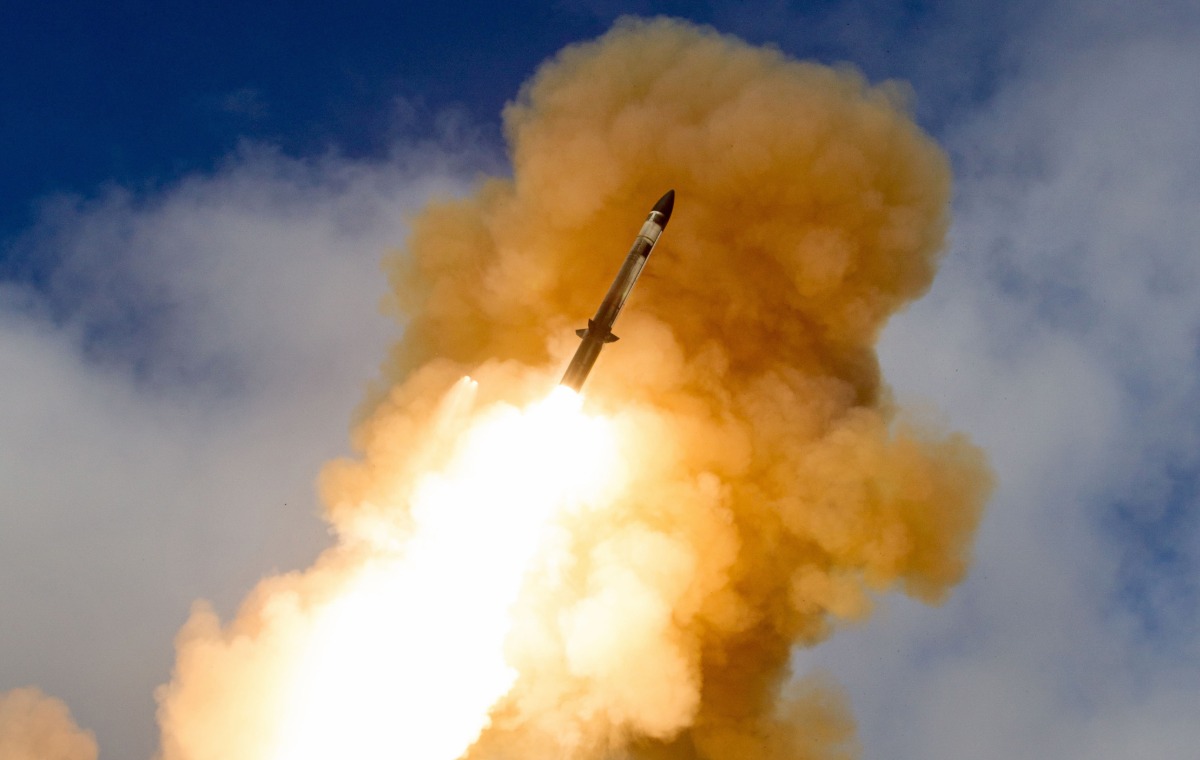
The U.S. Missile Defense Agency awarded Raytheon, the missile-making arm of aerospace giant RTX based in Tucson, Arizona, a contract worth $745 million to manufacture and assemble complete Standard Missile-3 Block IIA interceptors, according to a Department of War contract announcement covering awards made Aug. 7, 2026.
The deal covers what the Pentagon calls All-Up Rounds, meaning fully assembled, ready-to-fire missiles rather than separate components still requiring final integration, and the award will supply both the U.S. government and Japan’s Ministry of Defense under a Foreign Military Sales arrangement, the formal process through which allied nations purchase American-made weapons.
The Standard Missile-3, commonly shortened to SM-3, is not designed to blow up an incoming missile with an explosive warhead the way most weapons work. Instead, the interceptor relies entirely on kinetic energy, physically colliding with an enemy ballistic missile at extraordinary speed high above Earth’s atmosphere during what the military calls the midcourse phase of flight, the portion of a ballistic missile’s trajectory after it has left the atmosphere but before it begins descending toward its target. That hit-to-kill approach, destroying a threat through the sheer force of a direct collision rather than detonating nearby, reduces the risk that debris from the intercepted missile could still carry a functioning warhead toward the ground, a design philosophy the Missile Defense Agency has built its broader Aegis Ballistic Missile Defense program around.
The specific Block IIA variant covered by this contract represents the most advanced version of the SM-3 family currently in production, jointly developed by Raytheon and Japan’s Mitsubishi Heavy Industries in a partnership that reflects just how deeply intertwined American and Japanese missile defense programs have become. Compared to earlier SM-3 versions, the Block IIA carries a larger 53.3-centimeter (21-inch) diameter body rather than the 34.3-centimeter (13.5-inch) diameter of original Block I missiles, extending its range beyond 2,500 kilometers (1,553 miles) while reaching speeds exceeding Mach 10, more than ten times the speed of sound. Both the U.S. Navy and Japan’s Maritime Self-Defense Force field the missile aboard Aegis-equipped destroyers and cruisers, and the Block IIA has already seen real combat use, deployed during Iranian missile strikes on Israel in April 2024 and again during the broader Iran conflict earlier this year, giving the Missile Defense Agency operational performance data from actual intercept attempts rather than testing alone.
That combat record helps explain why the Pentagon structured this deal as what contracting officials call a noncompetitive, undefinitized contract action, government language for two separate but related decisions worth unpacking in plain terms. Noncompetitive means the Missile Defense Agency awarded the contract to Raytheon without opening it up to competing bids from other companies, a common arrangement for a missile that only one manufacturer is authorized and technically equipped to build. Undefinitized means the government authorized Raytheon to begin work immediately, before every remaining contractual detail, including the final negotiated price for portions of the work, has been fully locked down, a mechanism the Pentagon uses specifically to avoid delaying urgent production while paperwork catches up, though it also means some financial terms of this specific award could still shift once negotiations conclude.
Work on the new missiles will split across two Raytheon facilities, with assembly happening in Tucson and additional production work performed in Huntsville, Alabama, the same city that hosts the Missile Defense Agency’s own headquarters and contracting activity overseeing this award. The contract carries an estimated completion date of Feb. 28, 2031, giving Raytheon roughly four and a half years to deliver the full order of missiles covered under the deal, though the announcement did not specify exactly how many individual All-Up Rounds that timeline and dollar figure will ultimately produce.
The funding structure behind the award illustrates how closely the United States and Japan now share the financial burden of keeping this particular missile in production. The Missile Defense Agency obligated $275,613,909 in fiscal year 2026 U.S. procurement funds at the time of the award, essentially matched by $277,688,036 in Japanese Ministry of Defense Foreign Military Sales funding, meaning Japan is covering nearly half of the immediate funding tied to this contract rather than simply buying finished missiles off an existing American production line. That roughly even split reflects the SM-3 Block IIA’s origins as a genuine joint development program rather than a purely American weapon Japan happens to purchase, a distinction that has shaped the missile’s design, testing, and now its production funding from the start.
Japan has steadily expanded its own ballistic missile defense capability in recent years as North Korea’s missile testing has continued and regional tensions with China have grown, making a reliable, jointly produced interceptor supply chain a matter of direct strategic interest for Tokyo rather than simply a defense procurement line item.
Content preview only. Full article available at source. View Full Article
The U.S. Missile Defense Agency awarded a $745 million contract to Raytheon for the production of Standard Missile-3 Block IIA interceptors, with funding shared between the U.S. and Japan. This contract, announced on August 7, 2026, will support both nations' missile defense capabilities and is set for completion by February 28, 2031. The SM-3 Block IIA interceptors utilize a hit-to-kill approach for missile interception.
- The U.S. awarded a $745 million contract to Raytheon for SM-3 interceptors.
- The contract includes production for both the U.S. and Japan under a Foreign Military Sales arrangement.
- The SM-3 Block IIA is designed to intercept missiles using kinetic energy rather than explosives.
- Japan is contributing nearly half of the funding for the contract, reflecting joint development efforts.
- The contract is structured as a noncompetitive, undefinitized contract action.