
U.S. Marine Corps M142 HIMARS Fuji 12 Launches Demonstrate Deterrence of the First Island Chain
 Tanaka Takashi
U.S. Marine Corps M142 HIMARS 12-Round Firing Demonstrates Deterrence of the First Island Chain
At the East Fuji Training Area at the foot of Mount Fuji, two M142 HIMARS emerged from the cover of the trees and fired a total of 12 training rounds, six rounds each, before returning to their concealment positions. This event took place on May 20. According to the U.S. Indo-Pacific Command, the executing unit was the 3rd Battalion, 12th Marine Regiment, 3rd Marine Division, based in Okinawa, and the location was Camp Fuji in Shizuoka Prefecture.
Consecutive Year of Firing at Fuji
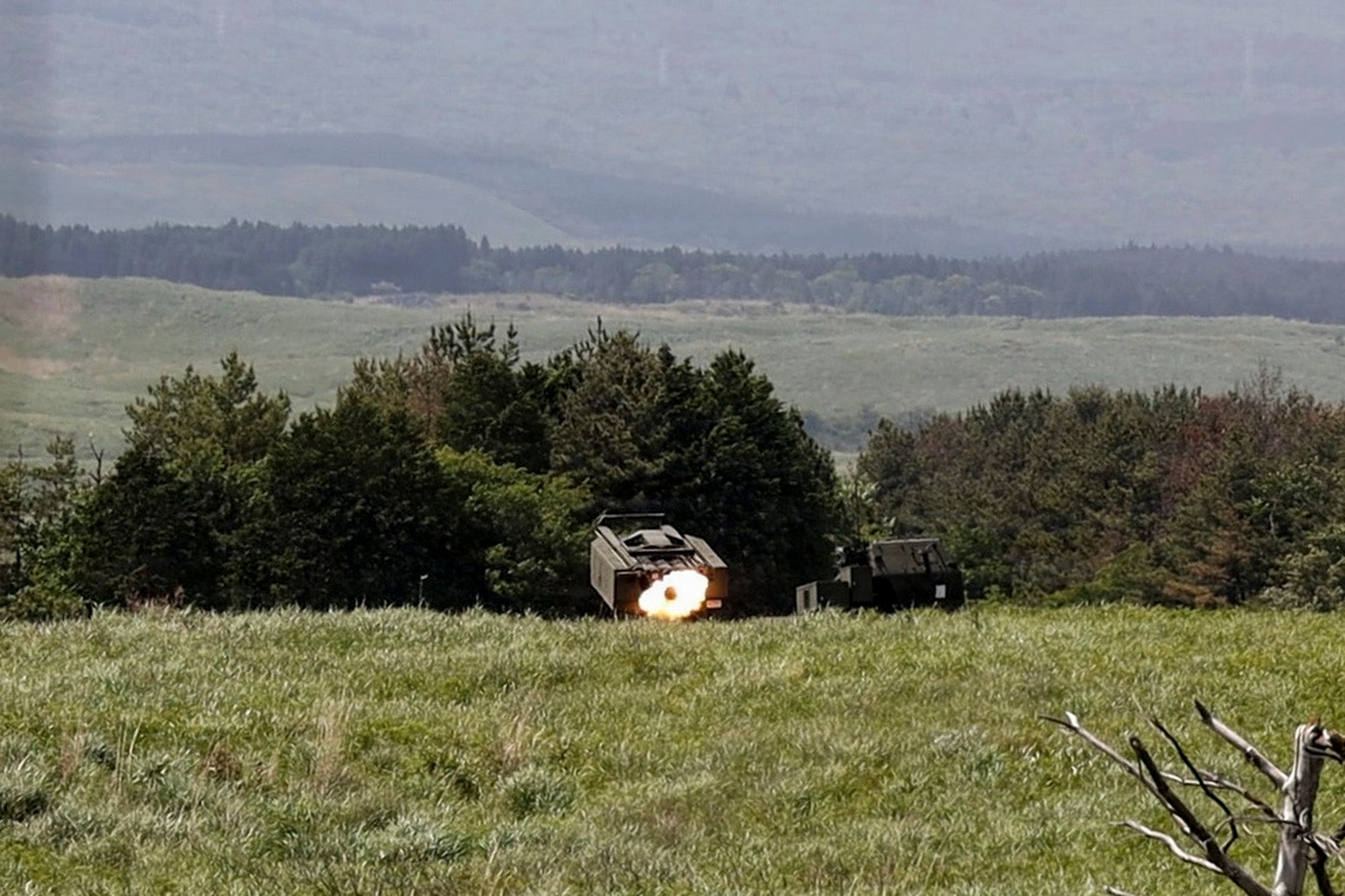
Stars and Stripes reported that this was the second consecutive year of HIMARS firing in the Fuji area, with approximately 40 to 50 Marines and two launchers participating. The rounds fired were training rockets with limited range, and two volleys were conducted before 2 PM. The AP reported that safety measures, including road closures, were implemented and closely coordinated with the Japanese side.
What is important here is not the type of ammunition itself, but the training location. Camp Fuji has traditionally been used for training infantry, artillery, Fuji Viper, Shinka, and ARTP, among others. The U.S. military announcement explained that this firing validated the long-range firepower operational capabilities of the facility. The ability for the U.S. Marine Corps to repeatedly conduct long-range precision fire launches, movements, reloading, and safety control on Japanese soil is significant.
Tactical Value of HIMARS
HIMARS is a truck-mounted rocket system rather than a tracked vehicle, designed for mobility and concealment. Since the Ukraine war, the density of drone and satellite surveillance has increased, rapidly decreasing the survivability of fixed positions. The concept of "shoot-and-scoot" is not new, but in the First Island Chain, the interplay of islands, roads, ports, private land, and political constraints means that proficiency cannot be achieved through tabletop exercises alone.
The U.S. Marine Corps' Force Design is shifting its focus from reliance on large bases and carrier air power to a concept where small, dispersed units can impede enemy approaches. HIMARS is a symbol of this shift. If the ammunition is GMLRS, a range of several dozen kilometers is expected, and if it is PrSM-class, a range of several hundred kilometers is anticipated. If deployed in the southwestern islands or northern Luzon, the pressure on the maritime and airspace around Taiwan would change significantly.
Implications for Japan
In my view, the recent firing at Fuji should not be seen separately from Japan's development of counterattack capabilities. During the Balikatan exercise in May, the Japan Ground Self-Defense Force's Type 88 anti-ship guided missile was fired for the first time from within the Philippines, targeting the decommissioned vessel BRP Quezon. If Japan's anti-ship missiles, the U.S. Marine Corps' HIMARS and NMESIS, and the Philippines' coastal defense firepower are interconnected, complementary deterrent lines will be formed in the north and south of Taiwan.
However, being able to fire 12 rounds at Fuji does not equate to the ability to continuously supply ammunition, launchers, maintenance personnel, and communication equipment to the southwestern islands during a crisis. Without the Japan Maritime Self-Defense Force's SLOC (Sea Lines of Communication) protection, air superiority, port processing capabilities, and resident evacuation plans, dispersed firepower could end up being a short-term political demonstration. Long-range firepower capabilities are determined more by the ammunition storage and transportation system than by the launchers themselves.
Unresolved Points in Alliance Operations
The U.S. side described this training as involvement in Japan's defense. This is effective for deterrence. On the other hand, as the U.S. military continues to handle long-range firepower in domestic training areas, issues related to local coordination, safety standards, launch authority, and target information sharing will surface. Particularly during the initial stages of a crisis, how quickly the U.S. military's target selection connects with the Japanese government's political decisions is still not clear from publicly available information.
The few minutes of volleys at Fuji are spectacular. However, the real issue is not the flames. It is whether the Japan-U.S. alliance can have a system that allows not only units that move after firing but also those that act decisively after a decision is made. If political processes remain slower than the mobility of HIMARS, deterrence in the First Island Chain will not be as agile as it appears.
Sources
U.S. Marines conducted a live-fire exercise at Camp Fuji on May 20, 2026, firing 12 training rockets from two M142 HIMARS. Approximately 40-50 Marines participated in the exercise, which tested the long-range precision fire capabilities of the unit. The event was coordinated with Japanese authorities and included safety measures such as road closures.
- U.S. Marines fired 12 training rockets from M142 HIMARS at Camp Fuji.
- The exercise involved approximately 40-50 Marines and 2 HIMARS units.
- The training was conducted on May 20, 2026, and involved safety measures and coordination with Japanese authorities.
- This marks the second consecutive year of HIMARS firing exercises at Fuji.
- The exercise tested long-range precision fire capabilities of the U.S. Marines.