
U.S. Marine Corps receives its final MV-22B Osprey
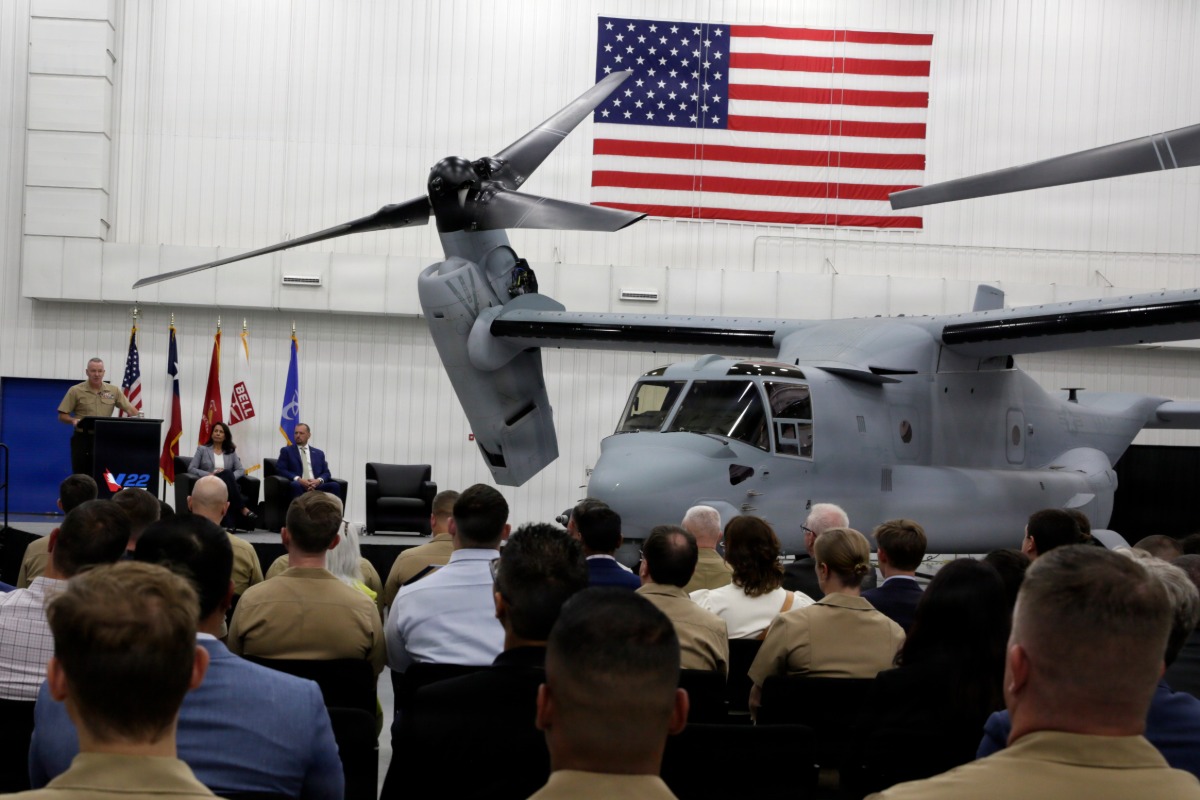
The U.S. Marine Corps has closed the book on one of its most consequential and controversial aircraft programs in decades, taking delivery of the final MV-22B Osprey after nearly two decades of production, the V-22 Joint Program Office reported July 28, 2026, in a story by Neil Lobeda. The milestone, marked in Amarillo, Texas, where manufacturer Bell builds the tiltrotor aircraft, shifts the Marine Corps’ focus away from fielding new Ospreys entirely and toward sustaining and modernizing the fleet it already has for the next three decades.
The MV-22B represents one of the more unusual engineering solutions the U.S. military has fielded, combining two adjustable propeller rotors mounted on rotating nacelles that let the aircraft take off and land vertically like a helicopter, then tilt forward once airborne to fly with the speed and range of a fixed-wing airplane. That hybrid design lets the Osprey transport troops and cargo faster and farther than the helicopters it replaced, operating from the deck of an amphibious ship one moment and an austere dirt landing zone hundreds of miles inland the next, without needing the runway a traditional cargo plane would require.
Lt. Gen. William Swan, Deputy Commandant for Aviation, described the aircraft’s impact on how the Marine Corps plans and executes missions in terms that went well beyond a simple equipment upgrade.
“The MV-22B didn’t just join our fleet; it fundamentally changed the way the Marine Air-Ground Task Force generates combat power,” Swan said. “It provides commanders with decision space that only speed and reach can provide, connecting ships, bases, and distributed forces in ways previous generations could only imagine. Today, Marine commanders build operations around the assumption that the MV-22B will be there.”
Since reaching initial operational capability in 2007, the Marine Corps’ MV-22B fleet has logged more than 683,300 flight hours across 114 operational deployments, supporting missions ranging from combat operations and contested logistics runs to medical evacuations and humanitarian assistance in locations scattered across the globe. Today the Osprey handles 75 percent of all Marine Corps rotary-wing assault support, a figure that underscores just how completely the aircraft has replaced the CH-46 Sea Knight helicopters it was originally built to succeed, and how central it has become to nearly every mission the Marine Corps flies.
Col. Robert Hurst, the V-22 Joint Program Office Program Manager, framed the final delivery as validation of a joint acquisition effort that has spanned decades and multiple military services.
“Completing the MV-22B Program of Record is a significant milestone,” Hurst said. “The V-22 Osprey sets the United States apart from every other military on the planet with the operational employment of tilt-rotor technology. The delivery of the MV-22B has extended the reach and lethality of the United States Marine Air-Ground Task Force for 20 years, and it will continue to be a game-changer on the battlespace.”
The Osprey has suffered a string of fatal accidents over its service life, including a June 2022 crash in California that killed five Marines after what investigators determined was a hard clutch engagement, a mechanical failure in the aircraft’s drivetrain, and a November 2023 crash off the coast of Japan that killed eight Air Force Special Operations Command airmen after a catastrophic gearbox failure, according to reporting from NBC News. That 2023 accident prompted the Air Force, Navy and Marine Corps to ground the entire V-22 fleet, an unprecedented fleet-wide standdown that lasted months while investigators worked to understand what had gone wrong, before the aircraft gradually returned to limited and then full service.
Those safety concerns have shaped much of the modernization effort now underway as the program shifts fully into its sustainment phase. Current initiatives include redesigning the aircraft’s nacelle wiring to reduce maintenance hours, developing improved prop-rotor gear boxes built from triple-melted, refined steel components specifically intended to address the kind of mechanical failures that caused past accidents, standardizing configurations across the fleet so maintainers work from a consistent baseline, and redesigning key components to improve both safety and long-term sustainability. The Marine Corps has set a target of keeping the MV-22B flying through 2055, meaning the aircraft delivered this week will likely still be in service alongside Marines not yet born.
Swan acknowledged that the program’s work is far from finished simply because production has ended.
“We cannot assume that because the MV-22B transformed Marine aviation once, its evolution is complete,” Swan said. “It is our responsibility to carry this legacy forward and ensure this aircraft remains ready, relevant, safe and lethal for the fight ahead.”
The Osprey program has come a long way since Bell and Boeing, partnered fifty-fifty on the aircraft’s manufacture, celebrated their 350th delivery at the same Amarillo facility back in 2017, a milestone that at the time still left years of production ahead. The program has also extended beyond U.S. shores, with Japan’s Ground Self-Defense Force taking delivery of its own V-22s and the U.S. Navy fielding a dedicated carrier variant, spreading tiltrotor capability across an expanding set of allied and joint military missions.
Closing out a Program of Record after nearly two decades marks an ending, but for the roughly 400 MV-22Bs now spread across the Marine Corps, the harder and less visible work is only just beginning. Keeping an aircraft this complex, this heavily used, and this scrutinized flying safely for another three decades will demand the same kind of sustained engineering effort that built it in the first place, and the Marines who will fly it into the 2050s are counting on that work getting done right.
Content preview only. Full article available at source. View Full Article
The U.S. Marine Corps received its final MV-22B Osprey in Amarillo, Texas, on July 28, 2026, marking the end of a nearly two-decade production program. The Marine Corps will now focus on sustaining and modernizing the existing fleet, which has become central to its operations, handling 75% of rotary-wing assault support. The MV-22B has logged over 683,300 flight hours and is expected to remain in service until 2055.
- The U.S. Marine Corps received its final MV-22B Osprey on July 28, 2026.
- The MV-22B Osprey has logged over 683,300 flight hours since its initial operational capability in 2007.
- The Osprey handles 75% of all Marine Corps rotary-wing assault support.
- The Marine Corps aims to keep the MV-22B flying through 2055.
- The program has faced safety concerns leading to a fleet-wide standdown in 2023.