
U.S. Marines fire attack drones live in South Korea for first time
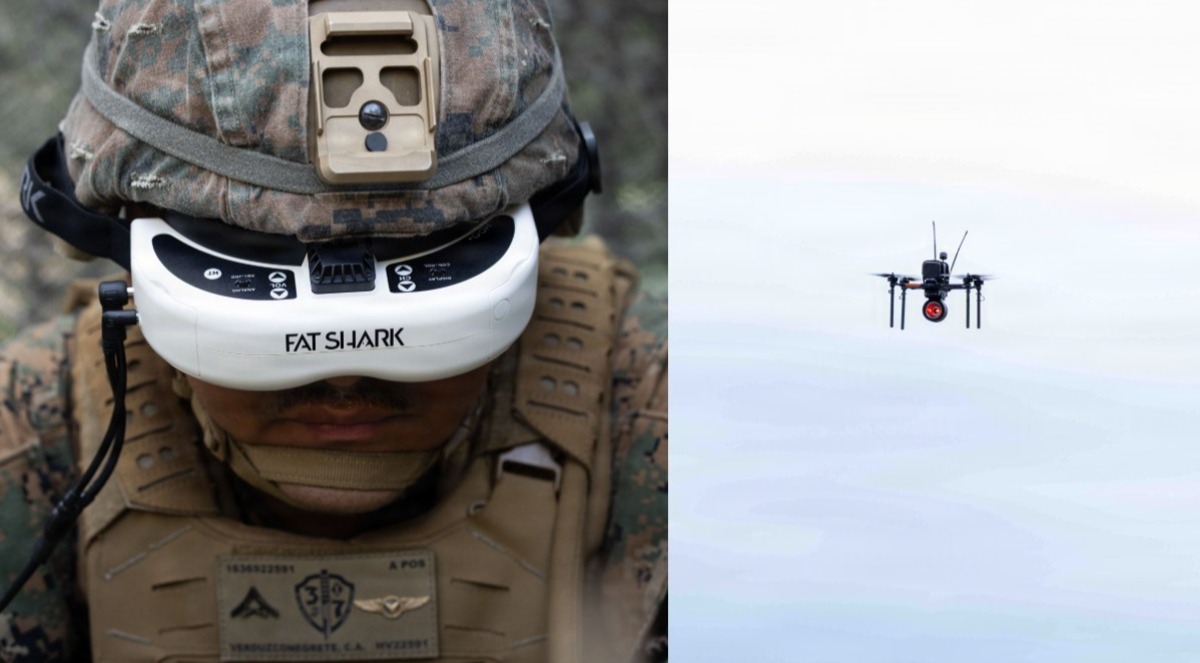
U.S. Marines have blown things up with attack drones in South Korea for the first time ever, marking a milestone the Marine Corps says brings the service one step closer to using these systems for real if a fight breaks out on the Korean Peninsula.
Marines with 4th Marine Regiment, 3rd Marine Division, completed the Marine Corps’ first-ever series of live-fire first-person view drone flights in South Korea on Aug. 5, 2026, according to a release from 3d Marine Division. The training unfolded in two separate events, an inaugural range run on July 30 by 3rd Light Armored Reconnaissance Battalion followed by a second iteration on Aug. 5 led by 3rd Battalion, 7th Marine Regiment, with both units forward deployed to the Indo-Pacific under the Unit Deployment Program, a rotational assignment system the Marine Corps uses to keep units cycling through the region without permanently stationing entire commands overseas.
Marines flying the drills used the Neros Archer, a first-person view attack drone built by Neros Technologies, a defense company founded in El Segundo, California, in 2023 by former professional drone racers Soren Monroe-Anderson and Olaf Hichwa, who started the company after watching Russia’s invasion of Ukraine transform small commercial-style drones into some of the most decisive weapons on a modern battlefield. An FPV drone gets its name from the way a pilot flies it, wearing video goggles that stream a live camera feed from the aircraft itself, letting the operator guide the drone with the same immersive, first-person perspective a video game might offer rather than watching from a separate ground-based screen. During the Korea training, Marines used the Archer to strike anti-armor and anti-personnel targets with an effective range of approximately 20 kilometers (12.4 miles), a reach that dramatically outclasses the one-to-two-kilometer (0.6-to-1.2-mile) range most infantry weapons at the squad level can manage on their own.
1st Lt. Evan Brace, a company executive officer with 3rd LAR, framed the value of training with deployed Marines on a live-fire range in a genuinely new environment as a direct step toward combat readiness.
“Training with these FPV drone systems with deployed Marines, on a live-fire range, and in a unique environment allows us to get one step further towards integrating it into real-world operations,” Brace said. “We learn what works, and most importantly, what needs to be worked on and refined, so that when the time comes to use the Neros Archer on the battlefield, we have perfected the craft.”
The Marine Corps has moved unusually fast to put the Archer into the hands of front-line units since first fielding the system. The service awarded Neros a multimillion-dollar contract in November 2025 to supply Archer drones and training to Fleet Marine Force units, followed by certification courses launched at Camp Pendleton, California, in January 2026 to formally train and qualify Marines as attack drone operators, and separate live-fire operational certification exercises conducted in Puerto Rico in late 2025 as part of broader Southern Command training tied to regional security concerns near Venezuela. Neros has scaled its own production dramatically to keep pace with that demand, reportedly building around 2,000 drones per day by December 2025, with roughly two-thirds of that output continuing to flow to Ukraine and the remainder split among American military customers including the Marine Corps, the Army, and U.S. Special Operations Command, and the company separately landed a $17 million Marine Corps contract for 8,000 Archer Strike variants equipped with anti-armor and anti-personnel payloads.
Bringing that same live-fire capability to South Korea required clearing hurdles well beyond simply showing up with drones and explosives. Conducting a first-of-its-kind high-explosive drone training series on the Korean Peninsula demanded a comprehensive safety and airspace framework, and 4th Marine Regiment worked closely with the U.S. Army’s 8th Army, the 2nd Infantry Division, and the 2nd Combat Aviation Brigade to establish the necessary regulatory structure in coordination with South Korean authorities, reflecting how tightly integrated American forces must operate with both Army units and a host nation’s own airspace rules before live explosive ordnance can fly anywhere near populated allied territory. Marines ran rigorous dry-fire safety rehearsals and built-in procedural checks ahead of each live-fire event specifically to validate those protocols before committing to a single high-explosive flight.
Brace pointed to that coordination as the key factor that let Marines push through obstacles inherent to running a genuinely new kind of training in an unfamiliar environment.
“Many of the obstacles we encountered before conducting this training, since it was the first of its kind here in Korea, were overcome through a mission focused mindset and through close cooperation and coordination with our Korean Allies,” Brace said.
Sgt. Maj. Ismael Bamba, senior enlisted leader for U.S. Marine Corps Forces Korea, described the training as proof of how quickly young Marines can adapt once handed genuinely modern weapons.
“The Neros Archer live-fire training proves that when we hand cutting-edge attack drones to our young Marines, they rapidly adapt, turning small units into highly lethal, self-sufficient precision strike forces,” Bamba said. “By mastering this technology, we are not just upgrading our tactics, we are building a faster, smarter, and deadlier team capable of standing shoulder-to-shoulder with our South Korean Allies, ready to dominate any modern battlefield.”
The broader significance of putting FPV strike capability directly into small units extends beyond any single training range. Small drone platforms like the Archer give Marines at the squad and platoon level access to precise, organic firepower that has traditionally required larger, dedicated platforms not typically assigned down to that level, extending what the Marine Corps describes as traditional marksmanship into the unmanned domain and giving units down to the fireteam level the ability to shape their own battlespace without waiting on support from higher up the chain of command.
Brace acknowledged that pioneering any new capability inevitably means working through unexpected complications as they arise.
“When implementing any new technology, there will be countless ‘firsts’ along the way,” Brace said. “This training is significant because it is the first series of FPV attack drone flights conducted by U.S. Marines in South Korea, and I’m proud that my team of professionals and I are able to play a small part in moving the needle forward when it comes to employing this emerging technology.”
The Marine Corps has framed this Korea training as the opening chapter of a broader push to expand joint and allied FPV attack drone training across the region rather than a one-off demonstration, a distinction that matters given how directly this capability could factor into any future contingency on the Korean Peninsula.
Content preview only. Full article available at source. View Full Article
U.S. Marines conducted live-fire training with the Neros Archer attack drone in South Korea on August 5, 2026, marking the first use of such drones in the region. This training involved multiple units from the Marine Corps and aimed to enhance combat readiness by integrating modern drone technology into operations. The exercises required extensive coordination with South Korean authorities and U.S. Army units to ensure safety and compliance with airspace regulations.
- This is the first time U.S. Marines have used attack drones in South Korea.
- The training involved live-fire exercises with the Neros Archer drone.
- The training took place on August 5, 2026, following earlier exercises on July 30, 2026.
- The Marines are integrating drone technology into their operations for enhanced combat readiness.
- The training required coordination with South Korean authorities and U.S. Army units.